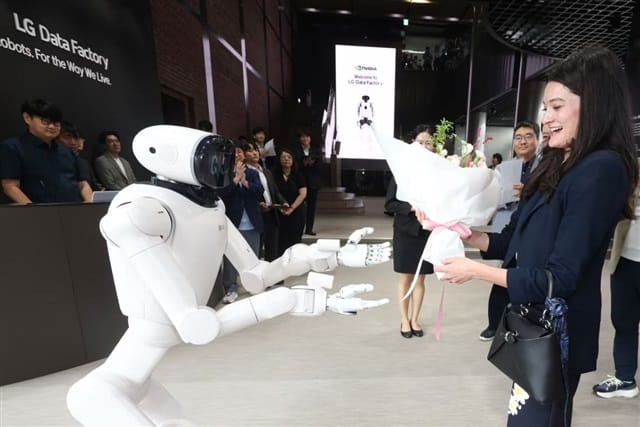
LG Electronics has partnered with Nvidia to accumulate 100,000 hours of robot training data by the end of 2026. Using its Seoul Data Factory and Nvidia compute architecture, LG is advancing its Robot Foundation Model ahead of launching a bipedal humanoid robot in early 2027.
SEOUL — South Korean tech giant LG Electronics has set a target to gather 100,000 hours of robot training data by the end of 2026 as it prepares for the commercial debut of its next-generation bipedal humanoid robot in early 2027.
The initiative relies heavily on LG’s newly established Yangjae Data Factory in Seoul and its deepened collaboration with Nvidia. Following a strategic memorandum of understanding signed on August 13, 2026, in Santa Clara between LG Group Chairman Koo Kwang-mo and Nvidia CEO Jensen Huang, senior Nvidia executives toured LG's Seoul facilities this week to inspect the physical AI data engine.
By capturing and synthesizing real-world and virtual dataset operational hours—equivalent to nearly 12 years of continuous physical learning—LG aims to power its proprietary Robot Foundation Model (RFM) and secure a leading position in commercial robotics.
Expanding Physical AI with Nvidia Architecture
The collaboration merges LG’s hardware manufacturing expertise with Nvidia's physical artificial intelligence stack. LG’s upcoming bipedal humanoid robot, scheduled for public unveiling in the first quarter of 2027, will run on Nvidia's Jetson Thor onboard compute system, the Isaac GR00T foundation model, and the Halos robotics safety framework.
Key Architectural Components of the LG-Nvidia Collaboration
Onboard Processing: Nvidia Jetson Thor system-on-chip for real-time motion control and reasoning.
Foundation AI Model: Nvidia Isaac GR00T framework integrated with LG's in-house RFM.
Safety Protocols: Nvidia Halos full-stack safety framework designed for human-robot co-existence.
Simulation Platforms: Nvidia Omniverse and Cosmos world models used for synthetic data generation.
The Yangjae Data Factory, spanning 10,000 square meters across four floors, features simulated environments replicating smart homes, logistics hubs, and assembly plants. LG's wheel-based robot, CLOiD, is currently generating baseline movement and manipulation data across these testbeds.
Manufacturing Integration and Commercial Strategy
LG is utilizing its "One LG" corporate structure to produce key hardware components internally. Actuators and optical sensors are being sourced from LG Electronics and LG Innotek, while high-density battery packs will be provided by LG Energy Solution.
Prior to the 2027 humanoid release, LG will deploy CLOiD wheel-based robots to its appliance manufacturing line in Tennessee by the end of 2026. Data collected from actual production tasks—such as stacking components and handling assembly operations—will feed directly into LG CNS's PhysicalWorks platform to refine spatial perception and manipulation skills.
The enterprise-wide strategy aims to transition LG from a consumer electronics brand into an end-to-end provider of physical AI and industrial robotics solutions.
Official Sources Section
According to official filings and statements issued by LG Electronics:
Quote Section
"We will secure competitiveness in physical AI by bringing together the group's core capabilities under the 'One LG' approach and through strategic cooperation with global partners," stated Lyu Jae-cheol, CEO of LG Electronics, during the facility review. "We aim to become a total robotics solutions provider."
Why It Matters
The shift toward physical AI marks a transition from text-based generative models to embodied artificial intelligence capable of operating safely alongside human workers. For industries facing labor shortages in manufacturing and logistics, autonomous humanoid systems offer scalable operational continuity.
Furthermore, LG's dual strategy of collecting real physical data alongside synthetic datasets reduces the cost and time required to train advanced multi-purpose robots.
Key Facts at a Glance
Training Goal: 100,000 hours of real and synthetic robot training data by the end of 2026.
Humanoid Debut Target: First quarter of 2027 for the official bipedal model unveiling.
Key Compute Hardware: Powered by Nvidia's Jetson Thor platform and Isaac GR00T foundation software.
Industrial Validation: Deployment of CLOiD robots to LG's Tennessee plant in late 2026.
Frequently Asked Questions
When will LG launch its commercial humanoid robot?
LG plans to officially unveil its bipedal humanoid robot in the first quarter of 2027.
Why does LG need 100,000 hours of training data?
Humanoid robots require massive amounts of spatial, mechanical, and situational data to safely navigate complex, unstructured human environments without pre-programmed paths.
What role does Nvidia play in LG's robotics platform?
Nvidia supplies the onboard AI computing processors (Jetson Thor), physical simulation environments (Omniverse), foundation models (Isaac GR00T), and safety architectures (Halos).
Source: Statements and regulatory updates provided by LG Electronics and Nvidia Corporation via official corporate communications.