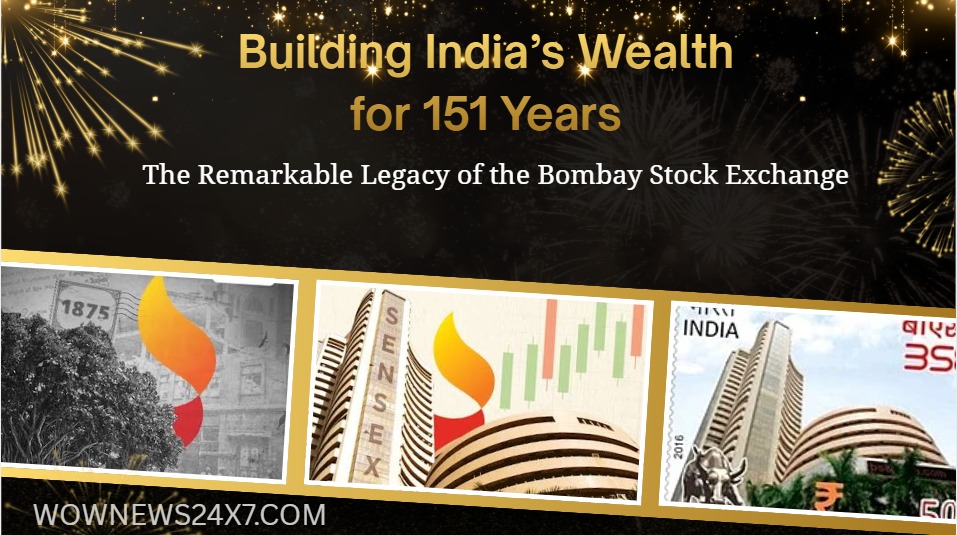
The Bombay Stock Exchange (BSE) celebrates 151 years as India’s market pulse. From its 1875 origins under a banyan tree to becoming the world's fastest electronic exchange, the BSE has been instrumental in India's industrial growth, democratizing access to capital for businesses and wealth creation for millions of investors.
As it completes a century and a half of operations, the Bombay Stock Exchange remains the heartbeat of India’s economic journey.
MUMBAI — The Bombay Stock Exchange (BSE), the oldest stock exchange in Asia, has officially reached its 151st anniversary. Since its inception in 1875, the exchange has evolved from a small, informal gathering of traders under a banyan tree near Mumbai’s Town Hall to a sophisticated, technology-driven powerhouse that serves as the cornerstone of the Indian capital markets.
For 151 years, the BSE has witnessed and facilitated India’s transformation through colonial rule, independence, landmark economic reforms, and the digital revolution. Today, as it marks this milestone, the exchange continues to fulfill its foundational purpose: connecting businesses in need of capital with investors seeking to build wealth.
From the Banyan Tree to Dalal Street
The origins of the BSE trace back to a group of brokers led by Premchand Roychand, who met under the shade of a banyan tree to trade shares and strike deals. At a time when physical presence and verbal contracts were the gold standard, these pioneers laid the groundwork for what would eventually become "The Native Share & Stock Brokers' Association" on July 9, 1875.
As the financial landscape of Bombay—India’s commercial nerve center—flourished with the textile, shipping, and banking industries, the exchange moved to Dalal Street. This transition solidified the exchange's role in the national economy, providing a transparent marketplace that helped industrial giants like the Tatas, Birlas, and Wadias raise the capital necessary to fuel India’s early industrialization.
A Legacy of Economic Resilience
Throughout its history, the BSE has weathered bull runs, bear markets, and systemic financial crises. Despite these cycles, it has remained the "heartbeat" of the Indian market. In 1986, the exchange launched the S&P BSE SENSEX, an index that has since become the primary gauge of the Indian economy’s health.
The transition from manual shout-based trading to a high-speed electronic platform is perhaps the most significant chapter in its evolution. With trading speeds now measured in microseconds, the exchange has democratized investing, moving from an era restricted to wealthy families to a modern ecosystem supporting millions of retail investors.
Evolution and Modernization
As the BSE completes 151 years, its operations reflect the broader maturation of India’s financial infrastructure. Today, the exchange’s ecosystem extends far beyond traditional equity trading. It encompasses:
SME Platform: Supporting the growth of small and medium enterprises.
Mutual Fund Platforms: Simplifying investment access for retail participants.
Derivatives and Currency Markets: Providing essential tools for hedging and risk management.
Technological Integration: Utilizing cloud computing, mobile applications, and AI to enhance market efficiency.
According to market analysts, the BSE's longevity is a result of its ability to adapt. By embracing digital trading, strengthening disclosure requirements, and improving corporate governance, the exchange has fostered greater investor confidence.
Official Sources
According to official exchange data and historical archives, the BSE is recognized as the first stock exchange in India to be granted permanent recognition under the Securities Contract Regulation Act, 1956. The exchange continues to align its strategic vision with India's goal of becoming a global economic force, emphasizing inclusivity and technological resilience.
Why It Matters
The 151-year milestone is more than just a celebratory date; it is a reflection of India’s progress from an agrarian-focused economy to a global financial hub. For investors, the BSE represents the stability and maturation of a market that now supports trillions of rupees in capitalization. Its evolution continues to drive capital formation, which is essential for "Viksit Bharat" (a developed India) by 2047.
Key Facts at a Glance
Founding Date: July 9, 1875.
Legacy: Asia’s oldest stock exchange.
Key Benchmark: Home to the S&P BSE SENSEX, launched in 1986.
Modern Status: World’s fastest stock exchange, with transaction speeds of 6 microseconds.
Milestone: First listed stock exchange in India (as of 2017).
FAQ
How did the BSE start?
It began as an informal group of brokers meeting under a banyan tree near Mumbai’s Town Hall in 1875 before moving to Dalal Street.
What is the significance of the SENSEX?
The S&P BSE SENSEX serves as the pulse of the Indian economy, tracking the performance of 30 well-established, financially sound companies listed on the exchange.
How has the exchange changed for retail investors?
The BSE has transformed from a broker-dominated manual floor to an electronic platform that allows individuals to invest via smartphones with low transaction costs and real-time data.
Source: BSE India, Times of India, Equentis