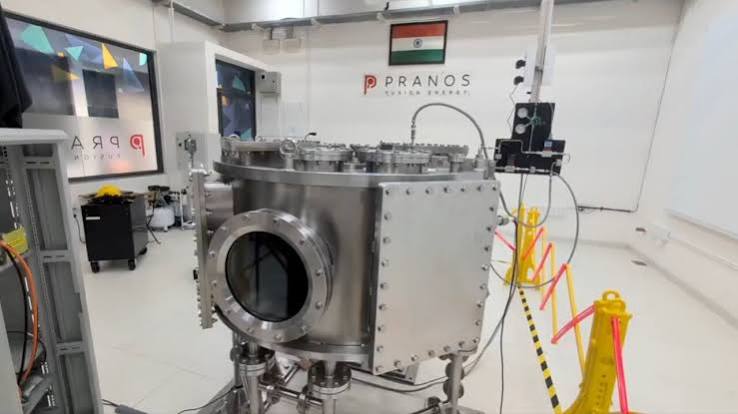
India has entered the global compact fusion race with the unveiling of PRAGYA, the nation's first privately developed tokamak reactor built by startup Pranos Fusion. Operating in Bangalore, the machine will serve as a high-frequency testbed for plasma physics, paving the way for advanced clean energy innovations by 2030.
BENGALURU — India's deep-tech sector has expanded its footprint in advanced energy research with the official unveiling of PRAGYA, the country's first privately developed compact tokamak reactor. Developed by Bangalore-based deep-tech startup Pranos Fusion and showcased at the Jawaharlal Nehru Centre for Advanced Scientific Research, the device introduces a cost-effective, scaled approach to magnetic confinement fusion.
The compact machine is engineered with a major radius of 0.40 meters, a toroidal magnetic field of 0.1 Tesla, and a target plasma current of 20 to 25 kiloamperes. While not built for commercial power generation, PRAGYA serves as an experimental testbed for plasma behavior control, advanced superconducting magnet integration, and auxiliary heating systems, joining institutional state-backed projects like those managed by the Institute of Plasma Research (IPR).
Compact Tokamaks and Private Enterprise
While massive multi-nation experiments such as ITER in France continue to drive large-scale magnetic confinement research, global interest has shifted toward compact low-aspect-ratio spherical tokamaks. These smaller designs achieve higher plasma pressure relative to magnetic field strength, offering a more economical pathway to study nuclear fusion dynamics.
Pranos Fusion’s engineering roadmap is supported by recent venture funding rounds, including a ₹63 crore injection co-led by pi Ventures and Ankur Capital. The facility is scheduled to run 10 to 12 experimental plasma shots daily—totaling approximately 3,000 runs annually over a projected two-decade operational lifespan—to generate empirical data for its planned successor, the larger Praniq reactor targeted for 2030.
According to corporate disclosures, startup funding filings, and research briefs:
Device Specifications: Major radius of 0.40 meters, 0.1 Tesla magnetic field, and 20–25 kA plasma current.
Testing Frequency: Designed to execute 10–12 experimental shots per day, yielding ~3,000 annual runs.
Supporting Technology: Developed alongside proprietary software frameworks including JENGA plasma control systems and MAGGA superconducting magnets.
Future Roadmap: Lays the technical groundwork for the commercial-scale Praniq fusion test reactor slated for completion by 2030.
Official Sources Section
Quote Section
"According to corporate disclosures and deep-tech industry briefings, the development of independent compact tokamaks highlights the growing role of private enterprise in advancing India's technological self-reliance in frontier energy sectors."
Why It Matters
For the domestic technology ecosystem, the transition of nuclear fusion research from state-run laboratories into agile private startups mirrors global trends in aerospace and semiconductor manufacturing. For energy researchers, accessible compact testbeds accelerate the empirical iteration needed to solve plasma containment challenges without requiring multi-billion-dollar state budgets.
Key Facts at a Glance
Project Name: PRAGYA Compact Fusion Reactor.
Developer: Pranos Fusion (Bangalore).
Funding Milestone: ₹63 crore investment round co-led by pi Ventures and Ankur Capital.
Primary Objective: Serve as an agile experimental testbed for plasma control and magnetic confinement.
FAQ Section
What is the primary purpose of the PRAGYA reactor?
PRAGYA is designed as an experimental testbed for plasma control, superconducting magnet performance, and auxiliary heating rather than commercial electricity generation.
Who developed India's first private compact tokamak?
The machine was engineered and built by Bangalore-based deep-tech startup Pranos Fusion.
How does a compact tokamak differ from traditional fusion reactors?
Compact low-aspect-ratio tokamaks feature a significantly smaller physical footprint and operate with high plasma efficiency, lowering construction and experimentation costs.
Where can stakeholders track updates on India's plasma research initiatives?
Institutional updates and national research guidelines are published via the Institute of Plasma Research Portal.
Source: Pranos Fusion Disclosures, Institute of Plasma Research, Mint Deep-Tech Bureau, The Economic Times Tech Desk