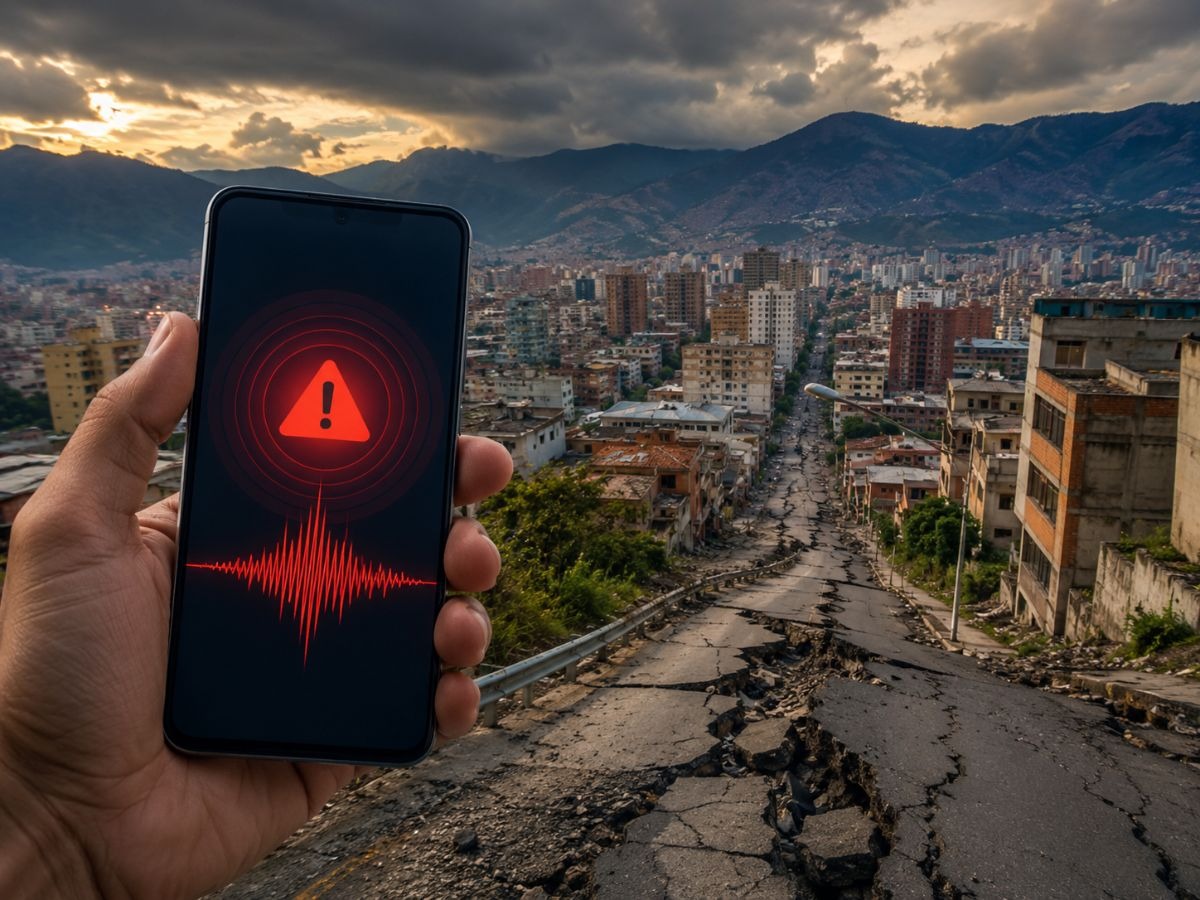
Millions in Venezuela received early warning alerts on their Android devices seconds before powerful earthquakes struck on June 24, 2026. By utilizing smartphone accelerometers to detect seismic P-waves, Google's system provides life-saving notice before the arrival of destructive S-waves, turning personal devices into a global emergency infrastructure.
Millions of residents across Venezuela received life-saving alerts on their Android smartphones on June 24, 2026, moments before two powerful earthquakes struck the nation’s Caribbean coast. The alerts, delivered through Google’s Android Earthquake Alerts System, provided a brief but essential window for citizens to seek safety as tremors measuring magnitudes of approximately 7.1 and 7.5 impacted the region.
The notifications, which appeared on devices shortly before the strongest shaking was felt, displayed the estimated magnitude of the event and its distance from the user’s location. Social media platforms were quickly flooded with screenshots from residents, many of whom credited the early warning for allowing them to move to safer areas before the ground began to shift.
How the Detection Network Functions
The system operates by turning the world’s billions of active Android devices into a vast, distributed seismic sensing grid. Every modern Android smartphone is equipped with an accelerometer—the same sensor responsible for rotating a screen when a device is tilted.
When a phone is stationary, this sensor can detect the initial, faster-moving "P-waves" (Primary waves) generated by an earthquake. While P-waves are relatively weak and cause little damage, they travel significantly faster than the destructive "S-waves" (Secondary waves) that follow.
"The system detects the first physical signs of an earthquake after the rupture has already begun, then sends a warning faster than the most damaging seismic waves can travel," according to tech analysts. Because digital signals travel at the speed of light—far outpacing the physical movement of seismic waves through the earth—Google’s servers can process these signals and push notifications to other phones in the projected path of the earthquake before the S-waves arrive.
Scaling Global Resilience
Google’s infrastructure essentially inverts the logic of traditional seismology. Rather than relying solely on a small number of purpose-built, expensive seismic stations, the Android system utilizes the density of the existing smartphone population to generate a real-time map of vibration intensity.
When enough devices in a specific area detect motion consistent with seismic activity, Google’s servers cross-reference the data to confirm an event and estimate its magnitude and epicenter. The system then automatically issues two types of alerts:
BeAware Alerts: For light shaking, providing a heads-up to users.
TakeAction Alerts: For moderate to heavy shaking, which override the user’s screen with loud warnings to prompt immediate safety measures like "Drop, Cover, and Hold On."
Official Sources
Why It Matters
For citizens in earthquake-prone regions, these alerts represent a technological shift in emergency response. Even a few seconds of warning can allow individuals to step away from glass, move to an open doorway, or reach a safer location. While not a prediction tool, the system provides an invaluable layer of protection by essentially racing the speed of light against the destructive speed of tectonic energy.
Key Facts at a Glance
Event: Twin earthquakes (approx. 7.1 and 7.5 magnitude) struck Venezuela on June 24, 2026.
Technology: Uses smartphone accelerometers to detect the fast-moving P-waves of a quake.
Speed: Digital alerts travel at light speed, arriving before the slower, more damaging S-waves.
Requirements: Users must have location services enabled and active Wi-Fi or cellular data connectivity.
FAQ
Does my phone predict the earthquake before it happens?
No. The system is not a prediction tool. It detects the earthquake the moment it begins and transmits a warning at the speed of light to users located further away from the epicenter.
Do I need a special app to get these alerts?
No, the feature is integrated into the Android operating system on phones running Android 5.0 and above. It can be toggled on or off in the device's safety settings.
Is this service available everywhere?
The service is active in many countries globally. Availability depends on local network connectivity and the system’s rollout status in specific regions.
Sources: Google Research Blog, GDACS event reports, and news coverage from LiveMint, Gulf News, and India Today.