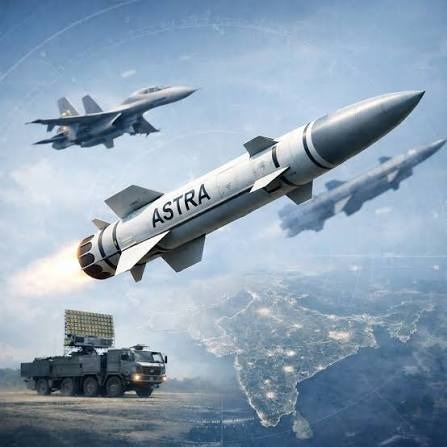
Indonesia has become the first international customer for India's indigenous Astra beyond-visual-range air-to-air missile. The deal, announced during PM Modi's visit to Jakarta, will see the supply of these high-precision, all-weather missiles to modernize Indonesia’s air force, highlighting the growing global competitiveness of India's indigenous defense technology.
As Indonesia becomes the first international buyer of India’s indigenous Astra missile, the beyond-visual-range system signals a major shift in global defense export capabilities.
JAKARTA — In a landmark expansion of defense diplomacy, India has finalized an agreement to supply its indigenous Astra beyond-visual-range air-to-air missile (BVRAAM) systems to Indonesia. The deal, announced on July 7, 2026, following bilateral talks between Prime Minister Narendra Modi and Indonesian President Prabowo Subianto, marks the first time this high-precision technology will be exported to a foreign nation.
The Astra system, developed by the Defence Research and Development Organisation (DRDO) and manufactured by Bharat Dynamics Limited (BDL), is set to be integrated into Indonesia’s existing fleet of fighter aircraft. The acquisition is a key component of Indonesia’s ongoing efforts to modernize its air defense capabilities and enhance interoperability with regional partners.
Advanced Features of the Astra Missile
The Astra is an all-weather, radar-guided weapon designed to engage and destroy highly maneuvering supersonic aircraft at long distances. Its integration into the Indonesian Air Force is expected to provide a significant qualitative edge in aerial combat scenarios.
Key technical specifications and capabilities of the Astra system include:
Beyond-Visual-Range (BVR) Engagement: Designed to track and engage targets well beyond the pilot’s visual line of sight, utilizing sophisticated radar guidance systems.
Active Radar Homing: The missile employs a high-performance active radar seeker for terminal guidance, ensuring high kill probability against agile targets.
Guidance and Navigation: It features mid-course inertial guidance—supported by a secure data link from the launch aircraft—which allows for mid-flight course corrections to adapt to evasive maneuvers by enemy aircraft.
Electronic Counter-Countermeasures (ECCM): The Astra is equipped with robust ECCM capabilities, allowing it to operate effectively in environments saturated with electronic jamming or signal interference.
Performance Metrics: The Astra Mark 1 variant is capable of engaging targets at distances exceeding 100 kilometers, while newer iterations, such as the Mark 2, have demonstrated ranges of up to 160 kilometers in recent flight trials.
Strategic Importance to Defense Exports
The decision to export the Astra missile is a milestone for India’s "Make in India" initiative. For years, the Astra system served exclusively as a cornerstone of the Indian Air Force’s (IAF) aerial defense, integrated primarily with Su-30MKI fighter jets. By clearing the system for export to a major maritime partner like Indonesia, India is demonstrating the operational maturity and reliability of its indigenous aerospace technology.
"The Astra deal marks a structural shift for Bharat Dynamics Limited, transitioning the company from a domestic supplier to a competitive global aerospace player," noted defense analysts. The move also serves to strengthen the Indo-Pacific security architecture, providing regional neighbors with advanced capabilities to uphold maritime and aerial sovereignty.
Official Sources
The missile supply agreement was finalized between Bharat Dynamics Limited and Republikorp, a prominent private defense holding company in Indonesia. Official Ministry of External Affairs (India) communications noted that the deal includes provisions for technical training and hardware integration, ensuring that the Indonesian Air Force can seamlessly incorporate the missiles into their existing fleet weapon bays.
Why It Matters
For Indonesia, the Astra system provides a cost-effective, high-performance alternative to Western or Chinese equivalents. For India, this export breakthrough validates the effectiveness of its defense R&D and paves the way for deeper military-industrial cooperation within Southeast Asia. The deal is expected to be a precursor to further defense technology transfers, including joint research and development initiatives.
Key Facts at a Glance
Missile Class: Beyond-Visual-Range Air-to-Air Missile (BVRAAM).
Developer/Manufacturer: DRDO (Design) and Bharat Dynamics Limited (Manufacturing).
Primary Capabilities: All-weather operation, active radar terminal guidance, and high ECCM resistance.
Range: Proven capabilities ranging from 100 km to over 160 km depending on the variant.
Significance: Indonesia is the first international customer for this indigenous Indian missile technology.
Frequently Asked Questions
What type of aircraft can carry the Astra missile?
The Astra is designed to be compatible with modern fourth and fifth-generation fighter jets. It is currently integrated with the Sukhoi Su-30MKI fleet in India and is adaptable to the multi-role fighters operated by the Indonesian Air Force.
How does the Astra compare to global alternatives?
Defense experts note that the Astra offers performance characteristics comparable to globally renowned systems like the AIM-120 AMRAAM or the MBDA Meteor, but at a significantly more competitive lifecycle cost.
What does the "beyond-visual-range" classification mean?
It refers to the missile's ability to engage targets at distances where the target cannot be seen by the pilot, relying entirely on onboard radar, data links, and seeker technology to identify and track the adversary.
Source: Ministry of External Affairs (India), Bharat Dynamics Limited (BDL), Indonesian Presidential Palace