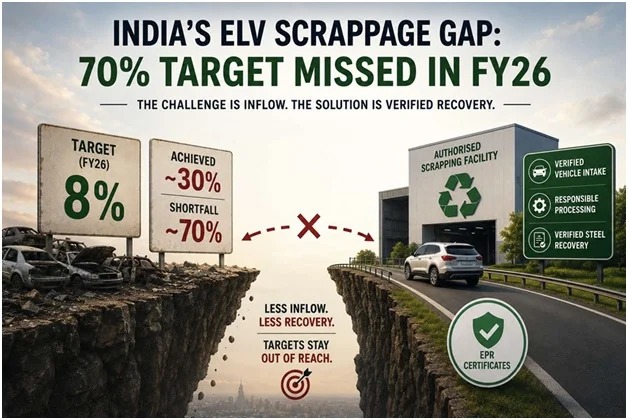
India's automotive sector faced a severe 70 percent shortfall in meeting its first-year ELV scrappage targets, processing only 2.42 lakh vehicles against a target of 7.62 lakh. A sudden March 2026 rule change banning external industrial steel for EPR certification left automakers exposed to heavy penalties amid weak collection infrastructure.
NEW DELHI — India’s automotive manufacturing sector has missed its inaugural Extended Producer Responsibility (EPR) recycling mandates by a staggering 70 percent, triggering a compliance crisis across the domestic transportation industry. Official transaction logs from the first full fiscal cycle under the newly enacted Environment Protection (End-of-Life Vehicles) Rules, 2025, confirm that vehicle manufacturers fell vastly short of their statutory steel-recovery obligations. Automotive industry executives, speaking anonymously through the Society of Indian Automobile Manufacturers (SIAM), attributed the severe baseline deficit to a highly restrictive regulatory amendment enacted on March 27, 2026, which abruptly blocked alternative scrap metal procurement channels. With hundreds of thousands of qualifying historic vehicles failing to reach formal processing facilities, major original equipment manufacturers (OEMs) are now scrambling to avoid severe regulatory environmental compensation penalties.
The Scale of the First-Year Target Deficit
The underlying framework of the ELV rules, which officially took effect on April 1, 2025 under the authority of the Ministry of Environment, Forest and Climate Change (MoEFCC), mandates that vehicle manufacturers reclaim a fixed percentage of steel weight on a historical domestic sales baseline. For the 2025–26 fiscal year, automakers were legally required to scrap a volume equivalent to 8 percent of the steel mass of commercial vehicles sold 15 years prior (FY2010–11) and personal vehicles sold 20 years prior (FY2005–06).
This mathematical matrix designated a total of 95.2 lakh vehicles nationwide as legally eligible for mandatory fitness testing, requiring a minimum of 7.62 lakh individual vehicles to enter authorized processing facilities to achieve sector-wide compliance.
However, official transaction registries compiled through the unified DigiELV digital platform revealed that only 2.42 lakh vehicles actually entered formal dismantling zones during the fiscal year. This created a severe supply deficit of 5.2 lakh units, meaning the entire domestic automotive ecosystem was left operating under an insurmountable 70 percent target shortfall.
The March 2026 Policy Pivot Tightens Compliance
Automotive asset managers emphasize that the primary trigger for this industry-wide non-compliance was not a failure of industrial intent, but a sudden, late-stage policy shift by the central government. When the baseline ELV rules were rolled out in January 2025, the language permitted manufacturers to secure valid EPR certificates using steel scrap collected from external industrial sources, provided it was processed at an authorized hub. Most major OEMs built their compliance models around this dual-sourcing strategy.
The situation changed dramatically with the notification of the March 27, 2026 draft amendment. The revision completely removed "other steel scrap materials" from the eligibility matrix, restricting the issuance of official EPR certificates solely to steel recovered directly from authentic end-of-life vehicles.
This sudden elimination of external industrial material immediately forced the full burden of compliance onto a severely undersized domestic vehicle collection pipeline.
Infrastructure Bottlenecks and the Informal Grip
A major factor contributing to the target shortfall is the slow operational expansion of India's authorized recycling network. Data tracked by structural environment monitors indicates that as of early 2026, the country possesses fewer than 100 fully operational Registered Vehicle Scrapping Facilities (RVSFs). This leaves vast geographic swaths of the subcontinent completely unserved by formal collection channels.
Furthermore, the vehicle scrappage system relies heavily on Automated Testing Stations (ATS) to identify and flag unfit machinery. Due to local execution delays, these automated stations have generated a negligible flow of mandatory ELV declarations.
Concurrently, India's informal scrap markets continue to maintain a strong competitive edge over the state's formal infrastructure. Informal operators can offer vehicle owners up to 20 percent higher upfront cash payouts because they completely bypass the strict, asset-draining depollution rules mandated under the central AIS-129 recycling framework.
While formal centers spend considerable resources recovering hazardous fluids, capturing refrigerants, and logging digital manifests, informal centers simply compress the bare metal, allowing toxic components to seep into urban water tables.
Official Sources Section
All baseline vehicle data, metric target deficits, and legislative parameters reviewed within this analysis are drawn from the public archives of the Ministry of Environment, Forest and Climate Change (MoEFCC) and the Ministry of Road Transport and Highways (MoRTH). Corporate compliance trends and tracking parameters are verified against transaction records published via the Press Information Bureau (PIB) and the Society of Indian Automobile Manufacturers (SIAM).
Quote Section
"According to officials representing the Society of Indian Automobile Manufacturers, the absolute lack of automated testing checkpoints and localized collection infrastructure makes it mathematically impossible to satisfy current recycling targets, requiring an immediate return to a phased transition framework that recognizes other forms of automotive metal scrap."
Why It Matters
The unresolved ELV scrappage crisis impacts corporate balance sheets, consumer vehicle pricing, and national sustainability metrics. Under the current environmental guidelines, automakers that miss their EPR targets face substantial Environmental Compensation fines, a cost structure engineered to exceed the actual market price of regular compliance certificates.
These added corporate financial liabilities threaten to filter down directly to everyday consumers in the form of price hikes on new personal and commercial vehicles. Furthermore, the 8 percent target is scheduled to continue only until 2029–30, after which it escalates to 13 percent, and eventually jumps to 18 percent by 2035–36.
Unless the government expands its formal collection footprint or allows a broader definition of scrap inputs, this compounding deficit could severely disrupt corporate ESG ratings and discourage international capital investment in the domestic automotive manufacturing grid.
Key Facts at a Glance
Compliance Shortfall: The Indian automotive industry missed its statutory first-year ELV steel-recycling commitments by a severe 70 percent.
Supply Crunch: Approved scrapping infrastructure captured only 2.42 lakh vehicles against a regulatory target baseline of 7.62 lakh units.
Policy Trigger: A March 2026 amendment cut off compliance options by banning the use of non-vehicle industrial steel scrap for EPR certification.
Escalating Mandates: The current 8 percent recovery target remains fixed until 2029–30 before jumping to 13 percent in subsequent cycles.
Financial Risk: Non-compliant auto corporations face heavy monetary penalties that impact their BRSR sustainability ratings.
FAQ Section
Why did Indian automakers miss their FY26 vehicle scrappage targets?
Automakers missed the targets because the actual number of old vehicles arriving at authorized centers fell short by 5.2 lakh units, a deficit made worse by a sudden regulatory ban on using industrial scrap from other sources.
What specific age thresholds classify a vehicle as an ELV?
Under the current framework, commercial vehicles are designated for mandatory fitness reviews after 15 years, while personal passenger vehicles undergo mandatory evaluation upon hitting 20 years from initial registration.
What happens if a manufacturer fails to meet its EPR recycling targets?
Companies face direct financial penalties under the "Environmental Compensation" clause and risk lower ESG scores, which can complicate corporate capital raises and compliance reviews under SEBI guidelines.
Source: Official regulatory notices published by the Ministry of Environment, Forest and Climate Change (MoEFCC), technical bulletins from the Ministry of Road Transport and Highways (MoRTH), and industry press statements distributed by the Press Information Bureau (PIB).