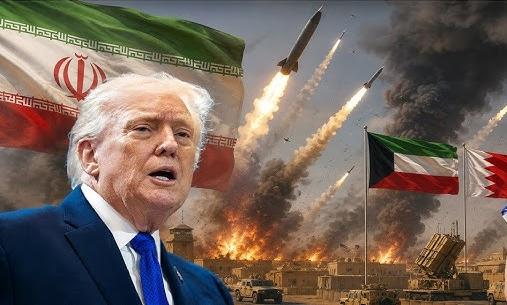
Bahrain has strongly condemned Iran’s launch of seven ballistic missiles targeting its territory and Kuwait, calling it a flagrant violation of sovereignty. U.S. Central Command confirmed that air defenses successfully intercepted six of the missiles following intense military exchanges near the volatile, commercially vital Strait of Hormuz.
MANAMA — The Kingdom of Bahrain strongly condemned a series of targeted ballistic missile strikes launched by Iran against its territory and neighboring Kuwait early Saturday. According to regional defense updates, the coordinated aerospace assault immediately threatened domestic security, forcing the island nation to activate its emergency air defense sirens and order urban residents to seek shelter.
The military escalation occurred following a swift chain of tactical exchanges between the United States armed forces and Iran's Islamic Revolutionary Guard Corps (IRGC) near the vital Strait of Hormuz. Defense officials confirmed that U.S. and allied integrated air defense systems successfully neutralized the majority of the incoming threats, preventing catastrophic damage across the targeted Gulf states.
Strategic Air Defenses Prevent Regional Casualties
According to an official combat briefing released by the U.S. Central Command (CENTCOM), the IRGC Aerospace Force fired a total of seven ballistic missiles directed toward strategic sites in Bahrain and Kuwait. Military tracking networks verified that six of the incoming projectiles were cleanly intercepted mid-flight by forward-deployed defensive batteries, while a seventh failed to reach its intended land target, splashing down harmlessly.
The missile salvos were launched just hours after American naval and air forces intercepted four Iranian one-way attack drones that CENTCOM determined posed an immediate, lethal threat to international commercial shipping. Following the drone intercepts, U.S. forces executed defensive retaliatory strikes, destroying critical Iranian coastal surveillance radar installations situated at Goruk and on Qeshm Island. The IRGC quickly characterized its subsequent ballistic missile barrage as direct retaliation for the destruction of those coastal monitoring assets.
Impact on Maritime Commerce and Regional Security
The sharp increase in hostilities has triggered immediate ripples across international energy markets and regional logistics infrastructure. The Strait of Hormuz, which functions as the primary transit corridor for more than 20% of the world's daily petroleum supply, remains highly volatile. The IRGC has issued formal warnings indicating that continued American military interventions could lead to a complete physical blockade of the strategic waterway.
| Theater Asset Profile | Current Operational Status (June 2026) | Regional Strategic Implications |
| U.S. Fifth Fleet HQ | Fully Operational (Manama, Bahrain) | Unharmed; generic Iranian claims of damage denied |
| Strait of Hormuz | Active Maritime Volatility | Threat of full closure by IRGC; over 20,000 sailors stranded |
| Regional Air Defenses | Defcon Elevation Level 2 | Kuwaiti and Bahraini forces maintaining high alert |
For international travelers, airline operators, and corporate investors, the geopolitical flare-up introduces heightened war-risk premiums. Commercial flight paths crossing Gulf airspace are experiencing precautionary rerouting, causing widespread scheduling delays across transport hubs in Doha, Dubai, and Manama. Furthermore, insurance syndicates have adjusted maritime freight coverage rates, directly increasing the global landed cost of crude oil and liquefied natural gas (LNG).
Official Sources Section
According to official diplomatic statements published by the Bahrain Ministry of Foreign Affairs, the kingdom considers the direct targeting of its sovereign boundaries an unprovoked act of regional destabilization. Parallel regulatory announcements from the Kuwaiti Military Command confirmed that its domestic defensive frameworks were fully activated to assist in tracking the airborne threats. Meanwhile, separate administrative filings from the White House emphasize that the localized exchanges have not officially broken the underlying, broader regional diplomatic ceasefire frameworks established earlier this spring.
Quote Section
Expressing absolute diplomatic rejection of the aerospace incursions, the Bahraini Foreign Ministry issued a clear denunciation of the cross-border strikes:
“The Ministry of Foreign Affairs strongly condemns the renewed attacks by the Islamic Republic of Iran against the Kingdom of Bahrain and the sisterly State of Kuwait. This blatant aggression constitutes a flagrant violation of the sovereignty of both countries.”
Dismissing adversarial propaganda regarding the targeting of key Western military positions on the island, a CENTCOM operational spokesperson stated:
"According to officials, initial assessments indicate six of the missiles launched by Iran were intercepted and a seventh did not reach its intended target. There are currently no reports of harm to U.S. personnel, and Iranian claims of damaging U.S. 5th fleet headquarters in Bahrain are false."
Why It Matters
The rapid transition from low-level drone friction to multi-state ballistic missile strikes carries deep practical consequences for global consumers and regional stability. A prolonged closure or mining of the Strait of Hormuz could trigger an immediate spike in international retail fuel prices, impacting logistics budgets and manufacturing overheads worldwide. For the millions of expatriate workers residing across the Gulf Cooperation Council (GCC) countries, the activation of urban air defense sirens emphasizes the pressing need for strict adherence to municipal emergency safety protocols.
Key Facts at a Glance
Multi-Target Incursion: Iran fired seven ballistic missiles directed toward targets inside the sovereign borders of Bahrain and Kuwait early Saturday morning.
High Intercept Efficiency: Allied air defense networks successfully shot down six incoming missiles, while the final projectile fell short of its target.
Preceding Hostilities: The missile exchange followed the destruction of four Iranian attack drones and subsequent U.S. strikes on radar sites on Qeshm Island.
Command Facility Secure: U.S. defense officials confirmed the strategic Fifth Fleet Headquarters in Manama suffered zero operational disruption or physical damage.
FAQ Section
Did any of the Iranian ballistic missiles successfully strike targets in Bahrain?
No. According to unified reports from the Bahraini Foreign Ministry and U.S. Central Command, six of the seven ballistic missiles were successfully intercepted by air defense systems, and the seventh failed to reach its destination.
Why did Iran launch this specific missile attack against its Gulf neighbors?
Statements carried by Iran's state-aligned Tasnim news agency indicate the IRGC launched the aerospace strikes in direct retaliation for U.S. military strikes that disabled coastal surveillance radars at Goruk and Qeshm Island.
Is the U.S. Fifth Fleet base in Bahrain safe?
Yes. U.S. military officials have explicitly confirmed that there were no casualties or infrastructure damages sustained at the base, labeling all claims of destruction broadcast by Iranian media channels as completely false.
How are these military hostilities affecting shipping through the Strait of Hormuz?
The escalation has dramatically increased regional maritime risk. Over 20,000 sailors remain stranded in nearby waters as commercial vessels face potential naval mines, soaring insurance premiums, and threats of a full physical blockade by Iranian forces.
Source: Bahrain Ministry of Foreign Affairs Official Diplomatic Communiqué, U.S. Central Command (CENTCOM) Operational Readiness Reports via X, Kuwaiti Armed Forces General Staff Press Release