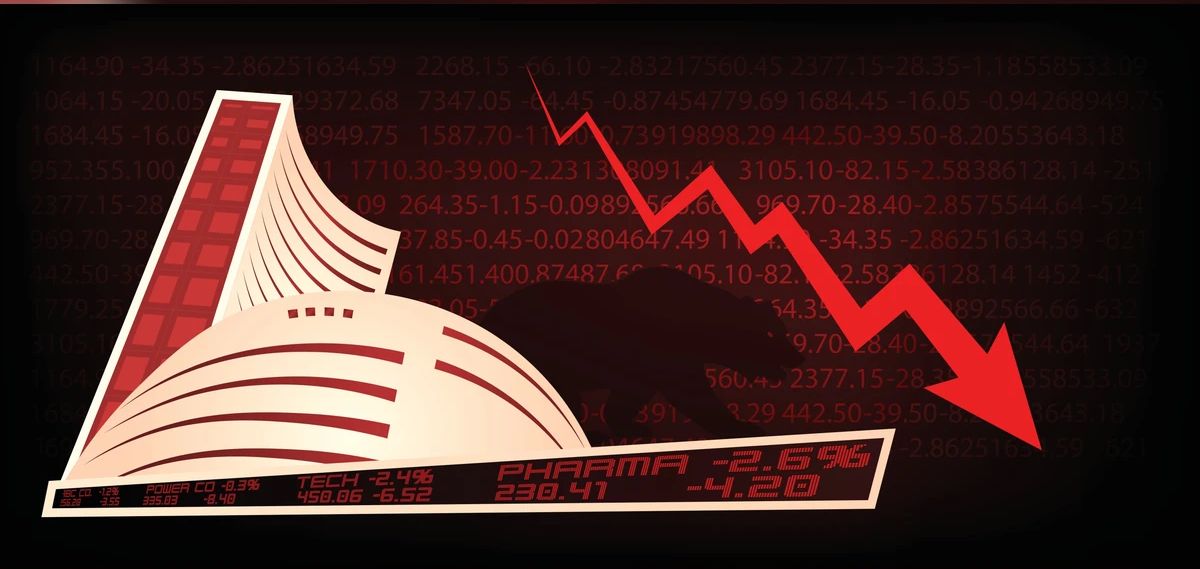
The Indian stock market suffered a major setback on June 23, 2026, as the Sensex plunged 893 points and the Nifty fell below 23,850. Weighed down by global market weakness, a tech sector sell-off, and foreign fund outflows, the indices recorded a single-day drop of over 1.1 percent.
MUMBAI — India’s benchmark equity indices suffered a sharp, broad-based sell-off on Tuesday, June 23, 2026, with both the Sensex and Nifty tumbling over 1 percent. The market remained under heavy selling pressure from the opening bell, completely erasing the recovery gains logged in the previous trading session.
According to data compiled from the BSE and the National Stock Exchange of India (NSE), the primary triggers behind the sudden crash include an intense, technology-led global market weakness, aggressive capital liquidations by foreign institutional investors (FIIs), a sharp decline in domestic core sector growth, and rising worries over an early monsoon deficit. Today's steep correction has forced market participants into quick asset repositioning as near-term volatility measures spike.
Global Market Weakness Grips Frontline Indices
The 30-share BSE Sensex tanked 893.39 points, or 1.16 percent, to settle at 76,200.68. During the day, intraday panic magnified the losses, dragging the index down by as much as 1,011.56 points, or 1.31 percent, to a low of 76,082.51. Concurrently, the 50-share NSE Nifty dropped 278.80 points, or 1.16 percent, to finish the session at 23,824.10.
The domestic downturn mirrored a major risk-off rout across broader international markets. In Asian markets, South Korea’s Kospi index triggered temporary trading cushions as it tanked approximately 10 percent. Japan's Nikkei 225, Shanghai's SSE Composite, and Hong Kong's Hang Seng index similarly closed deep in the red, while European markets traded in negative territory later in the afternoon.
Market sentiment was further dampened by growing expectations of tighter monetary policies by the U.S. Federal Reserve and a weakening Indian rupee against the U.S. dollar.
Domestic Headwinds and Heavy Sectoral Bleeding
Beyond global market weakness, structural domestic factors accelerated the afternoon slide. According to institutional updates from the Ministry of Commerce and Industry, India's eight core industries recorded a sharp growth slowdown to just 0.5 percent in May, indicating a broad deceleration in infrastructure and manufacturing output.
Additionally, the private sector felt immediate pressure as the HSBC Flash India Services PMI plummeted to a 17-month low of 57.3. Anxieties over a weak start to the southwest monsoon also triggered concerns regarding a prolonged squeeze on rural incomes and consumer demand.
From the sectoral perspective, information technology (IT) and metals emerged as the primary laggards. Nifty IT lost more than 2 percent, heavily dragged down by index heavyweights Infosys, which fell 3.42 percent, and Tata Consultancy Services (TCS), which fell over 3 percent. Banking majors also faced selling heat, with HDFC Bank sliding 1.75 percent.
Conversely, defensive rotation helped pharma and healthcare shares buck the broader trend, with Cipla, Dr. Reddy's Laboratories, and Sun Pharma posting notable gains.
Quote Section
"Indian equity markets snapped their recent oil-driven rally and declined sharply alongside global peers as a broad technology-led selloff weighed on sentiment," stated Ponmudi R., CEO of online trading and wealth-tech firm Enrich Money, in a closing commentary. "According to officials, losses were led by the IT sector, which declined more than 2 percent, while a weaker rupee and growing expectations of further U.S. monetary tightening added to investor caution and weighed on overall sentiment."
Why It Matters
The sharp correction in the Sensex and Nifty has immediate practical implications for everyday retail investors, mutual fund subscribers, and consumer businesses. A single-day drop of over 1 percent wipes out substantial household paper wealth and elevates the fear index, as shown by the 8.56 percent surge in the India VIX to 13.94. For businesses and industrial corporates, the drop reflects slowing output and weakening consumption indicators, indicating that companies may adopt a more cautious approach to near-term capital expenditure and expansion plans.
Key Facts at a Glance
Frontline Drop: The BSE Sensex plunged 893.39 points (1.16%) to close at 76,200.68, while the NSE Nifty 50 dropped 278.80 points to 23,824.10.
Global Rout: The domestic sell-off mirrored sharp declines across Asian and European boards, highlighted by a massive 10 percent plunge in South Korea's Kospi.
Foreign Fund Outflows: Foreign Institutional Investors (FIIs) accelerated the decline, offloading equities worth ₹635.91 crore in the preceding session.
Macro Stress: Internal pressures grew as India's eight core industries' growth slowed to 0.5 percent, and the flash services PMI hit a 17-month low.
Sector Performance: Tech and banking heavyweights like Infosys, TCS, and HDFC Bank dragged indices lower, while pharma counters served as defensive shields.
FAQ Section
What were the main reasons behind the market crash on June 23, 2026?
The sharp decline was triggered by a mix of weak global cues—including a technology sell-off in Asian markets—sustained foreign fund outflows (FII selling), slowing domestic infrastructure growth, and low monsoon rainfall anxieties.
How did the broader market perform compared to the frontline Sensex and Nifty?
The broader markets also faced downside pressure but showed relative resilience. The S&P BSE Mid-Cap index fell 0.88 percent, and the Small-Cap index declined 0.62 percent, outperforming the 1.16 percent drop on the main benchmarks.
Which stocks managed to gain despite the widespread sell-off?
Defensive sectors like pharmaceuticals and utility firms bucked the trend. Major gainers included Power Grid, Axis Bank, Sun Pharma, Cipla, and Maruti Suzuki.
Source: Trading closing disclosures maintained by the BSE, daily exchange sheets from the National Stock Exchange of India, and macro statistics from the Ministry of Commerce and Industry.