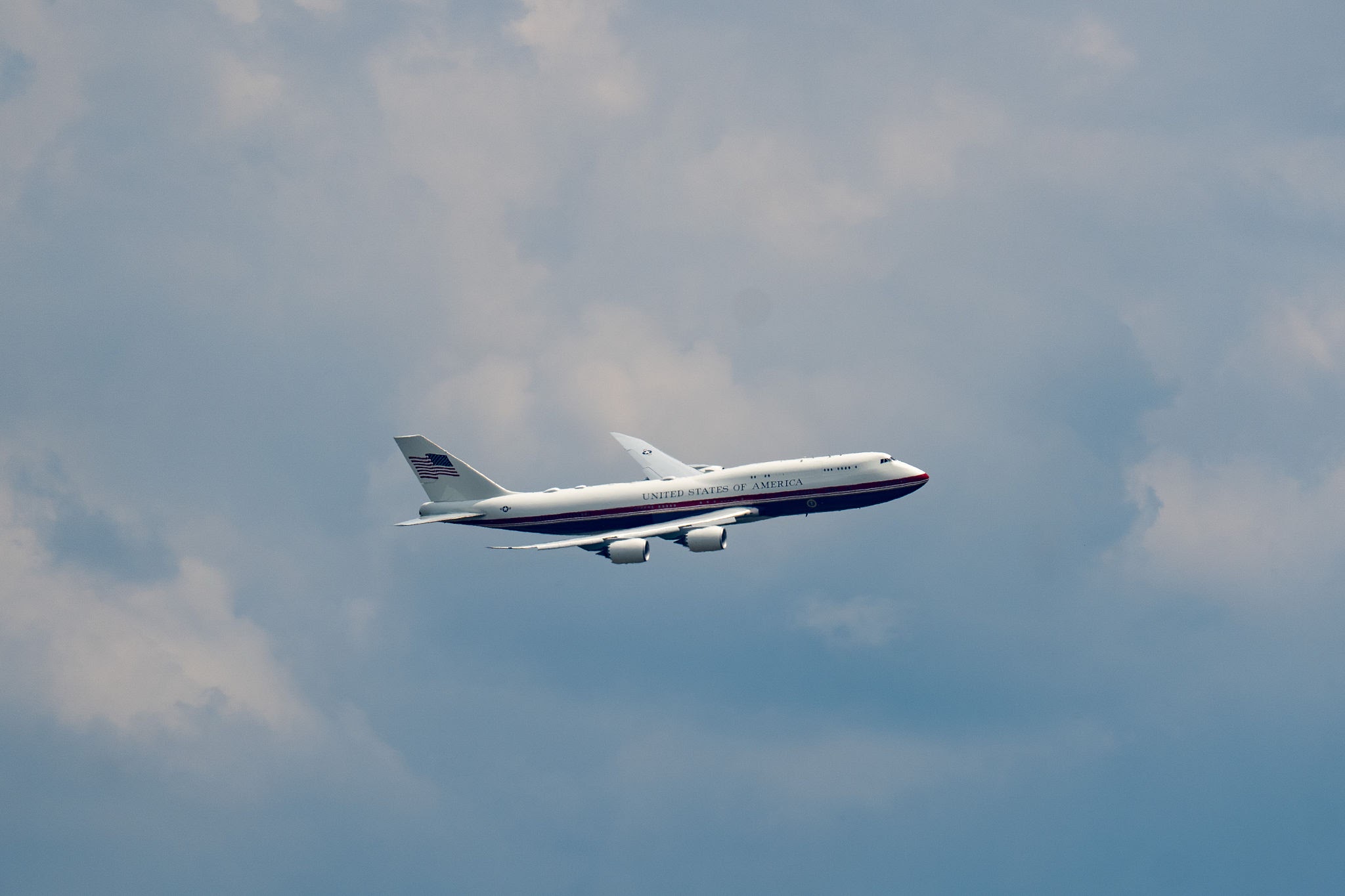
The Boeing Company reported a second-quarter net loss of $428 million ($0.76 per share) after taking a $280 million charge on its delayed Air Force One program. Despite defense losses, Boeing generated $631 million in free cash flow as commercial deliveries rose 14% and revenue reached $24.56 billion.
Defense Program Overruns Overshadow Commercial Recovery
SEATTLE & ARLINGTON, Va. — The Boeing Company (NYSE: BA) reported a second-quarter net loss of $428 million on Tuesday, July 28, 2026, as escalating engineering expenses on the U.S. Air Force One replacement program severely impacted defense division margins.
The planemaker recorded a core adjusted loss of 76 cents per share for the quarter ending June 30, 2026. The result fell short of Wall Street expectations, which had projected an average adjusted loss of 30 cents per share, according to LSEG market data. However, the quarterly loss represented an improvement from the $1.24 per share loss posted during the same three-month period last year.
Despite profitability pressure within the defense unit, Boeing generated $24.56 billion in total revenue an 8 percent increase year-on-year. The top-line growth was supported by accelerating commercial airplane deliveries and improved operational performance across narrow-body manufacturing lines.
Fixed-Price Defense Contract Incurs Further Charges
The primary driver behind the wider Boeing Q2 loss was a fresh $280 million pre-tax charge taken on the VC-25B presidential aircraft program, commonly known as Air Force One. The project involves heavily modifying two Boeing 747-8 jumbo jets to serve as state-of-the-art presidential transports under a $3.9 billion fixed-price contract negotiated in 2018.
Under fixed-price defense agreements, Boeing must absorb all cost overruns above the agreed ceiling rather than passing charges back to the U.S. Department of Defense. According to regulatory disclosures, the Air Force One program is currently more than four years behind schedule, with cumulative cost overruns surpassing $3 billion. Delivery of the first fully modified presidential aircraft is not expected until 2028.
| Financial & Operational Metric | Q2 2026 Performance | Prior Year (Q2 2025) | Market Expectations |
| Total Consolidated Revenue | $24.56 Billion | $22.74 Billion | $24.25 Billion |
| Net Loss | $428 Million | $1.44 Billion | $170 Million |
| Core Loss Per Share | $(0.76) | $(1.24) | $(0.30) |
| Air Force One Program Charge | $280 Million | — | — |
| Free Cash Flow | +$631 Million | -$200 Million | -$177 Million |
| Commercial Aircraft Deliveries | 171 Aircraft | 150 Aircraft | 165 Aircraft |
Commercial Delivery Ramp Generates Positive Cash Flow
In contrast to defense segment losses, Boeing's commercial airplanes business demonstrated clear operational recovery. Commercial deliveries rose 14 percent year-on-year to 171 aircraft during the quarter, driven by stabilized production of 737 MAX single-aisle jets at a rate of 47 aircraft per month.
Higher commercial customer delivery payments propelled free cash flow to $631 million for the quarter. This marked a substantial rebound from a negative free cash flow of $200 million recorded in the second quarter of 2025.
Boeing reaffirmed its full-year 2026 free cash flow guidance of $1 billion to $3 billion. Reaching this annual cash flow target would represent the company's first positive annual cash generation since 2023, bolstering balance sheet liquidity as it works to pay down long-term debt.
The global order backlog reached $715 billion at quarter-end, encompassing over 6,200 commercial aircraft valued at $596.7 billion.
Official Sources Section
According to official financial statements and regulatory filings submitted to the U.S. Securities and Exchange Commission (SEC), Boeing's second-quarter performance reflects ongoing manufacturing stabilization alongside localized engineering cost pressures on fixed-price defense developments.
Official regulatory documents confirmed that capital expenditures rose during the quarter as Boeing expanded 787 Dreamliner production infrastructure in Charleston, South Carolina, and upgraded military aircraft facilities in St. Louis, Missouri.
Quote Section
In an official message to employees accompanying the quarterly financial release, company leadership addressed operational priorities and turnaround progress:
"According to officials, Boeing is making steady progress in stabilizing its commercial operations, advancing certification milestones, and improving manufacturing quality. Management confirmed that while legacy fixed-price defense contracts continue to present short-term earnings volatility, the underlying cash flow recovery and record commercial backlog demonstrate fundamental business strength."
Why It Matters
The financial results reported in the Boeing Q2 loss announcement hold direct practical implications for airline customers, aerospace investors, and defense supply chains:
Airline Fleet Planning: Stabilizing 737 MAX production at 47 aircraft monthly gives commercial airlines greater schedule predictability for fleet renewals and international route expansions.
Balance Sheet Liquidity: Positive quarterly cash flow of $631 million provides the financial headroom needed to service corporate debt without dilutive equity raises.
Government Contracting Risk: Continued charges on the VC-25B program highlight structural risks associated with fixed-price defense procurement contracts during inflationary cycles.
Key Facts at a Glance
Boeing Q2 Loss Details: Net loss stood at $428 million with an adjusted core loss of $0.76 per share.
Air Force One Charge: Recorded a $280 million charge due to higher engineering costs on the delayed presidential aircraft project.
Revenue Rebound: Consolidated revenue rose 8% year-on-year to $24.56 billion.
Cash Flow Expansion: Generated $631 million in free cash flow, exceeding market forecasts.
Order Book Record: Global backlog expanded to $715 billion, including over 6,200 commercial airplanes.
Frequently Asked Questions (FAQs)
What caused the wider-than-expected Boeing Q2 loss?
The primary driver of the wider loss was a $280 million pre-tax charge on the Air Force One replacement program, caused by rising engineering costs on fixed-price defense contracts.
Did Boeing generate positive cash flow despite the Q2 loss?
Yes, Boeing generated $631 million in positive free cash flow during the second quarter, supported by higher commercial aircraft deliveries and customer advance payments.
When will the new Air Force One presidential aircraft be delivered?
According to Boeing and U.S. Air Force timelines, the two modified 747-8 presidential aircraft are scheduled for delivery in 2028, approximately four years behind original contract schedules.
Source: U.S. Securities and Exchange Commission (SEC), Boeing Investor Relations Portal, U.S. Federal Aviation Administration (FAA)