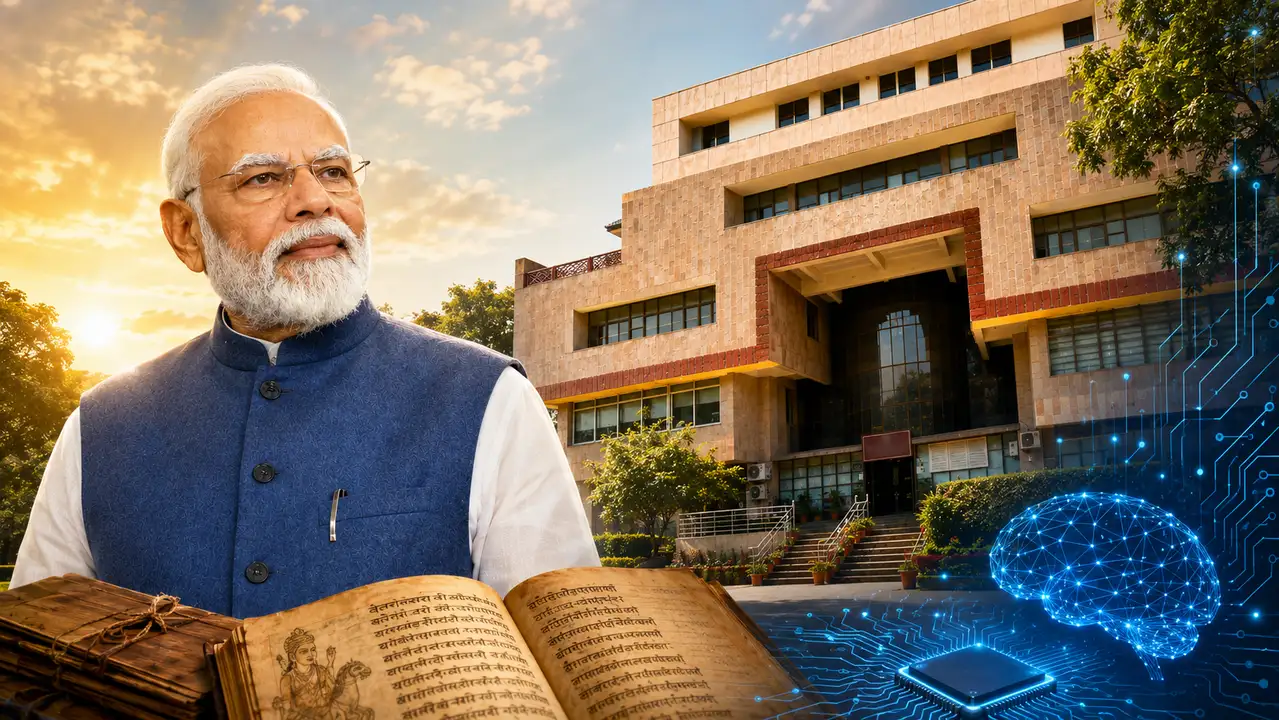
Central Sanskrit University has launched India’s first AICTE-approved four-year BTech in Artificial Intelligence and Data Science at its Nashik campus for the 2026–27 term. Endorsed by Prime Minister Narendra Modi, the program blends computer engineering with Indian Knowledge Systems to develop advanced AI-driven tools for regional language processing and manuscript preservation.
Central Sanskrit University Launches BTech in AI and Data Science
New Delhi institution bridges ancient linguistic frameworks and modern tech with a multi-disciplinary engineering degree.
NEW DELHI — In a historic shift for technical and classical education in India, Central Sanskrit University (CSU) announced on June 28, 2026, the launch of India’s first AICTE-approved Bachelor of Technology (BTech) programme in Artificial Intelligence and Data Science. The four-year degree course, scheduled to commence from the 2026–27 academic session at the university’s Nashik campus in Maharashtra, marks the first time a traditional Sanskrit institution has broken into mainstream engineering education. The move is designed to integrate ancient Indian Knowledge Systems (IKS) with contemporary computational engineering to address modern low-resource language processing demands.
Blending Computer Science with Indian Knowledge Systems
The formal introduction of the BTech course follows official approval from the All India Council for Technical Education (AICTE), elevating the accredited A++ grade institution into technical domains. According to university administrators, the curriculum satisfies the multidisciplinary benchmarks set by the National Education Policy (NEP) 2020 by demanding parity between rigorous technology training and classical language structural models.
Students enrolled in the programme will complete the standard core modules required of any conventional BTech in computer science or data analytics nationwide. This technical base covers foundational disciplines including Python programming, Machine Learning (ML), Deep Learning, Cloud Computing, and advanced statistical analysis.
However, the program adds a specialized structural twist by incorporating advanced elements of Sanskrit grammar, formal logic, and Indian linguistic structures. Faculty intend to leverage the mathematical and algorithmic nature of Paninian Sanskrit grammar to train future engineers in building superior Natural Language Processing (NLP) pipelines, conversational models, and machine translation interfaces specifically optimized for diverse Indian regional languages.
National Leadership Highlights Future-Ready Skills
The launch of the program garnered national prominence after Prime Minister Narendra Modi lauded the convergence during his 135th Mann Ki Baat public address. The Prime Minister framed the development as a crucial national milestone for balancing heritage and software modernization.
"Significant effort is underway to prepare the youth for new technology while keeping them rooted in their heritage," Prime Minister Modi stated. "The Central Sanskrit University is launching a BTech program in Artificial Intelligence and Data Science. It will facilitate the development of new AI tools for Indian languages and accelerate the digitization and preservation of our ancient texts and manuscripts."
University leadership emphasized that the ultimate goal is not to train classical scholars, but rather to construct an industry-ready workforce capable of engineering technical products without ignoring cultural frameworks.
Curriculum Focus and Practical Research Channels
According to the curriculum layout outlined by university boards, academic collaborations are underway with experts from the Indian Institutes of Technology (IITs) to balance the technical rigor. A primary research track for students involves tackling the bottleneck of un-digitized Indian archives. Millions of historical manuscripts remain locked away in classical scripts like Grantha, Nandinagari, and Newari.
The program intends to use student research projects to design high-accuracy Optical Character Recognition (OCR) systems, automated semantic data-tagging networks, and advanced document-recognition technologies. Furthermore, academics intend to test whether the mathematically consistent framework of Sanskrit can function as an efficient intermediary pivot language for multi-lingual translation algorithms across regional dialects.
Impact on Students, Industry, and the Technology Sector
For engineering aspirants entering through traditional competitive tracks like the Joint Entrance Examination (JEE), the program presents an unconventional path that pairs technical expertise with cross-disciplinary humanities research. Graduates will be eligible for standard software developer, data scientist, and AI research roles across the corporate tech sector, alongside highly specialized positions in digital humanities, computational linguistics, and sovereign language technology missions.
Furthermore, because the course operates under standard AICTE guidelines, enrolled students retain full institutional eligibility to participate in state-backed frameworks like the Smart India Hackathon and access national scholarship portals including the Pragati, Saksham, and Swanath student aid schemes.
Official Sources Section
According to official administrative notifications from the Ministry of Education, admissions have formally commenced for the inaugural batch. The authorized enrollment model contains a total sanctioned capacity of 66 seats, which is divided between 60 regular admission slots and six supernumerary placements, including provisions for candidates from the Economically Weaker Sections (EWS).
Why It Matters
Most modern AI translation systems and large language models are engineered around Western semantic structures and English-dominant training data, leaving low-resource regional languages with severe structural limitations. By training engineers who understand both machine learning parameters and the underlying algorithmic structure of classical Indian linguistics, this program aims to establish an autonomous technical ecosystem capable of safeguarding, digitizing, and translating India's massive cultural database into accessible digital knowledge.
Key Facts at a Glance
Academic Milestone: First AICTE-approved BTech engineering degree launched by a classical Sanskrit university in India.
Campus & Timeline: Operational starting the 2026–27 academic term at the Central Sanskrit University campus in Nashik, Maharashtra.
Seat Allotment: Total sanctioned intake of 66 seats, comprising 60 regular and six supernumerary entry paths.
Technical Domains: Core focus areas encompass Machine Learning, Deep Learning, Python programming, Computational Linguistics, and Natural Language Processing.
National Integration: Completely aligned with NEP 2020 guidelines with research targets aimed at automated script translation and manuscript digitisation via AI tools.
Frequently Asked Questions
What are the entry requirements for this BTech program?
Admissions are processed through standard national and state engineering streams, including the Joint Entrance Examination (JEE) and state-level admission mechanisms, matching the regulatory norms enforced by the AICTE.
Will students with no knowledge of Sanskrit be able to cope?
Yes. University officials stated that the syllabus matches standard BTech data science structures across India. For students lacking a linguistic background, a short, non-burdening foundational communication course will be utilized to help them navigate language datasets without needing to become classical language scholars.
What career profiles will graduates of this course look forward to?
Graduates will be fully certified to secure jobs in conventional software roles like Data Scientists, AI Engineers, and Machine Learning developers, as well as specialized roles in machine translation, digital humanities archiving, and semantic data engineering.
Source: Official academic launch manifestos, national broadcaster records, and program prospectus disclosures via the Central Sanskrit University Portal and technical directives issued by the All India Council for Technical Education.