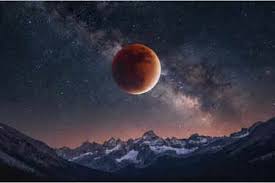
The final lunar eclipse of 2026 occurs on August 28 but will not be visible in India as it takes place during daytime hours. Because local visibility is absent, traditional Sutak restrictions do not apply, though global astronomy enthusiasts across the Americas and Europe can view the deep partial phase.
NEW DELHI — Skywatchers across India will miss out on the deep partial lunar eclipse, or Chandra Grahan, occurring on Friday, August 28, 2026.
According to astronomical data from organizations like NASA and regional time conversions, the celestial alignment takes place during daytime hours in South Asia, when the Moon remains entirely below the horizon. While observers throughout the Americas, Europe, and Africa experience the phenomenon—where roughly 96% of the lunar disk passes through Earth's central shadow—Indian domestic audiences must rely on digital livestreams to view the event.
Astronomical Timings and Global Visibility
The planetary alignment occurs on August 28, 2026, progressing through distinct phases measured in Indian Standard Time (IST). The penumbral stage initiates early in the morning at 6:54 AM, followed by the partial eclipse phase beginning at 8:04 AM. The maximum eclipse point peaks at 9:43 AM, with the partial and penumbral phases concluding by afternoon.
Because these stages unfold while the Sun is up and the Moon is out of sight in regions spanning New Delhi, Mumbai, Kolkata, and Bengaluru, local visibility is zero. Prime viewing zones remain restricted to the Western Hemisphere, western Asia, and parts of Europe and Africa.
According to official astronomical calculations, meteorological advisories, and space agencies:
Event Classification: Deep partial lunar eclipse (frequently noted for a copper-red hue similar to a Blood Moon).
Peak Timing: Maximum eclipse reached at approximately 9:43 AM IST on August 28.
Indian Visibility: Not visible; the Moon remains below the horizon throughout the transit.
Geographic View Zones: Primarily visible across North America, South America, Europe, and parts of Africa.
Astrological Interpretation and Sutak Rules
In traditional Vedic astrology, lunar eclipses carry deep spiritual and psychological symbolism, often associated with emotional introspection, mental balance, and the lunar nodes Rahu and Ketu. The August 28 eclipse takes place with the Moon positioned in Aquarius (Kumbha Rashi) under the Shatabhisha Nakshatra. Astrologers note that such alignments prompt periods of reflection and a re-evaluation of personal relationships or emotional attachments.
However, a major point of clarification for citizens following regional calendars involves the Sutak Kaal—the traditionally inauspicious period preceding an eclipse. Because customary Panchang guidelines tie Sutak restrictions strictly to the physical visibility of an eclipse at a given geographic location, religious scholars confirm that Sutak rules do not apply in India for this event. Consequently, traditional festival celebrations and daily routines remain unaffected.
Official Sources Section
Quote Section
"According to astronomical calculations and traditional Panchang guidelines, because the lunar eclipse is not observable from any part of India, traditional Sutak restrictions are not applicable, allowing scheduled public activities and daily routines to proceed without interruption."
Why It Matters
For millions of citizens, tracking celestial occurrences ensures clarity regarding traditional observances and modern science education. Knowing that an eclipse lacks local visibility prevents unnecessary confusion surrounding cultural routines, while digital access enables space enthusiasts to study global astronomical phenomena safely.
Key Facts at a Glance
Date: August 28, 2026.
Type: Deep partial lunar eclipse.
India Status: Not visible (daytime transit below horizon).
Sutak Kaal: Not applicable due to lack of local visibility.
FAQ Section
Will the August 28, 2026 Chandra Grahan be visible in India?
No, the lunar eclipse will not be visible from India because it occurs during daytime hours when the Moon is below the horizon.
Does Sutak Kaal apply in India during this eclipse?
No, according to traditional visibility-based rules followed in the Panchang, Sutak restrictions do not apply since the eclipse cannot be observed locally.
Where can the eclipse be viewed globally?
The eclipse is visible across major parts of North America, Central and South America, Europe, Africa, and western Asia.
Where can astronomy enthusiasts watch live coverage of the event?
Real-time streams and visual updates are hosted directly through platforms associated with the NASA Eclipse Web Portal.
Source: NASA Eclipse Web Portal, IMD Positional Astronomy Centre, Times of India Astrology, Hindustan Times