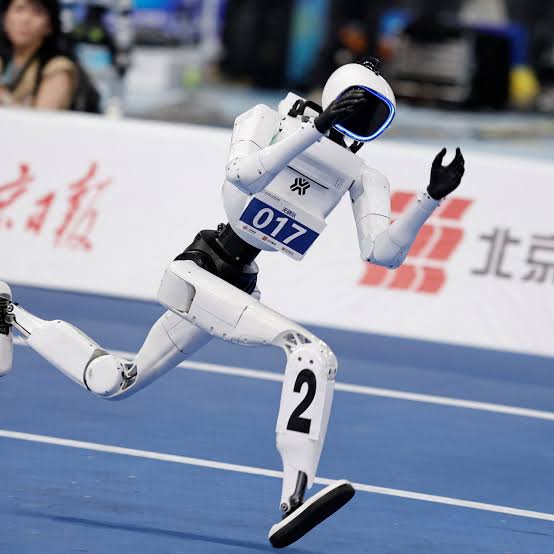
China's Tiangong Ultra humanoid robot has clocked an astonishing 8.86-second 100-metre sprint at the World Humanoid Robot Games in Beijing. Developed by the Beijing Humanoid Robot Innovation Center, the machine surpassed Usain Bolt's human record, showcasing major advancements in bipedal mobility, joint engineering, and dynamic balance control.
BEIJING — The boundaries of robotics and machine mobility were rewritten in Beijing as the advanced humanoid robot Tiangong Ultra clocked a stunning 8.86-second 100-metre sprint during the semifinals at the second annual World Humanoid Robot Games.
Hosted at Beijing’s National Speed Skating Oval, the event brought together thousands of robotic systems from across the globe. Tiangong's blazing performance comfortably eclipsed the longstanding human men's 100-metre world record of 9.58 seconds set by Jamaican legend Usain Bolt in 2009, marking a monumental leap in bipedal dynamic control and high-speed robotic actuation.
Engineering High-Speed Bipedal Locomotion
The record-breaking run follows a rapid technological trajectory for the machine. At the inaugural competition just a year prior, the initial iteration of Tiangong Ultra completed the 100-metre distance in 21.50 seconds. Engineers achieved the dramatic sub-9-second breakthrough by implementing structural upgrades, including lighter composite frames, reinforced joint actuators, and refined motion-control algorithms.
Unlike earlier iterations that relied strictly on surface line-following guides, the upgraded robot utilized map-based autonomous positioning systems. This allowed the machine to maintain high-speed momentum without track-marking constraints, though it culminated in a dramatic collision with safety barriers at the finish line.
According to official developer disclosures, tournament updates, and state media reports:
Official Time: 8.86 seconds in the large-size group semifinal.
Previous Benchmark: Lowered its own preliminary milestone of 9.39 seconds set earlier in the week.
Developer Entity: Beijing Humanoid Robot Innovation Center.
Event Context: Second World Humanoid Robot Games, featuring over 2,000 participating robots from 16 countries.
Official Sources Section
Beijing Humanoid Robot Innovation Center Official Disclosures: Technical upgrade summaries, actuator specifications, and motion-control algorithm updates.
World Humanoid Robot Games Event Organizers: Official heat timings, category rankings, and competition safety protocols.
Global Times Official Media Reports: Detailed engineering breakdowns and semifinal race transcriptions from Beijing.
Quote Section
"The competitions serve as a test of robots' limits in mobility and hardware reliability, paving the way for future applications such as long-distance inspections, logistics, and emergency response in complex 3D environments,"
— stated representatives from the Beijing Humanoid Robot Innovation Center.
Why It Matters
While sprinting records serve as high-visibility spectacles, the underlying engineering required to achieve them addresses core challenges in robotics. Mastering rapid acceleration, dynamic balance correction, impact absorption, and precise deceleration translates directly to real-world utility. For industries ranging from automated warehousing and disaster relief to hazardous industrial inspections, machines capable of navigating complex, unstable terrain with human-like agility represent a transformative commercial frontier.
Key Facts at a Glance
Machine Name: Tiangong Ultra (Large-Size Division).
Sprint Time: 8.86 seconds over 100 metres.
Comparison: Substantially faster than Usain Bolt's 2009 human world record of 9.58 seconds.
Broader Scope: One of 51 competitive events at the Beijing games designed to stress-test mobility, dexterity, and artificial intelligence.
FAQ Section
How fast did the Tiangong Ultra robot run the 100-metre sprint?
The robot clocked an official time of 8.86 seconds during the semifinal round of the World Humanoid Robot Games in Beijing.
Who developed the Tiangong humanoid robot?
Tiangong was developed by the Beijing Humanoid Robot Innovation Center.
Did Tiangong break Usain Bolt's record?
Yes, its time of 8.86 seconds is significantly faster than Usain Bolt's human world record of 9.58 seconds.
What is the practical purpose of teaching robots to sprint?
The engineering challenges solved during high-speed running—such as dynamic balance, stabilization, and rapid obstacle response—are essential for deploying robots in hazardous environments, search-and-rescue missions, and complex industrial logistics.
Source: Beijing Humanoid Robot Innovation Center, Global Times, Reuters, LiveMint