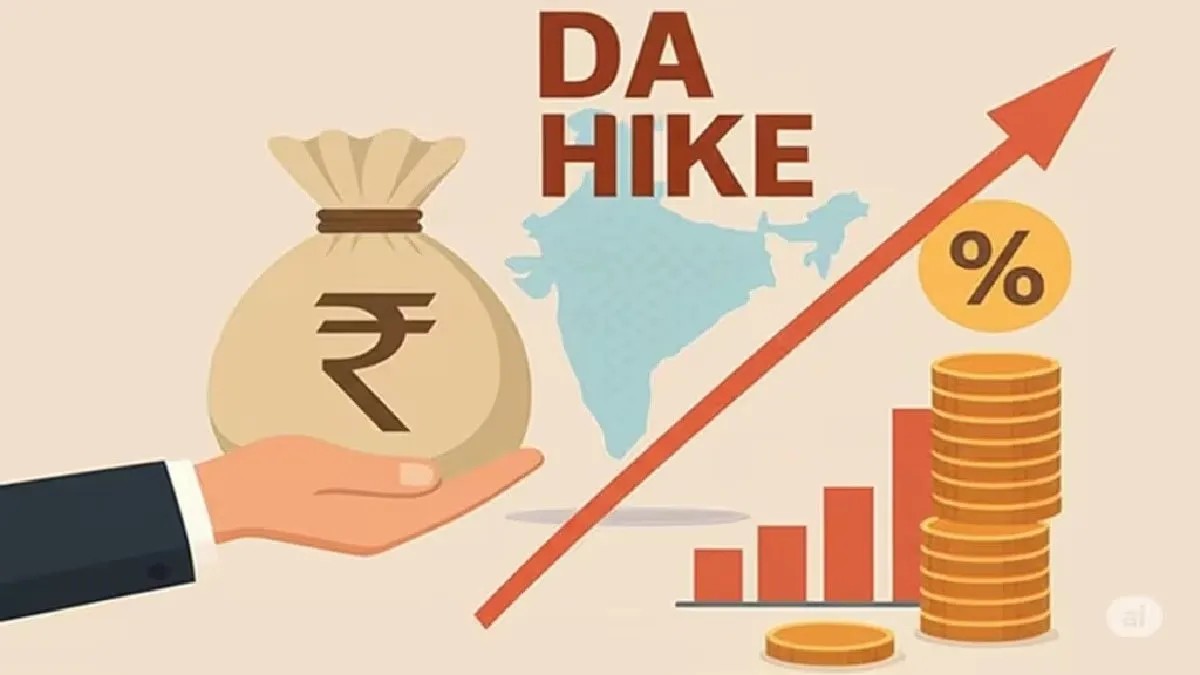
India's Finance Ministry, Indian Railways, and the Indian Banks' Association have announced revised Dearness Allowance (DA) rates for public sector staff and pensioners. Bounded by Labour Bureau CPI-IW inflation metrics, the central government DA reached 60%, benefiting over 1.1 crore employees and retirees while buffering household incomes against retail price rises.
NEW DELHI — The Union Ministry of Finance, the Ministry of Railways, and the Indian Banks’ Association (IBA) have finalized a series of dearness allowance (DA) and dearness relief (DR) hikes for central government personnel, railway staff, and banking employees. The updates follow the release of the All India Consumer Price Index for Industrial Workers (AICPI-IW) figures by the Labour Bureau, which establishes the official benchmark for inflation-linked compensation adjustments.
These salary adjustments affect more than 1.1 crore central employees and pensioners, alongside thousands of banking and public sector workers nationwide. The revisions come as workforce unions engage with the government regarding recommendations for the upcoming 8th Central Pay Commission.
Finance Ministry and Central Government Allowance Revisions
The Union Cabinet, chaired by Prime Minister Narendra Modi, approved a 2% increase in Dearness Allowance and Dearness Relief for central government employees and pensioners. This adjustment raised the official allowance rate from 58% to 60% of basic pay and pension.
According to official releases from the Ministry of Finance, the revision entails an annual burden of ₹6,791.24 crore on the national exchequer. The decision directly benefits roughly 50.46 lakh central employees and 68.27 lakh pensioners.
Recent monthly readings from the Labour Bureau’s CPI-IW index—which recorded a level of 151.9 for June—indicate that a subsequent 3% DA hike is projected for the second half of the year, potentially bringing total DA to 63%.
Indian Railways Align Allowance Rates for Staff and Retirees
Following the central government's directive, the Ministry of Railways formally approved corresponding DA and DR increases across its operational divisions.
Railway personnel, including track maintainers, locomotive drivers, station staff, and administrative officers, saw their allowance component updated to 60% of basic salary. In addition to general allowance updates, the Railway Board updated kilometrage allowances and Allowance in Lieu of Kilometrage (ALK) for running staff to maintain parity with overall compensation frameworks.
Banking Sector and State Government Salary Revisions
The banking sector also announced restructured compensation figures. The Indian Banks' Association (IBA) issued circulars revising the Dearness Allowance for bank officers and workmen under the 12th Bipartite Settlement framework.
Concurrently, several state governments aligned their regional pay scales with central benchmarks. West Bengal approved an allowance increase to 38%, while states including Assam, Tamil Nadu, Uttar Pradesh, Arunachal Pradesh, Bihar, and Odisha announced incremental DA hikes ranging between 2% and 5%.
Official Sources Section
All data regarding allowance adjustments, fiscal impact figures, and beneficiary numbers are derived from formal announcements issued by government authorities and industry bodies:
Ministry of Finance (Department of Expenditure): Official Cabinet releases detailing DA and DR percentages and exchequer allocation.
Labour Bureau (Ministry of Labour & Employment): Monthly All India Consumer Price Index for Industrial Workers (AICPI-IW) statistics.
Ministry of Railways (Railway Board): Gazette notifications and service orders for railway staff and pensioners.
Indian Banks' Association (IBA) & All India Bank Employees' Association (AIBEA): Bipartite settlement circulars and bank employee pay notifications.
Quote Section
"The Union Cabinet has approved an additional instalment of Dearness Allowance to Central Government employees and Dearness Relief to pensioners to compensate against price rise, representing an increase over the existing rate in accordance with the accepted formula of the 7th Central Pay Commission."
— Ministry of Finance, Government of India
"According to officials from the Labour Bureau, the All India Consumer Price Index for Industrial Workers serves as the objective mathematical basis for calculating periodic allowance revisions across central government sectors."
Why It Matters
Inflation-linked DA adjustments directly influence household disposable income for millions of public sector personnel.
For employees, these revisions help preserve real purchasing power amidst changing retail prices for food, housing, and essential services. For local economies, periodic DA arrears and monthly pay increases boost consumer expenditure across retail, housing finance, and consumer goods sectors.
Key Facts at a Glance
Central Government DA Rate: Increased to 60% of basic pay, with projections pointing toward 63% based on Labour Bureau CPI-IW data.
Fiscal Exchequer Impact: Estimated at ₹6,791.24 crore annually for the central government.
Beneficiary Coverage: Over 50.46 lakh central employees and 68.27 lakh pensioners.
Sector-Wide Updates: Revisions implemented across Indian Railways, banking institutions under IBA, and state administration cadres.
Frequently Asked Questions (FAQ)
What is Dearness Allowance (DA) and how is it calculated?
Dearness Allowance is an inflation-compensation component paid to government employees and pensioners. It is calculated twice a year based on the 12-month average of the All India Consumer Price Index for Industrial Workers (AICPI-IW) published by the Labour Bureau.
Who is eligible for the DA and DR hikes?
Serving central government civil employees, defence personnel, railway staff, public sector bank employees, and retired pensioners drawing pensions under the 7th Pay Commission framework are eligible.
Will arrears be paid for past months?
Yes, when DA hikes are announced retroactively, employees and pensioners receive accrued arrears for the intervening period between the effective date and the implementation month.
Source: Official announcements from the Ministry of Finance, the Press Information Bureau (PIB), the Ministry of Railways, and the Indian Banks' Association (IBA).