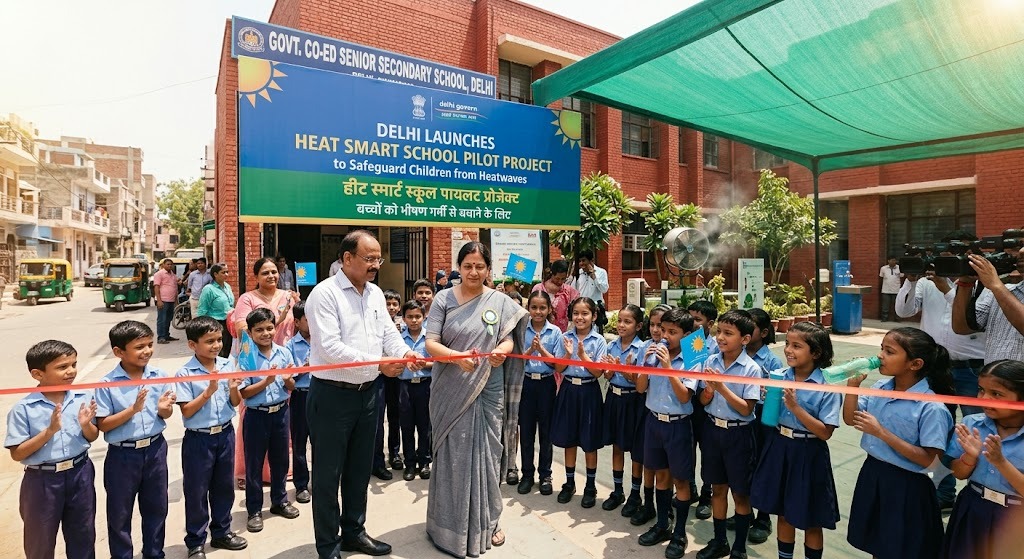
Delhi has launched a "Heat Smart School" pilot project at a government school in Shalimar Bagh to protect students from extreme heatwaves. The initiative features cool roofs, better hydration facilities, and climate education, serving as a scalable model for climate-resilient public infrastructure under the state's broader Heat Action Plan.
The government’s new climate-resilient initiative aims to safeguard students from extreme heatwaves through structural upgrades and school-level interventions.
NEW DELHI – In a proactive move to mitigate the growing threat of extreme weather, the Delhi government has launched a “Heat Smart School” pilot project. The initiative, officially unveiled this week, seeks to transform educational institutions into climate-resilient zones capable of protecting students from the impact of soaring temperatures during the capital’s intense summer months.
A high-level inspection of the pilot project was conducted on Wednesday at Sarvodaya Bal Vidyalaya in Shalimar Bagh. The project is a collaborative effort between the Delhi District Administration (Central-North), the National Disaster Management Authority (NDMA), and GIZ India, reflecting a multi-stakeholder approach to public health and safety.
Scaling Climate Resilience in Education
The "Heat Smart School" model introduces a range of practical, scalable interventions designed to reduce heat stress. During the recent site visit, a delegation—which included officials from the NDMA, the German Embassy, and GIZ India—reviewed the structural and behavioral modifications implemented at the school campus.
Key interventions include the installation of cool roofs to mitigate heat absorption, the creation of shaded corridors and waiting areas, and the enhancement of drinking water facilities. Beyond structural changes, the pilot emphasizes student-led awareness, heat safety displays, and participatory educational activities designed to help children recognize and manage heat-related risks.
According to officials, the pilot is a practical extension of the broader Delhi Heat Action Plan, which was directed by Chief Minister Rekha Gupta to address the capital's vulnerability to extreme heat.
Integrating Heat Safety into Public Policy
The initiative marks a significant shift from reactive measures to institutionalized adaptation. NDMA Member Secretary Krishna S. Vatsa highlighted that heatwaves are among India's fastest-growing climate-induced hazards. He noted that the project aims to integrate preparedness and awareness into public infrastructure, effectively turning students into "ambassadors of climate adaptation" within their own families and communities.
The project, part of the InCRIS (Integrated Climate Risk Information System) effort, is designed to be affordable and replicable. Officials indicated that if the pilot proves successful in its current form, the government plans to expand the model to additional schools across the national capital, aiming to secure learning environments for thousands of students.
Impact on Students and Infrastructure
For the students of Delhi, this development is a critical step in ensuring that education remains uninterrupted and safe despite worsening climatic conditions. Earlier this year, the Directorate of Education had already implemented “water bell” systems and curtailed outdoor activities to protect children during peak heat. The new "Heat Smart School" pilot builds on these efforts by providing a permanent, climate-responsive framework rather than relying solely on temporary alerts.
Key Facts at a Glance
Pilot Location: The first "Heat Smart School" pilot is operational at Sarvodaya Bal Vidyalaya in Shalimar Bagh, Delhi.
Strategic Partners: The project is a joint initiative by the District Administration (Central-North), NDMA, and GIZ India.
Core Interventions: Upgrades include cool roofs, improved hydration stations, shaded waiting zones, and climate-responsive student education.
Policy Objective: The pilot is an expansion of the Delhi Heat Action Plan, aimed at making public infrastructure more climate-resilient.
Frequently Asked Questions
1. What is a "Heat Smart School"?
It is a model school equipped with structural interventions like cool roofs and enhanced hydration facilities to minimize heat stress, coupled with educational programs to teach students about climate adaptation.
2. Is this model intended for all schools in Delhi?
The government has expressed confidence in the model and plans to expand it to more schools across the capital, provided the pilot yields positive, scalable results.
3. How does this differ from the existing Delhi Heat Action Plan?
While the Heat Action Plan provides the overarching policy and district-level guidelines, the "Heat Smart School" project focuses on direct, site-specific implementation within the school campus to protect vulnerable children directly.
Source: National Disaster Management Authority (NDMA), Chief Minister's Office, Delhi, GIZ India, DD News.