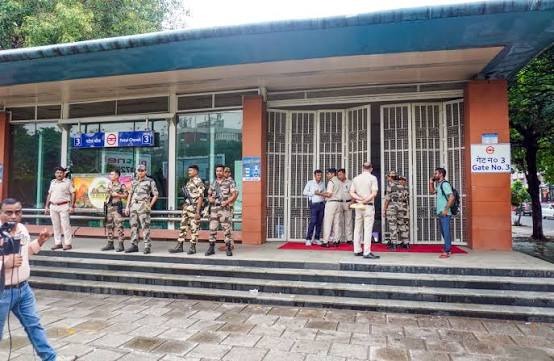
The Delhi Metro Rail Corporation suspended operations across 16 major transit hubs in central Delhi following security advisories from law enforcement. The closures follow late-night confrontations near Jantar Mantar and Parliament. Authorities emphasized that cross-line interchange options remain operational to limit capital-wide commuter disruption.
NEW DELHI — The Delhi Metro Rail Corporation (DMRC) ordered the temporary closure of 16 key metro stations across central Delhi on Thursday following advisories from law enforcement agencies. The action was taken after late-night clashes erupted between security forces and demonstrators near Jantar Mantar and Tolstoy Marg, escalating concerns over public order in the national capital.
The affected stations include high-density transit nodes such as Rajiv Chowk, Central Secretariat, Mandi House, Patel Chowk, Lok Kalyan Marg, Barakhamba Road, Supreme Court, Seva Teerth, Janpath, ITO, Delhi Gate, Indraprastha, Khan Market, Jor Bagh, Ramakrishna Ashram Marg, and Shivaji Stadium. While entry and exit gates at these stations remain sealed to passenger traffic, DMRC confirmed that interchange facilities at Rajiv Chowk, Mandi House, and Central Secretariat remain active to allow transfer between connecting lines.
Law enforcement authorities tightened security parameters across the New Delhi district to prevent unauthorized gatherings near government installations during the ongoing Parliament session.
Background and Security Deployment Details
The heightened security measures follow days of demonstrations organized near Jantar Mantar, where student groups and political activists assembled to demand official accountability regarding competitive examination conduct. Tensions escalated on Wednesday evening when a section of demonstrators moved toward Connaught Place, leading to stone-pelting incidents near Tolstoy Marg that injured a senior police officer.
In response, the Delhi Police imposed strict prohibitory measures under Section 163 of the Bharatiya Nagarik Suraksha Sanhita (BNSS), which restricts public assemblies of five or more persons in the New Delhi district. Units from the Rapid Action Force (RAF) and Central Reserve Police Force (CRPF) have been stationed alongside local police officers at all closed station gates and major road intersections.
"Security personnel have been positioned at key infrastructure points across the city center to maintain public order and prevent unapproved marches," a senior Delhi Police officer stated during a press briefing.
Commuter Impact and Urban Surface Traffic
The sudden suspension of entry and exit points across 16 Delhi Metro stations created significant logistical delays for thousands of morning commuters, office workers, and students. Crowds gathered outside peripheral operational stations as commuters sought alternate road transport options, leading to sharp increases in autorickshaw fares and extended wait times for public buses.
Traffic authorities issued real-time advisories warning of heavy congestion along major arteries surrounding Connaught Place, Janpath, Rafi Marg, and Ashoka Road due to security barricading. Commercial businesses and private offices in the central business district advised employees to utilize remote working or allow extra travel time.
Official Sources Section
Official policy updates, security notices, and transit advisories were published by regulatory bodies and law enforcement divisions:
Quote Section
"According to officials from the Delhi Police and DMRC, the temporary operational restrictions were enforced strictly as a precautionary security measure following intelligence advisories regarding potential law and order disruptions. Authorities confirmed that station operations will be fully restored as soon as security clearance is issued by central enforcement agencies."
Why It Matters
For Daily Commuters: Requires alternative route planning across central transit corridors, though core underground interchange facilities remain available.
For Local Businesses: Leads to reduced footfall and delayed operational schedules within Connaught Place and central commercial markets.
For Public Safety Management: Demonstrates the rapid deployment of urban crowd control protocols to prevent unauthorized escalation near government zones.
For Municipal Infrastructure: Highlights the reliance on multi-tiered transport redundancies to preserve cross-city transit during security lockdowns.
Key Facts at a Glance
Total Stations Impacted: 16 Delhi Metro stations shut for entry/exit access in central areas.
Operational Exceptions: Interchange facilities at Rajiv Chowk, Mandi House, and Central Secretariat remain active.
Catalyst Event: Late-night clashes near Jantar Mantar and Tolstoy Marg during student-led demonstrations.
Legal Measures Imposed: BNSS Section 163 enforced across New Delhi district restricting large assemblies.
Security Agencies Deployed: Delhi Police, Rapid Action Force (RAF), and CRPF units.
Frequently Asked Questions (FAQ)
Which 16 Delhi Metro stations are shut?
The affected stations are Lok Kalyan Marg, Rajiv Chowk, Patel Chowk, Ramakrishna Ashram Marg, Barakhamba Road, Supreme Court, Seva Teerth, Janpath, Mandi House, Central Secretariat, ITO, Delhi Gate, Indraprastha, Khan Market, Jor Bagh, and Shivaji Stadium.
Can passengers still change lines at Rajiv Chowk or Mandi House?
Yes. The Delhi Metro Rail Corporation confirmed that interchange facilities remain operational at Rajiv Chowk, Mandi House, and Central Secretariat, allowing commuters to switch lines without exiting the station.
Why were the station closures implemented?
The closures were requested by law enforcement due to security concerns and public order maintenance following clashes near the Jantar Mantar protest site.
How long will the metro station restrictions remain in force?
DMRC announced that stations will remain closed "until further instructions" subject to daily security reassessments by the Delhi Police.
Source: Official announcements from the Delhi Metro Rail Corporation (DMRC), Delhi Police advisories, and Ministry of Home Affairs briefings.