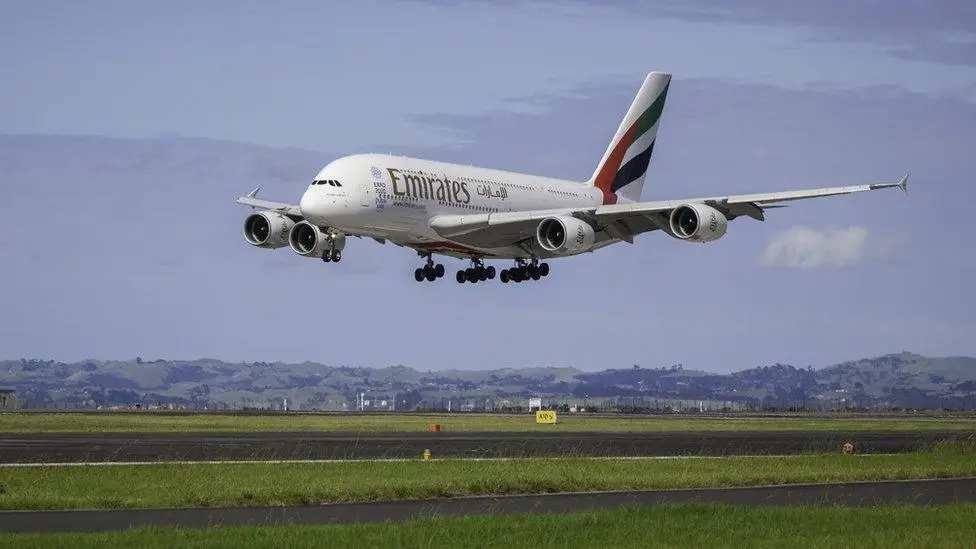
The 8,810-mile flagship route between Dubai and Auckland serves as a masterclass in hub-and-spoke economics. By leveraging 16 daily UK flights and a high-frequency network across 9 Indian cities, Emirates funnels massive regional transit demand into a singular, highly profitable ultra-long-haul corridor that bridges the Eastern and Western hemispheres.
DUBAI — Emirates Airline's ultra-long-haul flight between Dubai International Airport (DXB) and Auckland International Airport (AKL), which spans an incredible 8,810 miles, owes its commercial viability to two primary origin markets located thousands of miles away from the United Arab Emirates: the United Kingdom and India.
According to global aviation data and network scheduling reports published by industry tracker OAG, the non-stop route frequently highlighted as one of the longest scheduled commercial flights in the world functions primarily as a critical transit mechanism for travelers migrating between Western Europe, South Asia, and New Zealand.
The Power of the Hub-and-Spoke Model
Emirates' operational framework utilizes its hub at Dubai International Airport (DXB) to collect passengers from dense, short-to-medium-haul networks and funnel them into high-capacity, ultra-long-haul corridors. Market analysis indicates that up to 66% of all passengers traveling on Emirates do not begin or end their journeys in Dubai, but instead use the airport as a mid-way transit point.
The airline's scheduling windows are precisely calibrated to align incoming flights from the UK and India with departing long-haul flights to Oceania. This strategic synchronization minimizes connection times and maximizes aircraft passenger loads, allowing Emirates to consistently fill its massive double-decker Airbus A380-800 aircraft on the lengthy Auckland route.
High-Volume Feeder Markets: The UK and India
The United Kingdom represents the single largest market for Emirates by capacity deployment. The Dubai-based carrier operates 16 daily flights across eight British gateways, including five daily A380 operations to London Heathrow (LHR) and three daily frequencies to London Gatwick (LGW). In July, this figure is scheduled to scale back up to 20 daily frequencies as seasonal demand intensifies.
India serves as Emirates' second-most critical market, with the airline operating high-frequency services to nine destinations, including major hubs like Mumbai (BOM) and Delhi (DEL). Due to bilateral air services agreements that cap overall capacity, Emirates deploys smaller widebody aircraft, such as the Boeing 777-300ER, to Indian cities but maintains intense daily frequencies to secure a continuous flow of connecting traffic.
The historical, familial, and economic ties linking both the UK and India to New Zealand generate a predictable, year-round volume of dual-directional passenger traffic. This organic demand bypasses regional stopovers by consolidating traffic directly through Dubai.
Official Sources Section
Data provided by the OAG Aviation Network verifies that connecting traffic accounts for the vast majority of seats occupied on Oceania services. Furthermore, historical regulatory filings with the Dubai Airports Company highlight that DXB handled nearly 90 million passengers annually, bolstered heavily by international-to-international transit demographics.
Quote Section
According to aviation analysts monitoring Gulf carrier networks:
"The commercial success of ultra-long-haul routes like Dubai-Auckland is entirely dependent on upstream network feed. Without the 16 to 20 daily flights pouring passengers out of the UK, and the high-frequency feeder lines out of India, an 8,810-mile flight on a 500-seat Airbus A380 would be structurally impossible to sustain financially."
Why It Matters
For international travelers and global commerce, this route architecture means lower relative ticket pricing and seamless, single-stop connectivity between distant regions. By consolidating global demand into a central super-hub, Emirates lowers the per-seat operating cost of ultra-long-haul flying.
For investors and the broader aviation industry, it proves that structural hub geography remains a dominant economic moat, insulating mega-carriers from volatile local point-to-point market shifts.
Key Facts at a Glance
Route Distance: 8,810 miles non-stop between Dubai (DXB) and Auckland (AKL).
Primary Aircraft: Airbus A380-800 configured with up to four cabin classes.
Transit Dependency: Approximately 66% of Emirates' global passengers are transit consumers.
Core Feeders: 16 daily UK frequencies and 9 distinct destination connections across India.
Future Infrastructure: Expansion plans at Al Maktoum International (DWC) aim to handle 260 million passengers annually to support future hub growth.
FAQ Section
How long does the non-stop flight from Dubai to Auckland take?
The outbound flight from Dubai to Auckland takes approximately 15 hours and 50 minutes, while the return leg can exceed 17 hours due to prevailing headwinds.
Why doesn't Emirates rely on local Dubai-to-New Zealand traffic?
The local point-to-point population between Dubai and New Zealand is far too small to consistently fill a daily Airbus A380. The route requires massive volumes of connecting passengers from high-density regions like Europe and South Asia to remain profitable.
What is a fifth-freedom flight, and does this route use it?
A fifth-freedom flight allows an airline to carry passengers between two foreign countries as part of a service connecting its home state. While the non-stop DXB-AKL flight is direct, Emirates utilizes fifth-freedom rights on other regional routes, such as its service to Christchurch via Sydney.
How do bilateral agreements impact Emirates' flights to India?
Bilateral air service agreements restrict the total number of seats or weekly flights an international airline can operate into a country. To stay within India's strict legal limits while capturing maximum transit traffic, Emirates utilizes high frequencies with slightly smaller aircraft rather than deploying its largest A380s to every Indian city.
Source: OAG Aviation Network Data Reports, Emirates Airline Route Intelligence, Dubai International Airport Traffic Operational Statements.