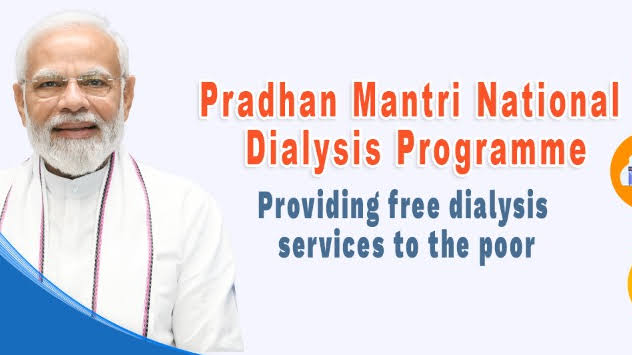
The Pradhan Mantri National Dialysis Programme (PMNDP) has expanded across all 36 Indian states and union territories, covering 751 districts. Managed under the National Health Mission (NHM), the program operates 1,856 hemodialysis centers equipped with 13,535 machines to provide free, accessible renal-care services to eligible patients nationwide.
NEW DELHI — The Union Ministry of Health and Family Welfare confirmed that the Pradhan Mantri National Dialysis Programme (PMNDP) is now fully operational across all 36 states and union territories, covering 751 districts nationwide. In a written response submitted to Parliament on August 11, 2026, Union Minister of State for Health and Family Welfare Prataprao Jadhav reported that as of June 30, 2026, the national initiative encompasses 1,856 functional hemodialysis centers equipped with 13,535 hemodialysis machines.
Launched under the umbrella of the National Health Mission (NHM), the PMNDP was established to mitigate the severe financial burden placed on families by End-Stage Renal Disease (ESRD). By offering free hemodialysis and peritoneal dialysis services to Below Poverty Line (BPL) cardholders and heavily subsidized rates for non-BPL patients, the expansion establishes a critical public health safety net in district hospitals and community health centers.
Infrastructure Growth and Operational Framework Under NHM
According to official updates from the Ministry of Health and Family Welfare, the installation of dialysis centers is executed through annual Programme Implementation Plans (PIPs) submitted by individual states and union territories. The Central Government provides technical and financial assistance through the NHM framework, enabling regional health departments to upgrade district-level facilities.
To ensure flexibility based on local administrative needs, the program operates through three primary service delivery models:
Public-Private Partnership (PPP) Mode: Deployed across 14 states and union territories to leverage specialized private health infrastructure.
In-House Public Sector Delivery: Managed directly by state health personnel across 16 states and union territories.
Hybrid Execution Model: Implemented in 6 states to combine public facility oversight with third-party technical operations.
State-Level Distribution and Quality Monitoring Protocols
State-wise implementation records published by the Press Information Bureau reveal substantial infrastructure development in high-density regions. Gujarat leads the tally with 282 functional dialysis centers, followed by Karnataka with 214 centers, Maharashtra with 158 centers, and Tamil Nadu with 146 centers.
To maintain clinical standards and minimize equipment downtime, the Ministry conducts periodic reviews through the Common Review Mission (CRM) and senior administrative inspections. Non-operational centers or staffing bottlenecks are flagged directly to state health secretaries for prompt corrective intervention. Furthermore, the national 'One Nation-One Dialysis' digital portal allows registered patients to access portability benefits, enabling seamless treatment continuity when traveling across state borders.
| Top State / UT | Functional Centers (FY 2024-25) | Functional Centers (FY 2025-26) |
| Gujarat | 272 | 282 |
| Karnataka | 200 | 214 |
| Maharashtra | 65 | 158 |
| Tamil Nadu | 141 | 146 |
| Kerala | 111 | 113 |
Impact on Public Health Expenditure and Patient Access
Every year, an estimated 2.2 lakh new patients develop End-Stage Renal Disease in India, generating an additional national requirement of over 3.4 crore dialysis sessions annually. Prior to the PMNDP’s rollout, rural and tier-3 city residents were forced to travel long distances to metropolitan tertiary care hospitals, incurring heavy transportation costs alongside recurring medical fees.
Decentralizing care to district hospitals and taluka-level Community Health Centers (CHCs) drastically cuts travel time and associated household expenditure. Official metrics indicate that the PMNDP has facilitated tens of millions of free dialysis sessions since its inception, protecting lower-income households from medical debt.
Official Sources Section
Regulatory updates, state-wise statistics, and parliamentary disclosures regarding the program are maintained by official health bodies:
Quote Section
"Public Health and Hospitals are state subjects; however, the Government of India provides technical and financial support to the States and Union Territories under the National Health Mission to strengthen healthcare infrastructure, including free dialysis services for eligible patients," stated Union Minister of State for Health and Family Welfare Prataprao Jadhav in a written parliamentary reply.
Why It Matters
The full-scale expansion of the Pradhan Mantri National Dialysis Programme across 751 districts bridges a critical healthcare gap in rural and suburban India. End-stage kidney failure requires ongoing, multi-weekly dialysis sessions that can easily impoverish families without state support. By decentralizing renal care to local district hospitals and community health centers, the government provides equal healthcare access, reduces out-of-pocket spending, and improves long-term patient outcomes.
Key Facts at a Glance
Geographic Coverage: Active across all 36 states and union territories, reaching 751 districts.
Infrastructure Capacity: Features 1,856 functional centers operating 13,535 hemodialysis machines as of June 2026.
Financial Model: Funded via the National Health Mission (NHM) through PPP, in-house, and hybrid models.
Patient Benefit: Free dialysis care for Below Poverty Line (BPL) patients and subsidized rates for non-BPL citizens.
FAQ Section
What is the primary objective of the Pradhan Mantri National Dialysis Programme?
The PMNDP aims to provide accessible and free or subsidized life-sustaining dialysis care to patients suffering from End-Stage Renal Disease, specifically focusing on Below Poverty Line (BPL) families.
How many districts are covered under the PMNDP?
The programme is operational across 751 districts (including 44 linked districts) in all 36 Indian states and union territories.
How are the dialysis centers established and funded?
Centers are set up based on gap assessments submitted by state governments in their annual Programme Implementation Plans (PIPs), supported by financial and technical funds from the central government's National Health Mission.
Source: Official press releases and parliamentary records from the Press Information Bureau (PIB), statistics from the PMNDP Portal, and documentation from the Ministry of Health and Family Welfare.