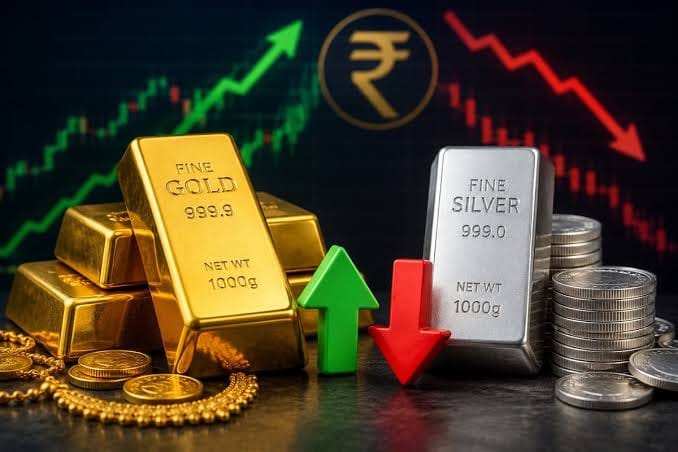
Gold prices in New Delhi jumped ₹2,700 to ₹1,67,100 per 10 grams, securing a fourth consecutive session of gains. Meanwhile, silver fell ₹3,500 to ₹2,50,000 per kg as investors booked profits following a three-day rally, despite mild pullbacks in international spot bullion benchmarks.
NEW DELHI — Gold prices in the national capital continued their strong upward trajectory on Tuesday, surging by ₹2,700 to reach ₹1,67,100 per 10 grams. The move marks the fourth consecutive session of gains for the yellow metal, driven by robust domestic demand. Conversely, silver prices recorded a sharp reversal, falling by ₹3,500 to settle at ₹2,50,000 per kilogram as market participants engaged in profit-booking following a multi-day rally.
The movement in the domestic precious metals market highlights a widening divergence between gold and silver, even as international spot benchmarks experienced slight declines across the board.
Gold Extends Winning Momentum Beyond Key Thresholds
According to market updates provided by trade bodies, 99.9% purity gold opened higher and maintained strong buying momentum throughout Tuesday's session. The metal had previously settled at ₹1,64,400 per 10 grams on Monday. Tuesday’s single-day surge of ₹2,700 represents a gain of approximately 1.64%, comfortably pushing gold prices past the ₹1.65-lakh mark per 10 grams in local bullion exchanges.
Traders in New Delhi attributed the fourth straight day of domestic appreciation to sustained institutional demand, currency adjustments, and localized physical buying, which insulated domestic physical rates from minor overnight retreats observed in foreign markets.
Silver Rally Pauses After Three-Session Streak
While gold continued to move higher, silver witnessed a pull-back after three straight sessions of steep price increases. The white metal dropped ₹3,500, or roughly 1.38%, down from its previous closing level of ₹2,53,500 per kg.
Despite the single-day contraction, silver managed to hold its ground above the key psychological support level of ₹2,50,000 per kg (inclusive of all applicable taxes). Analysts noted that the decline was largely technical, reflecting routine profit-booking by investors consolidating short-term gains rather than a systemic shift in broader industrial demand.
Global Bullion Dynamics Lose Steam
The contrasting performance in local markets occurred alongside a general consolidation in global commodity hubs. Overseas, international spot gold snapped its multi-day advance, giving back part of its recent gains.
Spot Gold: International spot gold fell by $11.87, or 0.26%, to trade at $4,639.51 per ounce after two sessions of increases.
Spot Silver: Spot silver extended its weakness for a second consecutive session, slipping 1.04% to $67.88 per ounce.
Domestic physical rates often fluctuate independently of international spot benchmarks due to localized landed costs, import tariffs, regional inventory levels, and foreign exchange rates.
Official Sources Section
Market rates, trading volume, and official settlement figures were reported according to public data releases and market monitoring from the following institutions:
Statements and daily rate updates released by the All India Sarafa Association.
Data feeds from domestic spot metal exchanges and international commodity benchmark tracking via Multi Commodity Exchange of India (MCX).
Quote Section
According to officials at the All India Sarafa Association, domestic physical demand for gold stayed resilient despite international spot easing, whereas silver experienced predictable profit-booking after reaching elevated levels over recent trading cycles.
Why It Matters
The divergent price movements in gold and silver have direct consequences for various economic sectors:
Consumers and Jewelers: Rising gold prices increase the cost of physical jewelry and investment coins, impacting retail budgets ahead of seasonal buying periods.
Investors: Portfolio managers looking at precious metals must navigate short-term volatility as silver undergoes profit-taking while gold trends near elevated territories.
Industrial Consumers: Silver’s pullback provides temporary cost relief for industrial sectors including electronics, solar manufacturing, and automotive components that rely on silver supplies.
Key Facts at a Glance
Gold Surge: Gold surged ₹2,700 to reach ₹1,67,100 per 10 grams in New Delhi, marking its fourth consecutive winning session.
Silver Decline: Silver fell ₹3,500 to ₹2,50,000 per kg due to heavy profit-booking after a three-day rally.
Percentage Moves: Gold appreciated by ~1.64%, while silver dropped by ~1.38%.
Overseas Trends: Spot gold slipped 0.26% to $4,639.51/oz, and spot silver declined 1.04% to $67.88/oz.
Frequently Asked Questions (FAQ)
Why did gold rise while international prices dropped?
Domestic gold prices account for localized import duties, currency exchange shifts between the US Dollar and Indian Rupee, and physical inventory demand in regional Sarafa markets, which can temporarily decouple local rates from global spot movements.
What caused the drop in silver prices?
Silver dropped due to profit-booking by short-term traders and investors taking gains off the table after three straight days of strong price appreciation.
Are taxes included in the reported domestic bullion prices?
The reported domestic prices provided by market trade bodies like the All India Sarafa Association are inclusive of applicable local levies and taxes.
Source: Free Press Journal, All India Sarafa Association.