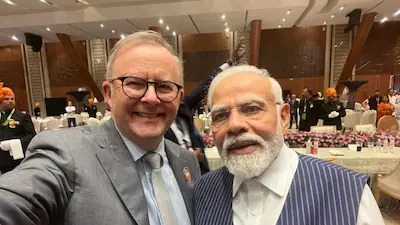
The Indian government has posted a casual "selfie of the day" featuring Prime Ministers Narendra Modi and Anthony Albanese at the 2026 Annual Leaders' Summit in Melbourne. The image underscores a deep personal chemistry supporting high-stakes negotiations on critical minerals, trade expansions, and clean energy technology.
MELBOURNE — Capturing a candid moment that transcended standard diplomatic protocols, the Indian government shared its official "selfie of the day" post featuring Prime Minister Narendra Modi and Australian Prime Minister Anthony Albanese. Released on July 9, 2026, during the high-stakes Australia-India Annual Leaders' Summit in Melbourne, the viral image perfectly summarized the warm personal relationship anchoring the fast-growing geopolitical and trade bonds between the two democracies.
The casual photo, taken on the sidelines of the India-Australia CEO Forum, rapidly circulated across social channels, drawing massive engagement from the global Indian diaspora and highlighting New Delhi's proactive use of digital diplomacy to cement international alliances.
Digital Diplomacy Anchors High-Stakes Melbourne Summit
The spontaneous photo session occurred directly after both heads of government concluded addresses at the concurrent Economic Roadmap Business Reception. Seizing a brief transition before entering closed-door strategic panels, Australian Prime Minister Anthony Albanese broke formal protocol by producing his personal phone to snap the picture with Prime Minister Modi.
The visual asset was quickly picked up by official state information handles, broadcasted under the uniform title "Selfie of the Day." According to media communications specialists, using relaxed, direct-to-camera visuals at a primary bilateral junction serves to humanize statecraft.
The strategy creates an accessible narrative for millions of digital citizens across both hemispheres, illustrating that while institutional policy negotiations remain highly technical, the foundational leadership layer operates on deep personal trust and mutual respect.
Natural and Trusted Partners Amid Global Volatility
Behind the viral social media post sits an incredibly dense, multi-sector economic and defense agenda. Addressing top industrialists and investment managers at the CEO Forum, Prime Minister Modi explicitly characterized the two nations as "natural and trusted partners" essential to stabilizing volatile global markets.
The leaders celebrated the rapid milestones achieved under the bilateral Economic Cooperation and Trade Agreement (ECTA), noting that the framework has successfully unlocked new market access and zero-duty exports across several manufacturing lines since its early implementation.
To sustain this growth momentum, the summit discussions turned heavily to long-term resource integration and infrastructure investments:
Clean Energy Frameworks: India pitched heavy opportunities for Australian long-term investors across its solar module, wind energy, and green hydrogen supply networks.
Uranium Supply Strategy: Prime Minister Modi highlighted a "historic" chance for Australia, which holds 28% of global reserves, to supply the uranium needed for India's nuclear energy transformation.
Critical Tech Development: Highlighting New Delhi’s USD 10 billion financial backing for its national AI, Quantum, and Semiconductor programs, the leaders explored shared data infrastructure projects.
Pension Fund Allocation: The delegation pitched India’s stable infrastructure assets—including expanding airports and highways—to Australia's massive USD 4 trillion pension fund capital stack.
Official Sources Section
The official summit itineraries and regional announcements are formally logged and archived via the Ministry of External Affairs (MEA) and the Prime Minister of Australia Media Centre. Joint progress declarations have been logged in full alignment with the Department of Foreign Affairs and Trade (DFAT) guidelines.
Leadership Commentary
"Today, the world is going through a period of uncertainty, supply chain disruptions, and an energy crisis," stated Prime Minister Narendra Modi during his primary ministerial address. "At such a time, it is both natural and necessary for India and Australia to move forward as natural and trusted partners. Our economic synergy remains pivotal to driving global stability."
"Prime Minister Modi, your leadership and your personal engagement with Australia has been absolutely central to this change," stated Australian Prime Minister Anthony Albanese during his corporate reception remarks. "The relationship between our two nations has never been more consequential for the peace and prosperity of the Indo-Pacific."
Why It Matters
For citizens and everyday tech workers, the strong personal alignment displayed by the leaders means expedited processing for skilled visa mobility, faster educational degree cross-recognitions, and safer digital infrastructure. For international markets, it signals that India and Australia are actively building insulated supply chains for critical minerals and renewable tech, reducing dependence on single-source trade corridors.
Key Facts at a Glance
Viral Moment: The Indian government shared a highly engaged "selfie of the day" captured by PM Albanese during the Melbourne Summit.
Summit Host: The official bilateral meeting took place between July 8 and 10, 2026, in Victoria, Australia.
Energy Agenda: Discussions prioritized securing Australian uranium exports and attracting capital to India’s 500 GW renewable energy target.
Tech Alliance: Both nations seek deeper industrial synergy across a USD 10 billion AI, quantum computing, and semiconductor ecosystem.
Frequently Asked Questions
Where was the viral Modi-Albanese selfie taken?
The photo was captured by Prime Minister Albanese on July 9, 2026, at the conclusion of the India-Australia CEO Forum and Economic Roadmap Business Reception held in Melbourne.
What are the primary trade goals of this three-day summit?
The summit aims to expand on the successes of the ECTA framework, directly targeting massive investments from Australia's USD 4 trillion pension system into Indian infrastructure and green technology.
Why is Australia's uranium reserve important to India's energy goals?
India is targeting carbon neutrality by 2070. Accessing Australia’s massive uranium resources—which comprise roughly 28% of the global supply—is crucial to accelerating India’s long-term nuclear power generation capability.
Source: Official media briefings distributed by the Prime Minister of Australia Media Centre, press dispatches released by the Ministry of External Affairs, and data summaries logged at the India-Australia CEO Forum.