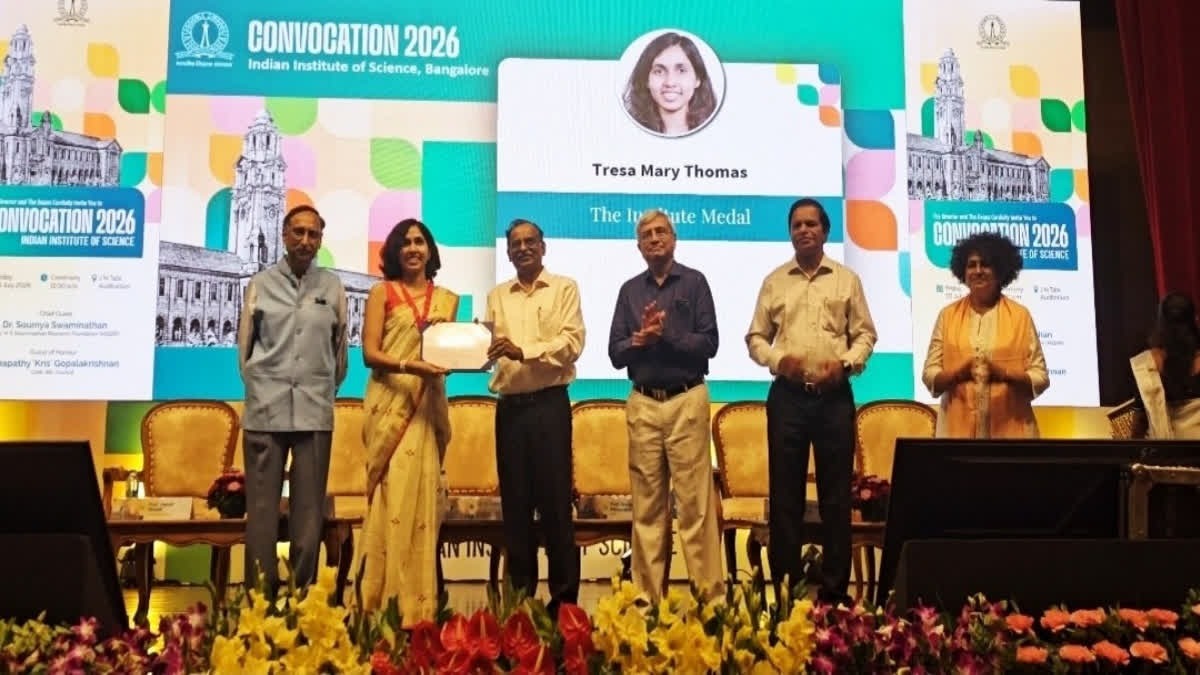
The Indian Institute of Science (IISc) celebrated its Convocation 2026 in Bengaluru, conferring degrees upon 1,570 graduates and presenting 83 medals for academic excellence. Leading scientific authorities urged the cohort of 1,452 postgraduates and 118 undergraduates to leverage their education ethically against modern threats like climate change and AI.
BENGALURU — The Indian Institute of Science (IISc) conferred degrees on 1,570 graduating students during its highly anticipated Convocation 2026 ceremony held at the JN Tata Auditorium on Friday. The benchmark event celebrated the academic culmination of the 2025–26 academic year, honoring 83 exceptional scholars with medals for outstanding academic excellence. The gathering brought together prominent leaders from India's scientific and space sectors, highlighting the vital role these newly minted researchers and engineers will play in addressing cross-border structural, environmental, and technological challenges.
A Milestone Convocation for Advanced Research
The graduation ceremony spotlighted the institute's robust focus on high-level postgraduate research and technical development. Of the 1,570 degrees awarded by the Indian Institute of Science, a dominant majority of 1,452 were presented to PhD and Master’s students, alongside 118 undergraduate research degrees.
The ceremony was presided over by Senapathy "Kris" Gopalakrishnan, Chair of the IISc Council, who stood as the Guest of Honour. Dr. Soumya Swaminathan, Chair of the M S Swaminathan Research Foundation (MSSRF) and former Chief Scientist of the World Health Organization (WHO), delivered the keynote address virtually as the Chief Guest. Additionally, Indian Space Research Organisation (ISRO) Chairman Dr. V. Narayanan addressed the graduating class, emphasizing the critical responsibilities that await the nation’s top scientific minds.
Navigating the Ethical Frontier of AI and Climate Change
During her virtual address, Dr. Soumya Swaminathan focused on the complex global landscape that the Class of 2026 is entering. She underlined the convergence of rapid developments in artificial intelligence (AI), climate change, emerging infectious diseases, and evolving energy systems.
According to Dr. Swaminathan, scientific advancements risk widening societal inequalities rather than narrowing them if they are decoupled from strong ethical judgment. She noted that the modern world requires deep wisdom and human-centric technology just as much as it requires raw data and innovative tools.
Fueling India's Developed Nation Vision
Adding to the call for national service, ISRO Chairman Dr. V. Narayanan urged the IISc graduates to contribute actively to the public good and embrace lifelong learning. He framed the opportunity to study at a premier institution like the Indian Institute of Science as a profound privilege supported by public taxpayers, teachers, and parents.
Dr. Narayanan connected the graduates' future career trajectories directly to the government's Viksit Bharat 2047 vision, which aims to transform India into a fully developed economy by the centenary of its independence. Drawing parallels to ISRO's own historical trajectory—evolving from launching early rockets with international assistance to independently executing the Chandrayaan lunar missions, the Mars Orbiter Mission, and perfecting indigenous cryogenic propulsion—he credited institutional teamwork as the ultimate driver of major milestones. He noted that India is steadily executing timelines to establish its own space station by 2035 and launch a human mission to the Moon by 2040.
Impact on Global Tech and Research Sectors
The graduation of 1,570 highly trained specialists provides a substantial injection of elite talent into global research and development (R&D) hubs, academic bodies, and corporate technology sectors. As businesses scale their AI systems and clean energy infrastructures, the influx of specialized PhD and Master's personnel from IISc helps satisfy a pressing industrial demand for deep-tech expertise. Furthermore, the focus on interdisciplinary problem-solving prepares these graduates to drive foundational breakthroughs in industries ranging from aerospace engineering to molecular biophysics.
Official Sources Section
The details and metrics presented regarding the convocation were compiled from formal press statements issued by the Indian Institute of Science (IISc) Academic Section, official event records from the JN Tata Auditorium, and official public addresses delivered by representatives of the M S Swaminathan Research Foundation and the Indian Space Research Organisation. Since its founding in 1909, IISc has produced more than 34,000 highly qualified graduates.
Quote Section
"A degree reflects what students have learned, but your conduct in the years ahead will determine whether you have earned the tradition. The world does not necessarily need more information. It needs more wisdom, technology guided by humanity, and scientists who are trusted."
— Dr. Soumya Swaminathan, Chair of the M S Swaminathan Research Foundation
"Please give back to society, contribute to society, and work towards making our country a developed nation. Today, you have a lot of opportunities to contribute to the country... I have no doubt that the country will become a developed nation before we celebrate 100 years of Independence."
— Dr. V. Narayanan, ISRO Chairman
Why It Matters
For consumers and businesses alike, the graduation of elite researchers from the Indian Institute of Science means accelerated development in critical everyday technologies. These scholars are directly responsible for piloting innovations in sustainable energy grids, public healthcare data modeling, and localized AI infrastructure. By bridging the gap between theoretical labs and consumer application, these graduates help improve national security, optimize industrial supply chains, and foster high-value technology jobs within India's growing digital economy.
Key Facts at a Glance
Total Graduates: 1,570 students successfully received degrees for the 2025–26 academic year.
Advanced Research Focus: The batch comprised 1,452 PhD and Master’s scholars alongside 118 undergraduate students.
Academic Honours: 83 students were awarded special commemorative medals for exceptional academic performance.
National Milestones: Keynotes highlighted strategic Indian timelines, including a sovereign space station by 2035 and a manned lunar mission by 2040.
FAQ Section
How many total students graduated during the IISc Convocation 2026?
A total of 1,570 students graduated during the ceremony in Bengaluru, representing both undergraduate and advanced postgraduate divisions.
Who were the main dignitaries presiding over the event?
The event featured Dr. Soumya Swaminathan (Chair of MSSRF) as the virtual Chief Guest, Senapathy "Kris" Gopalakrishnan (Chair of the IISc Council) as the Guest of Honour, and ISRO Chairman Dr. V. Narayanan as a primary speaker.
What breakdown of degrees was awarded by the institute?
Degrees were conferred upon 1,452 postgraduate scholars (encompassing PhD and Master's programs) and 118 undergraduate students.
What core thematic challenges were emphasized by the speakers?
The dignitaries focused on the intersection of artificial intelligence, climate change, energy systems, and the crucial need for scientists to practice transparency, empathy, and ethical societal contribution.
Source: Indian Institute of Science Convocation Portal, M S Swaminathan Research Foundation Official Announcements, Indian Space Research Organisation Media Desk.