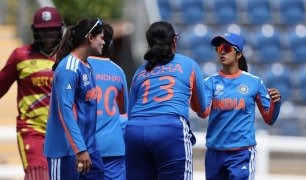
The India women’s national cricket team secured a convincing 26-run victory over the West Indies in an official T20 World Cup warm-up match at Sophia Gardens, Cardiff. Batting first, India posted a commanding total of 179/8, propelled by Bharti Fulmali’s steady 56 and rapid top-order contributions from Smriti Mandhana (39) and Shafali Verma (29), despite a strong 4/23 bowling performance from the West Indies' Afy Fletcher. In response, the West Indies were restricted to 153/8 in their 20 overs. While star all-rounder Deandra Dottin anchored the chase with a resilient 49, a disciplined Indian bowling display stifled the Caribbean side's momentum. Spinners Shreyanka Patil (4/36) and Radha Yadav (3/25) tore through the opposition lineup, ensuring a vital tactical victory for India as both squads finalize their preparations ahead of the main tournament.
CARDIFF, United Kingdom — In a critical preparatory fixture ahead of the tournament showcase, the India women’s national cricket team secured a commanding 26-run victory over the West Indies women’s cricket team. The warm-up match, held at the Sophia Gardens Cricket Ground on June 8, 2026, provided both structural management teams an essential opportunity to refine tactical combinations under competitive pressure.
Driven by an aggressive half-century from Bharti Fulmali and a balanced top-order foundation, India posted a highly competitive total of 179/8 in their allotted 20 overs. In response, a disciplined Indian bowling attack, led by Shreyanka Patil and Radha Yadav, successfully choked the West Indies chase, restricting the Caribbean side to 153/8 to wrap up an authoritative win.
Technical Breakdown: India's Batting Resilience
After the West Indies won the toss and elected to bowl first to leverage early overhead conditions, India's opening pair took an aggressive approach. Opening batter Smriti Mandhana set an authoritative tone, striking eight boundaries in a swift 39 runs off just 23 deliveries. Fellow opener Shafali Verma provided rapid momentum from the onset, clearing the inner ring with precision to contribute 29 runs off 13 balls at a strike rate of 223.08.
Following quick breakthroughs from the West Indies bowling unit, middle-order batter Bharti Fulmali anchored the secondary phase of the innings. Fulmali constructed a vital 56 runs off 40 deliveries, anchoring the middle overs with six boundaries and a towering six. Yastika Bhatia offered valuable lower-middle-order resistance with a composed 36 runs off 26 balls.
The primary breakthrough for the West Indies came via veteran spinner Afy Fletcher, who disrupted India's lower-order acceleration. Fletcher finished with exceptional figures of 4/23 across her 4-over quota. Despite her regular strikes, India utilized their deep batting lineup to finish on a demanding 179/8.
Defensive Execution: Indian Bowlers Stifle the Chase
The West Indies response ran into structural trouble early against India’s disciplined new-ball operational strategies. While star all-rounder Deandra Dottin fought valiantly with a top-scoring 49 runs off 44 balls—including eight boundaries—the rest of the batting order struggled to maintain the steep required run rate. Shemaine Campbelle contributed a steady 25 runs from 22 balls, but regular positional dismissals broke the momentum of the chase.
India's bowling response was spearhead by spinner Shreyanka Patil, whose tactical variations consistently deceived the Caribbean batters. Patil produced match-winning figures of 4/36 in her 4 overs. Left-arm orthodox spinner Radha Yadav offered impeccable secondary containment, claiming 3/25 to consistently apply pressure from the opposite end.
Renuka Singh and Shree Charani combined to restrict any late-innings acceleration, ultimately limiting the West Indies women's cricket team to 153/8 when the 20 overs concluded.
Official Sources Section
According to official match data disseminated via the International Cricket Council and verified match configurations by the Board of Control for Cricket in India (BCCI), this fixture was conducted under official ICC warm-up parameters. The structural guidelines permitted full squad participation to maximize international acclimatization before the official Group Stage matches begin.
Quote Section
"Organizers stated that the warm-up window remains absolutely paramount for international rosters to test their bench depth and adjust to structural variations in pitch telemetry across regional host venues."
Why It Matters
For cricket fans and analysts, this warm-up game acts as a definitive indicator of squad health, tactical readiness, and individual form. India’s victory demonstrates substantial depth in their secondary batting tiers and reinforces the efficiency of their specialized spin department under European playing conditions. For the West Indies, the fixture exposes specific vulnerabilities in their middle-order acceleration strategies that require technical correction prior to official tournament operations.
Key Facts at a Glance
Final Scoreline: India Women 179/8 (20 overs) defeated West Indies Women 153/8 (20 overs) by 26 runs.
Top Performers (Batting): Bharti Fulmali anchored India with 56 runs (40 balls); Deandra Dottin led the West Indies with 49 runs (44 balls).
Top Performers (Bowling): India's Shreyanka Patil claimed 4/36, while the West Indies' Afy Fletcher registered an identical 4/23.
Venue Parameters: The match was successfully completed at Sophia Gardens Cricket Ground in Cardiff, United Kingdom.
FAQ Section
1. Was this warm-up match part of the official T20 World Cup group standings?
No. Warm-up matches are sanctioned by the International Cricket Council strictly for preparatory practice and player acclimatization. Statistics and points from these games are not added to the official tournament standings or permanent international records.
2. How many players are allowed to participate in an ICC warm-up match?
Unlike a standard international fixture where playing XIs are rigid, tournament warm-up rules permit teams to utilize all members of their selected squad for batting and bowling drills, though only 11 players can take the field at any single time.
3. Who was the most economical bowler during the match?
India's Shafali Verma and Shree Charani proved highly effective in their short spells, both maintaining an economy rate of exactly 4.50 runs per over to restrict the opposition scoring opportunities.
Source: International Cricket Council Official Portal, Board of Control for Cricket in India Data Desk.