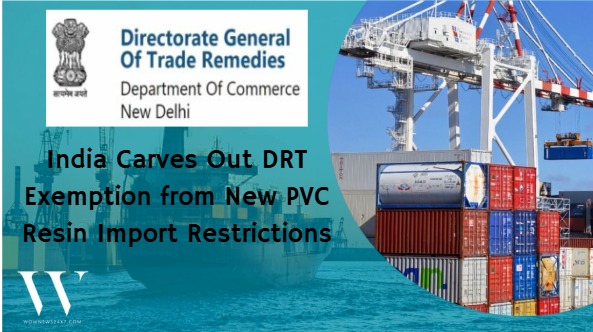
India's new import price restrictions on suspension-grade PVC resin exceeding $0.766/kg will not apply when the material is utilized for Designated Rubber Technology Standards (DRTs). The official exemption protects specialized industrial supply chains from administrative bottlenecks while maintaining broader domestic market stability.
NEW DELHI — In a critical regulatory clarification, the Government of India has officially announced that recent price-based import restrictions on suspension-grade polyvinyl chloride (PVC) resin will exempt shipments dedicated to Designated Rubber Technology Standards (DRTs). The exemption, outlined by national trade and commerce authorities, ensures that specialized industrial processing streams relying on suspension-grade PVC resin for specific compounding and technical applications are not hindered by the newly instituted $0.766 per kilogram delivered price cap. This policy update is vital today as it strikes a balance between safeguarding domestic polymer manufacturing and maintaining uninterrupted raw material access for advanced technical and rubber-blended manufacturing sectors.
Scope of the Exemption and Regulatory Clarity
The exemption addresses a vital operational nuance within India's broader chemical and polymer import framework. According to official announcements from trade administration bodies, the newly introduced pricing threshold—which restricts suspension-grade PVC resin shipments carrying a delivered price higher than $0.766/kg—contains explicit carve-outs for specialized technical applications.
The policy coordination involves oversight from the Ministry of Commerce and Industry and the Directorate General of Trade Remedies (DGTR), ensuring that industrial entities utilizing suspension-grade polymers for DRT-compliant applications can procure necessary inputs without administrative friction. By drawing this distinction, regulatory authorities have prevented unintended supply chain bottlenecks for specialized compounders who require specific grade characteristics not universally mapped to standard commodity pricing brackets.
Background and Context in Polymer Trade
India's domestic petrochemical landscape has experienced continuous regulatory adjustments, driven by surging infrastructure demand, anti-dumping investigations, and quality standardization mandates administered alongside the Bureau of Indian Standards (BIS). Suspension-grade PVC resin serves as a core raw material across multiple heavy industries, ranging from agriculture pipe manufacturing to advanced technical molding.
While broad policy measures are routinely deployed by the Ministry of Finance and allied departments to stabilize local market pricing and protect domestic producers from low-cost import surges, carving out technical exemptions like DRTs demonstrates a calibrated approach to safeguarding niche manufacturing ecosystems that depend on specialized foreign inputs.
Impact on Industrial Stakeholders and Businesses
The targeted carve-out carries distinct operational implications across various commercial sectors:
Specialized Compounders: Manufacturers utilizing suspension-grade PVC resin for DRT-compliant applications can continue procurement operations without being bound by the $0.766/kg price ceiling.
Domestic Resin Producers: Local petrochemical producers retain a protected pricing environment for general-purpose commodities while non-competing technical grades remain smoothly supplied.
Industrial Supply Chains: Downstream processors avoid costly production pauses, ensuring that technical and rubber-blended product lines maintain steady output schedules.
Importers and Compliance Desks: Procurement teams must maintain precise documentation proving that incoming high-tier shipments are strictly destined for qualifying DRT applications.
Official Sources and Regulatory Disclosures
Supervision and enforcement of trade parameters continue to be managed through official government administrative channels.
"According to official announcements from trade and revenue authorities, the import price restriction framework includes explicit provisions ensuring that suspension-grade PVC resin imports allocated for designated technical standards remain exempt from the baseline valuation cap."
All regulatory notifications and compliance updates are systematically broadcasted via official trade portals and exchange reporting frameworks.
Why It Matters
For industrial consumers, specialized manufacturers, and supply chain managers, this clarification eliminates regulatory ambiguity regarding high-specification polymer imports. By exempting shipments utilized for Designated Rubber Technology Standards (DRTs) from the six-month price restriction, the government ensures that niche manufacturing sectors are not inadvertently penalized by broad market stabilization policies, preserving technological flexibility alongside domestic market health.
Key Facts at a Glance
Target Product: Suspension-grade polyvinyl chloride (PVC) resin.
The Exemption: Restrictions on import prices exceeding $0.766/kg do not apply when used for Designated Rubber Technology Standards (DRTs).
Primary Objective: To balance domestic market price stabilization with uninterrupted access for specialized technical manufacturing.
Regulatory Oversight: Supervised through coordinated trade and commerce frameworks.
Frequently Asked Questions (FAQ)
Are all suspension-grade PVC resin imports subject to the new price restriction?
No, imports are restricted if their delivered price exceeds $0.766/kg, but an explicit exemption applies when the material is used for Designated Rubber Technology Standards (DRTs).
What is the purpose of the DRT exemption?
The exemption ensures that specialized industrial compounders and technical manufacturers relying on specific resin grades are not disrupted by broad commodity pricing caps.
Who oversees these polymer trade regulations?
Policy updates and import controls are administered through national trade bodies, including the Ministry of Commerce and Industry and allied regulatory departments.
What must importers do to qualify for the exemption?
Importers must maintain transparent documentation verifying that the incoming suspension-grade PVC resin shipments are strictly allocated for qualifying technical applications.
Source: Ministry of Commerce and Industry, Directorate General of Trade Remedies (DGTR), and Ministry of Finance.