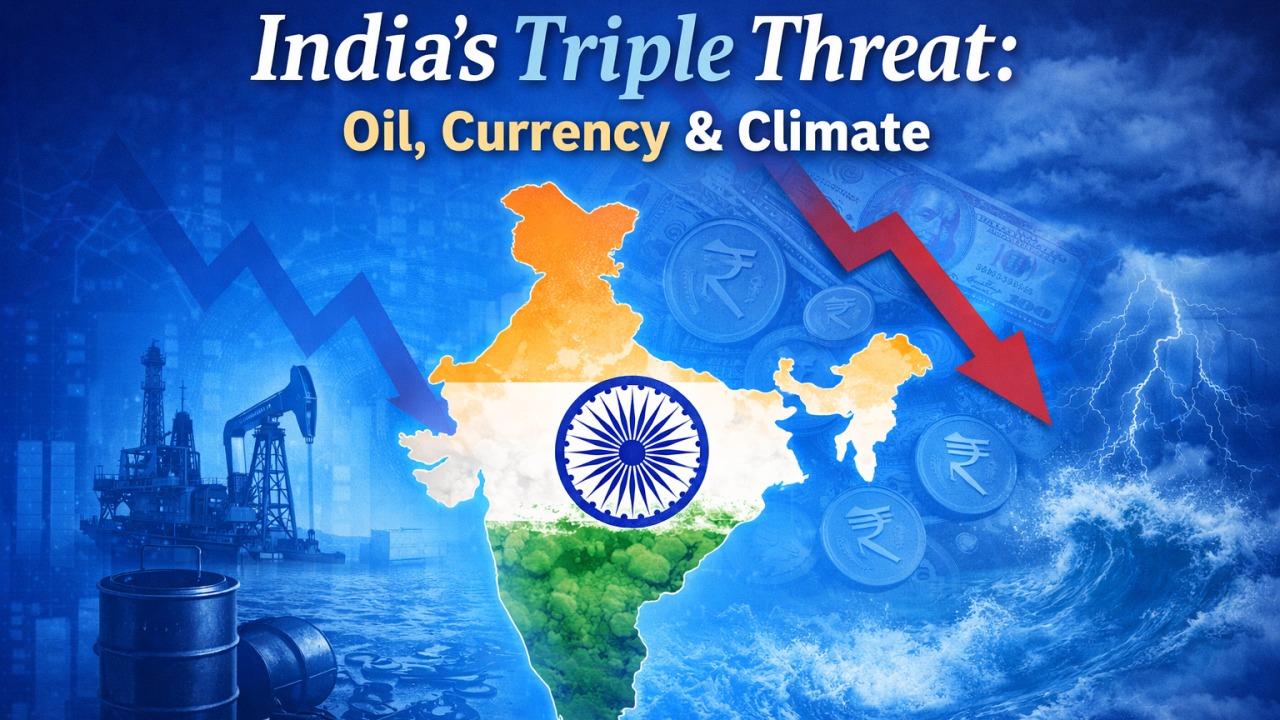
India's Finance Minister has flagged a triple challenge of volatile crude oil prices, foreign exchange uncertainties, and domestic rain shortfalls threatening the external economic outlook. While domestic fundamentals remain resilient, the government is leveraging fuel tax cuts and a ₹1 lakh crore stabilization fund to protect consumers.
MUMBAI — Union Minister for Finance and Corporate Affairs Nirmala Sitharaman has outlined a complex macroeconomic landscape for the country, warning that the domestic economy is navigating a critical triple challenge driven by highly volatile foreign exchange rates, fluctuating international crude oil prices, and an emerging shortfall of rains this year. Speaking at a high-level economic forum in Mumbai, the Finance Minister emphasized that while India's domestic economic fundamentals remain fundamentally resilient, a convergence of external geopolitical disruptions and domestic weather patterns requires highly calibrated policy responses.
The minister’s assessment underscores the government's current economic focus on protecting household budgets and stabilizing corporate input supply chains. With the global energy landscape experiencing sharp pricing shifts over the last 90 days, the administration is closely monitoring the combined impact of import bills and changing agricultural outposts on the nation's broader growth trajectory.
Global Volatility Shakes Foreign Exchange and the '3F' Crisis
The Finance Minister broken down what she termed the "Three Fs" crisis presently exerting pressure on India's external accounts: Fuel, Fertilizer, and Foreign Exchange. The ongoing West Asia crisis has moved beyond a localized geopolitical friction point to become a structural disruption for global trade, driving up international freight shipping costs, insurance premiums, and transit delays through major maritime corridors.
According to central bank data, international crude oil prices have been highly dynamic, fluctuating rapidly week-over-week. Because India relies on imports to fulfill nearly 90% of its domestic petroleum requirements, these erratic crude oil movements create an immediate, rolling expansion in the national import bill.
Concurrently, an "unimaginable increase" in global fertilizer and gold prices has intensified the demand for US Dollars, as these multi-billion-dollar trade transactions must be settled exclusively in foreign exchange with zero rupee-denominated trade flexibility.
Rain Shortfall Puts Pressure on Agricultural Output and El Niño Trajectories
Compounding these external headwind factors is an domestic supply-side risk: a visible shortfall of rains during the ongoing monsoon cycle. Agricultural economists tracking the seasonal data point out that a below-normal monsoon—partially aggravated by a severe El Niño weather pattern—is beginning to strain crop sowing metrics across major agricultural states.
| Economic Variable | Operational Status / Performance Impact | Policy Mitigation Strategy |
| Crude Oil Prices | High volatility across 90-day trading cycles | Strategic reserve management and local fuel tax adjustments |
| Foreign Exchange | Depreciating Rupee pressure from dollar-denominated trade imports | RBI market intervention and export custom duty adjustments |
| Monsoon Rainfall | Deficit accumulation risking lower agricultural yield rates | Price stabilization buffer deployment and irrigation aid |
A structural dip in rural output directly risks triggering a spike in domestic food inflation items, which could complicate the monetary policy easing cycle planned by the country's central bank. To cushion consumers, the central government has already implemented a severe ₹10 per liter reduction in state excise duties on petrol and diesel, insulating citizens from global spikes despite a direct revenue impact exceeding ₹1 lakh crore.
Official Sources Section
The economic data, monetary policy variables, and fiscal performance indicators referenced in this report are compiled from formal ministerial addresses distributed by the Ministry of Finance, Government of India. Operational liquidity levels, trade variables, and balance-of-payments data are cited in strict accordance with the statistical frameworks published by the Reserve Bank of India (RBI), alongside corporate briefings held at the Small Industries Development Bank of India (SIDBI) anniversary celebrations.
Quote Section
"According to officials clarifying the macro-economic interventions, the deployment of a ₹1 lakh crore Economic Stabilization Fund in the national budget serves as an intentional financial shock-absorber designed to insulate MSMEs and domestic consumers from cascading external energy crunches."
Why It Matters
The confluence of volatile crude oil, currency depreciation, and rain shortfalls impacts every layer of the Indian economy. For regular consumers, these variables govern everyday fuel costs, food price stability, and local lending interest rates. For corporate enterprises and small manufacturers, managing highly unpredictable raw material input costs while facing foreign exchange fluctuations complicates working capital planning, making risk mitigation and flexible financing essential tools to sustain growth.
Key Facts at a Glance
The 3F Framework: India's external economy is actively navigating a combined challenge involving fuel, fertilizer, and foreign exchange reserves.
Crude Pressure: Continued volatility in international oil benchmarks directly expands the national import bill, as India imports nearly 90% of its petroleum.
Currency Constraints: Strategic trade items like gold and fertilizers require exclusive dollar settlements, putting a premium on foreign exchange conservation.
Monsoon Risks: An emerging rain shortfall linked to El Niño shifts threatens domestic crop yields, elevating food inflation risks.
FAQ Section
1. Why does India face foreign exchange stress when domestic fundamentals are strong?
India's foreign exchange stress is primarily externally driven. Because foundational imports like crude oil, specialized fertilizers, and gold must be purchased using global currencies (like the US Dollar) rather than local rupees, any sharp increase in global prices automatically accelerates foreign exchange outflows.
2. How does a shortfall of rains impact the wider industrial economy?
A shortfall of rains directly lowers agricultural production and rural household incomes. This contraction dampens consumer spending across secondary sectors, such as automobiles, tractors, and fast-moving consumer goods (FMCG), while increasing headline food inflation pressures.
3. What steps has the government taken to shield small businesses from energy shocks?
The government implemented custom duty exemptions on critical petrochemical inputs through June 2026, lowered retail fuel excise costs by ₹10 per liter, and utilized a specialized ₹1 lakh crore Economic Stabilization Fund to absorb supply chain crunches.
Source: Ministry of Finance, Reserve Bank of India (RBI), Small Industries Development Bank of India (SIDBI) Records