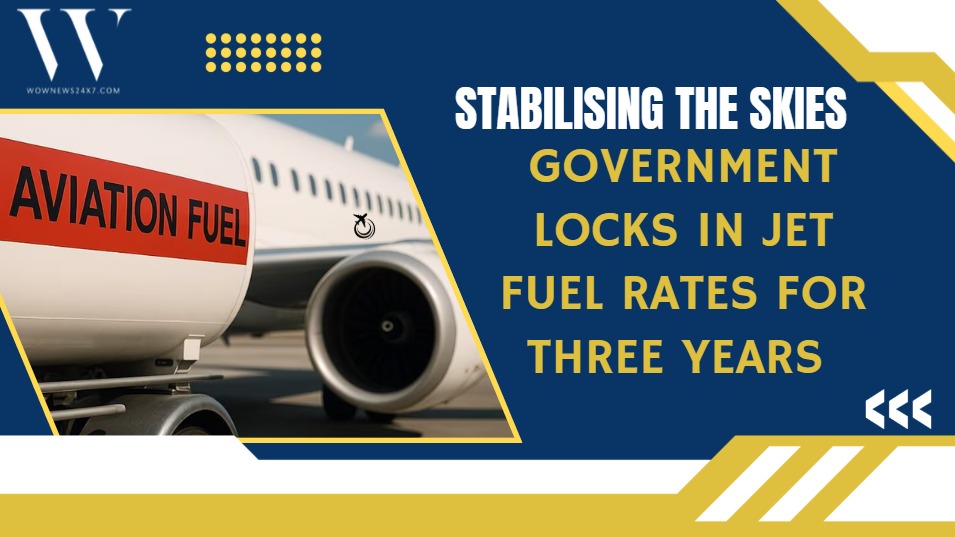
The Indian government has launched a ₹10,000 crore aviation fuel stabilisation fund to protect airlines from global price shocks. Participating carriers can now lock in jet fuel at ₹115 per litre, significantly reducing operational costs and shielding passengers from sudden airfare hikes caused by the ongoing West Asia crisis.
The Government of India has officially launched a ₹10,000 crore Price Stabilisation Fund to shield the domestic aviation sector from the extreme volatility in global Aviation Turbine Fuel (ATF) prices. The scheme, which began rolling out this week, offers Indian airlines a fixed fuel rate of ₹115 per litre for the next three years, insulating participating carriers from the sharp fluctuations currently roiling international oil markets.
The initiative follows a period of unprecedented cost pressure for the aviation industry, where international ATF prices surged nearly 2.5 times—rising from ₹60.50 per litre in March 2026 to approximately ₹142 per litre by May 2026. With fuel costs ballooning to nearly 60% of total operating expenditure, the government’s intervention aims to prevent route cancellations and curb the pass-through of fuel shocks to passengers in the form of higher airfares.
How the Stabilisation Scheme Functions
The scheme is a voluntary, three-year arrangement managed through a tripartite agreement between participating Indian airlines, Oil Marketing Companies (OMCs), and the central government.
Fixed Pricing: Participating airlines can lock in their ATF procurement at ₹115 per litre, significantly lower than the current market-linked price of roughly ₹142 per litre.
Interest-Free Advances: To compensate OMCs for the difference between the fixed price and the volatile Import Parity Price (IPP), the government is providing an interest-free advance of up to ₹10,000 crore from the Consolidated Fund of India.
True-Up Mechanism: When international fuel prices moderate, the differential will be recovered from OMCs and returned to the government, ensuring the fund acts as a revolving buffer rather than a permanent subsidy.
Exclusive Sourcing: Airlines opting for the fixed rate must source their fuel exclusively from OMCs for the duration of their participation in the scheme.
Addressing Regional and Global Challenges
The aviation sector's financial distress has been exacerbated by the broader West Asia crisis, which has not only driven up crude oil prices but also led to operational hurdles, including the closure of specific airspaces that force Indian carriers to take longer, more fuel-intensive routes to Europe and North America.
"According to officials," the stabilisation mechanism is designed to provide greater predictability in financial planning for carriers. By capping the fuel price, the government aims to sustain air connectivity to remote, Tier-II, and Tier-III cities, protecting the viability of regional routes previously expanded under the UDAN (Ude Desh ka Aam Nagrik) scheme.
Monitoring and Oversight
To ensure transparency and fiscal discipline, a high-level Monitoring Committee—comprising representatives from the Ministry of Civil Aviation, the Ministry of Petroleum and Natural Gas, and the Department of Expenditure—has been established. This committee will oversee claim verification, reconciliation, and audits to ensure that the interest-free advances are settled effectively.
Why It Matters
For travelers, the scheme is expected to moderate airfare volatility, providing a more stable pricing environment during a period of geopolitical uncertainty. For the industry, it offers a lifeline to airlines struggling to balance operational costs without resorting to drastic capacity reductions. By stabilizing the primary cost component for airlines, the government hopes to protect employment across the aviation, tourism, and hospitality sectors.
Key Facts at a Glance
Fund Corpus: ₹10,000 crore in interest-free budgetary support.
Fixed Fuel Price: ₹115 per litre for participating airlines.
Market Price Comparison: Standard market-linked rates currently hover around ₹142 per litre.
Scheme Duration: Up to 36 months, subject to annual reviews or full fund recovery.
Eligibility: All scheduled Indian airlines for both domestic and international operations.
FAQ Section
1. Is the fuel stabilisation scheme mandatory for all airlines?
No, the scheme is entirely voluntary. Airlines must decide whether to opt into the fixed-price regime or continue with market-linked pricing.
2. What happens if global oil prices drop significantly?
The scheme includes a "true-up" mechanism. If international prices fall below the benchmark, the differential is recovered from OMCs to replenish the fund, ensuring it remains self-sustaining.
3. Will this move reduce ticket prices immediately?
The scheme is intended to moderate price spikes and provide fare stability. While it prevents further sharp hikes, actual ticket prices will continue to be influenced by demand, seasonal trends, and competitive dynamics.
4. How does the scheme handle international operations?
The scheme covers both domestic and international operations of Indian carriers, allowing them to hedge their fuel costs regardless of the flight destination.
Source: Press Information Bureau (PIB), Ministry of Civil Aviation, Ministry of Petroleum & Natural Gas