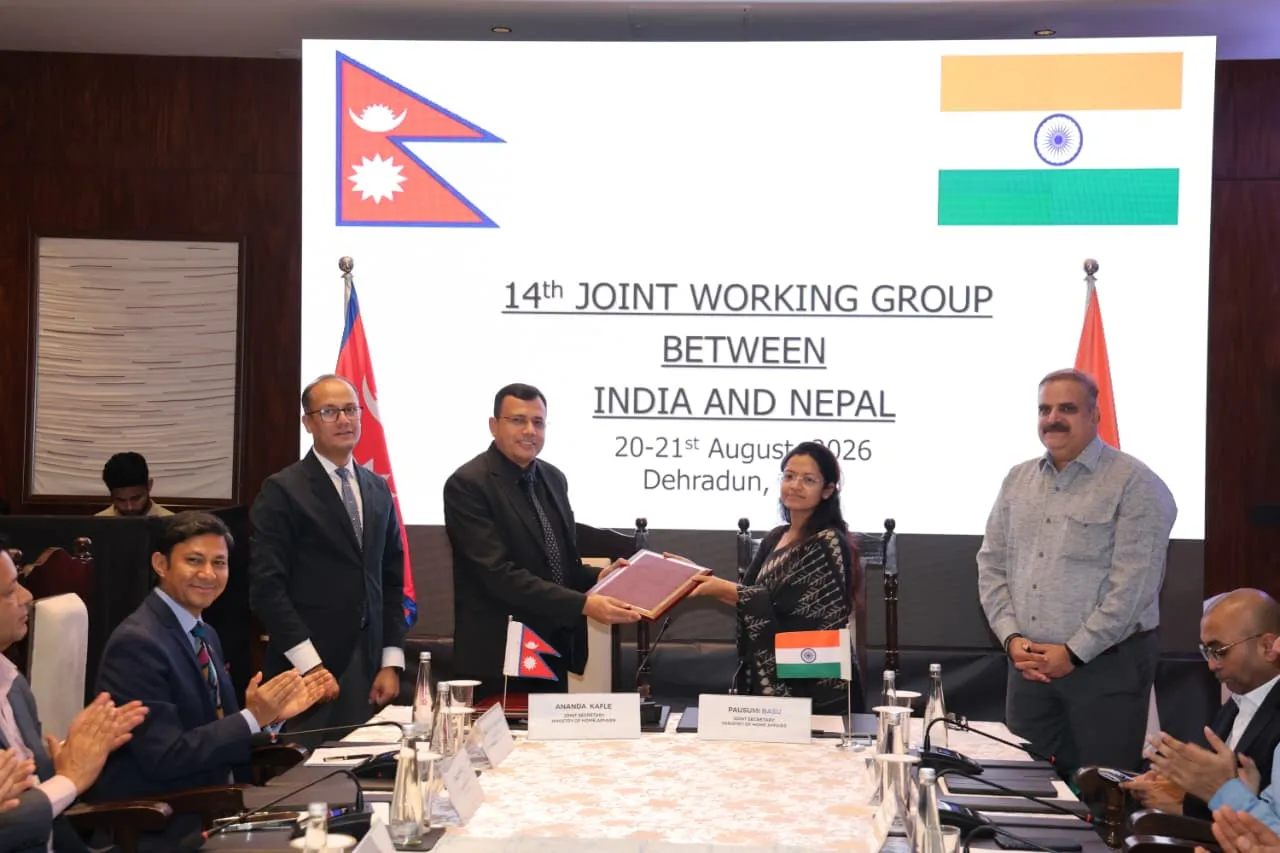
The 14th India-Nepal Joint Working Group meeting in Dehradun concluded with both nations agreeing to strengthen border management and security. Delegations led by Indian and Nepalese Home Ministry officials prioritized tackling trans-border crime, upgrading Integrated Check Posts, clearing frontier encroachments, and repairing boundary pillars to enhance connectivity and stability.
DEHRADUN — India and Nepal have reaffirmed their commitment to deepen bilateral security and streamline cross-border movement following the conclusion of the 14th meeting of the India-Nepal Joint Working Group (JWG) on Border Management and Security, held in Dehradun on August 20–21, 2026. Led by senior home ministry officials from New Delhi and Kathmandu, the bilateral delegation reviewed the entire spectrum of frontier cooperation, establishing priority measures to dismantle trans-border criminal networks, optimize Integrated Check Posts (ICPs), remove unauthorized border encroachments, and maintain boundary pillars. The talks come amid growing regional efforts to modernize transit connectivity and strengthen digital financial corridors between the two neighboring economies.
Enhancing Border Infrastructure and Transit Efficiency
A central focus of the two-day high-level deliberations was the modern operationalization of shared physical infrastructure. Delegations from both countries evaluated the utilization rates of key Integrated Check Posts (ICPs), cross-border roads, and connecting railway networks designed to facilitate lawful commerce and passenger transit while deterring illicit trade.
Officials noted that the rapid expansion of transport corridors requires continuous administrative coordination to prevent transit bottlenecks. The two sides discussed protocols to enhance cargo handling capabilities, simplify customs screening through integrated technologies, and ensure seamless movement across active transit routes connecting Uttar Pradesh, Bihar, West Bengal, and Uttarakhand with southern Nepal.
Security Coordination, Encroachment Removal, and Pillar Upkeep
Addressing security challenges along the open 1,751-kilometer international boundary formed another primary agenda item. Both delegations agreed to step up coordinated intelligence sharing and joint ground patrolling to prevent:
Trans-Border Crime and Smuggling: Curbing the illicit flow of narcotics, contraband, counterfeit currency, and unauthorized wildlife products.
Encroachment Clearance: Executing systematic joint inspections to identify and clear unauthorized civil encroachments in the "No Man's Land" buffer areas along the frontier.
Boundary Pillar Maintenance: Expediting the physical restoration, repair, and GPS-tagging of damaged or missing boundary markers.
Institutional Capacity Building: Expanding joint training programs, technical exchanges, and sector-specific operational coordination among border guarding forces, including India's Sashastra Seema Bal (SSB) and the Armed Police Force (APF) of Nepal.
Bilateral Leadership and Follow-up Roadmap
The Indian delegation was led by Pausumi Basu, Joint Secretary (Border Management-I) in the Ministry of Home Affairs, while the Nepalese delegation was headed by Ananda Kafle, Joint Secretary in the Ministry of Home Affairs, Government of Nepal.
Both sides confirmed that regular technical-level interactions will continue over the coming months to review ground-level implementation, agreeing that the 15th meeting of the India-Nepal Joint Working Group will be hosted in Nepal on a mutually convenient date.
Official Sources Section
The operational updates, delegation details, and joint agreements detailed in this report are based on official communiqués and statements released by the Ministry of Home Affairs of India, official diplomatic briefings from the Ministry of External Affairs of India, and releases disseminated via the Press Information Bureau.
Quote Section
"Discussions covered addressing trans-border crime and criminal activities; the strengthening and effective utilisation of border infrastructure, particularly Integrated Check Posts, roads, and railway networks; and the removal of encroachments and maintenance of boundary pillars," according to official statements issued by the Ministry of Home Affairs.
Why It Matters
Trade Facilitation: Optimizing Integrated Check Posts reduces logistics transit times, lowering supply chain costs for cross-border commercial freight.
Border Security: Stronger ground-level coordination mitigates human trafficking, narcotics smuggling, and illicit financial flows across open frontier sectors.
Boundary Clarity: Joint maintenance of boundary pillars and removal of buffer encroachments prevents localized administrative friction between border communities.
Key Facts at a Glance
Event & Location: 14th Meeting of the India-Nepal Joint Working Group on Border Management and Security, held in Dehradun, Uttarakhand.
Delegation Leaders: Pausumi Basu (Joint Secretary, MHA India) and Ananda Kafle (Joint Secretary, MHA Nepal).
Core Priorities: Tackling trans-border crime, upgrading ICP infrastructure, clearing buffer-zone encroachments, and repairing boundary pillars.
Next Step: Agreed to convene the 15th JWG meeting in Nepal on a mutually agreed date.
Frequently Asked Questions
What is the India-Nepal Joint Working Group on Border Management?
The Joint Working Group (JWG) is an institutional bilateral mechanism between India and Nepal that regularly meets to address frontier security, border infrastructure, cross-border crime, and administrative coordination.
Where and when was the 14th India-Nepal JWG meeting held?
The 14th meeting took place on August 20–21, 2026, in Dehradun, Uttarakhand.
What were the key outcomes of the Dehradun talks?
Both nations agreed to boost operational coordination at Integrated Check Posts, remove buffer encroachments, maintain boundary pillars, enhance joint capacity building, and host the next meeting in Nepal.
Source: Ministry of Home Affairs, Ministry of External Affairs, Press Information Bureau.