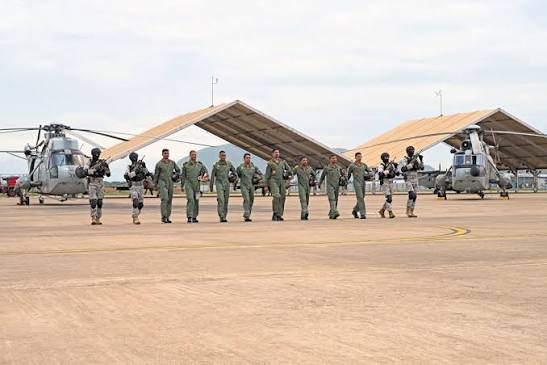
The Indian Navy has officially retired its fleet of Sea King Bravo multi-role helicopters after 36 years of maritime service. The legendary "flying frigates" completed their final flight at INS Shikra in Mumbai on June 14, 2026, passing anti-submarine duties to the newly acquired MH-60R Seahawk fleet.
MUMBAI — Marking the definitive conclusion of a storied multi-decade chapter in South Asian naval aviation, the Indian Navy formally retired its iconic Sea King Bravo helicopter fleet on Sunday, June 14, 2026. The final operational aircraft executed a ceremonial final flight from INS Shikra, the premier Western Naval Command base situated in Colaba, Mumbai. The high-profile de-induction signals a critical transition phase for India’s maritime defense forces, drawing a curtain on 36 years of frontline anti-submarine and anti-ship operations while paving the way for next-generation aviation platforms.
The Sunset of the Flying Frigates
The Sea King Mk 42B Bravo fleet was initially procured from British manufacturer GKN Westland between 1989 and 1990 to provide advanced airborne sub-surface hunting capabilities. At its operational peak, the Indian Navy maintained a robust fleet of approximately 20 of these versatile airframes, which pilots and defense analysts widely designated as "flying frigates." This elite moniker stemmed directly from the aircraft's rare structural capacity to simultaneously execute dual high-stakes roles: tracking hostile submarines via advanced dunking sonar and delivering heavy anti-ship ordnance over deep waters.
The final ceremonial sortie over Mumbai saw the last operational Sea King Bravo take to the skies, escorted by a pair of Sea King Charlie utility helicopters. Upon touching down for the last time at the INS Shikra tarmac, the historic aircraft received a formal water cannon salute from naval fire tenders. Prior to this de-induction, the Indian Navy had already phased out its legacy Sea King Mark 42 and 42 Alpha variants, making the Bravo retirement the definitive conclusion for the British-origin combat sub-series.
Decades of Strategic Maritime Deployment
Throughout their 36 years of uninterrupted service, the Sea King Bravo helicopters served as the tactical eyes and ears of India's surface fleet. The aircraft operated extensively across a shifting array of naval architecture, embarking from the decks of iconic aircraft carriers like the now-decommissioned INS Viraat, alongside Leander-class, Godavari-class, and Delhi-class guided-missile destroyers.
Equipped with sophisticated Super Searcher radar systems, HS-12 deep-dunking sonar arrays, acoustic processors, and lethal combat payloads—including Italian A244S torpedoes, depth charges, and British Sea Eagle anti-ship missiles—the Bravos regularly patrolled critical blue-water choke points across the Indian Ocean Region. Beyond their primary combat configurations, the aircraft functioned as reliable utility platforms for emergency search and rescue (SAR) missions during severe cyclonic disruptions and maritime accidents.
Transition to the Advanced MH-60R Seahawk
According to retired defense officials, roughly eight Sea King Bravo airframes remained functional in the twilight leading up to the decommissioning ceremony. Moving forward, the Indian Navy will utilize a "reduce to produce" technical framework for the retired Bravo assets. Under this system, three of the decommissioned airframes will be retained as fixed ground testbeds at INAS 336 for domestic developmental trials, while the remainder will provide spare parts to support the six original, airworthy Sea King Mk 42C commando utility helicopters that remain active with the Marine Commando Flight.
The operational responsibilities long held by the Bravos are transitioning directly to the newly inducted Sikorsky MH-60R Seahawk multi-role helicopters. Acquired via a $2.6 billion government-to-government agreement with the United States, these highly sophisticated "Romeo" platforms feature cutting-edge digital avionics, advanced multi-mode radars, and integrated hellfire missiles, filling the capability gap left by the legacy fleet.
Official Sources Section
The logistical timelines, historical figures, and squadron frameworks detailed in this report are compiled from verified public releases issued by the following defense organizations:
The Ministry of Defence (India): Official operational directives and regional naval aviation transition briefs.
The Indian Navy / Western Naval Command: Press updates and formal media invitations regarding the INS Shikra decommissioning ceremony.
Indian Naval Air Squadron (INAS) 330: Logistical flight logs and archival squadron registries.
Official Quotes and Reflections
"When it was introduced, the Sea King Bravo was an incredibly advanced helicopter as far as its core avionics and multi-role mission profiles were concerned. The Sea King Bravo has been a vital part of my journey in the Indian Navy and the world of aviation. Today, I share tears of both joy and sorrow—joy because I was part of this wonderful family, and sorrow because I will never again see this wonderful machine flying in Indian Naval colors."
— Captain (Retd.) Sanjay Karve, Veteran Aviator who piloted the Sea King Bravo until 2004
Why It Matters
The retirement of the Sea King Bravo fleet marks an essential shift toward modern, cross-compatible hardware for India's maritime defense sector. While the Bravos provided exceptional service for 36 years, maintaining mechanical parts and sourcing vintage components for the aging British platforms had become a severe fiscal and logistical challenge for naval engineers. Transitioning entirely to modern platforms like the American-built MH-60R Seahawk guarantees total technical interoperability with partner navies and significantly enhances India's anti-submarine deterrence profile across the volatile Indian Ocean trade corridors.
Key Facts at a Glance
Service Lifespan Concluded: The Indian Navy has retired its Sea King Bravo helicopter fleet after 36 years of active operational service.
Final Sortie Location: The ceremonial final flight and subsequent water cannon salute took place at INS Shikra in Colaba, Mumbai.
Combat Legacy: Known as "flying frigates," the Mk 42B aircraft were specialized in both anti-submarine and anti-ship warfare.
Future Utility Strategy: The retired airframes will face a "reduce to produce" protocol to harvest parts for active Sea King 42C commando utility choppers.
Modern Replacement: The fleet's frontline mission profile is being fully assumed by the newly inducted U.S.-made Sikorsky MH-60R Seahawk.
Frequently Asked Questions (FAQ)
Why were the Sea King Bravo helicopters called "flying frigates"?
The fleet earned the title because they possessed a rare combination of heavy sensors and offensive weaponry. Unlike standard naval helicopters, a single Sea King Bravo could independently locate and destroy enemy submarines while carrying heavy anti-ship missiles, mimicking the capabilities of a surface warship.
What will happen to the physical helicopters now that they are retired?
Under naval protocol, three of the remaining Sea King Bravo airframes will serve as stationary testbeds for domestic aviation trials. The remaining aircraft will be carefully stripped for high-grade components to keep India's separate fleet of Sea King 42C commando utility helicopters operational.
Which aircraft is taking over the Sea King Bravo's mission?
The multi-mission roles are being assumed by the newly inducted Sikorsky MH-60R Seahawk helicopters, which India purchased from the United States to modernize its fleet.
Source: Official decommissioning logs and statements from the Indian Navy and the Press Information Bureau under the Ministry of Defence.