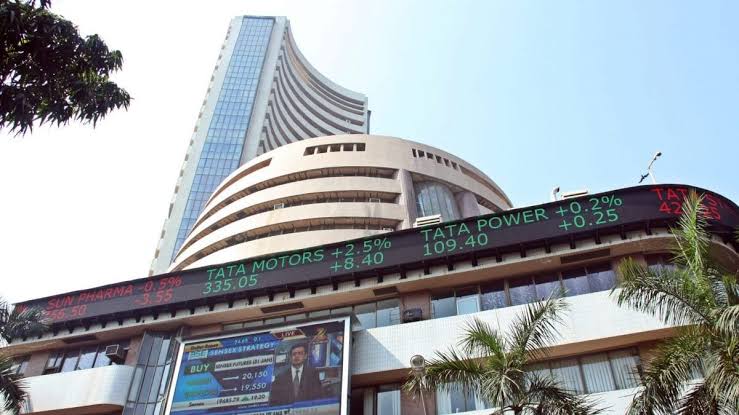
India’s benchmark equity indices closed virtually unchanged on Friday as the BSE Sensex erased a 0.02% loss and the NSE Nifty 50 rose 0.08%. The Indian rupee held steady at 95.70 per U.S. dollar at 3:30 p.m. IST, reflecting broad stability and low volatility across financial markets.
MUMBAI — India’s benchmark equity indices ended little changed on Friday, with the BSE Sensex recovering from minor intraday declines and the NSE Nifty 50 inching slightly higher by market close. The cautious close on the Bombay Stock Exchange (BSE) and the National Stock Exchange (NSE) reflected broader consolidation across domestic sectors as institutional and retail investors weighed ongoing macroeconomic indicators, corporate performance trends, and global interest rate trajectories.
Benchmarks Hold Steady in Range-Bound Session
The 30-share BSE Sensex settled virtually flat after erasing an intraday deficit of 0.02%, recovering composure in late-session trading. Concurrently, the broader 50-share NSE Nifty 50 index closed 0.08% higher, adding to an intraday uptick of 0.01% recorded during mid-day trade.
Trading throughout the session remained confined to tight bands across major sectoral sub-indices. Banking, information technology, and fast-moving consumer goods (FMCG) counters witnessed mixed flows, preventing any decisive breakout in either direction. According to market data from both major exchanges, trading volumes remained in line with daily weekly averages as market participants opted for selective stock picking rather than aggressive broad-based positions.
Indian Rupee Remains Flat Against U.S. Dollar
In the foreign exchange market, the Indian rupee (INR) traded virtually unchanged against the U.S. dollar, reflecting steady balance-of-payments flows and stable central bank liquidity management.
The domestic unit stood at 95.70 per U.S. dollar as of 3:30 p.m. IST, compared with its previous close of 95.7050. Currency dealers attributed the stability to balanced dollar demand from domestic importers against regular foreign portfolio inflows and intervention checks from monetary authorities. Foreign institutional investors (FIIs) and domestic institutional investors (DIIs) showed calibrated activity, providing steady support to current account settlement dynamics.
Broader Market Impact and Investor Sentiment
The flat finish across Indian stock market gauges indicates a period of price discovery and institutional repositioning. For retail investors and domestic portfolio holders, sideways trading suggests low short-term volatility, lowering downside risks while capping immediate capital appreciation.
For corporate borrowers and multinational companies operating in India, the currency’s steady performance at 95.70 per dollar limits foreign exchange volatility risks, offering predictability for import payments, overseas debt servicing, and supply chain procurement.
Official Sources and Regulatory Disclosures
According to official daily trading disclosures published by the BSE, the NSE, and foreign exchange operational desks monitored by financial regulators:
BSE Limited: Data confirmed that the Sensex recovered intraday losses of 0.02% to settle virtually flat by the close of the trading session.
National Stock Exchange of India (NSE): Regulatory trading statistics showed the Nifty 50 recorded an advance of 0.08%, supported by modest late-session buying in select heavyweights.
Foreign Exchange Clearing Operations: Official settlement reports logged the USD/INR reference parity holding steady at 95.70 as of 3:30 p.m. IST, against the earlier reference point of 95.7050.
Market Commentary
"According to market analysts and exchange trading desks, the muted movement across Indian stock market benchmarks reflects prudent positioning ahead of global economic releases. Investors chose to consolidate portfolios amid steady foreign exchange fundamentals and balanced liquidity conditions across domestic banking channels."
Why It Matters
Portfolio Stability: A stable close protects investor portfolios from sharp intraday swings, encouraging steady capital allocation into systematic investment plans (SIPs) and long-term equities.
Import and Export Certainty: A stable currency ensures that energy importers and industrial manufacturers experience minimal fluctuations in landing costs for raw materials.
Capital Flow Continuity: Balanced market movements keep foreign institutional participation orderly without triggering sudden risk-off capital flights.
Key Facts at a Glance
BSE Sensex: Erased intraday losses of 0.02% to close little changed.
NSE Nifty 50: Gained 0.08%, building slightly upon an intraday rise of 0.01%.
Indian Rupee (USD/INR): Settled nearly flat at 95.70 per U.S. dollar at 3:30 p.m. IST versus 95.7050 at the prior close.
Market Dynamics: Range-bound sector movement with balanced institutional buying and selling.
Frequently Asked Questions
What caused the BSE Sensex and Nifty 50 to close flat today?
The Indian stock market moved in a narrow range due to balanced institutional buying and selling, steady foreign exchange rates, and an absence of major domestic triggers, leading traders to consolidate existing holdings.
How did the Indian rupee perform against the U.S. dollar?
The Indian rupee traded nearly flat, closing at 95.70 per U.S. dollar at 3:30 p.m. IST compared to its previous close of 95.7050, demonstrating resilience and steady foreign exchange liquidity.
What does this market consolidation mean for retail investors?
A sideways market indicates reduced volatility, allowing long-term investors and SIP contributors to accumulate quality assets without navigating sharp intraday price dislocations.
Source: Official market closing disclosures from BSE Limited, National Stock Exchange of India (NSE), and interbank foreign exchange market data feeds.