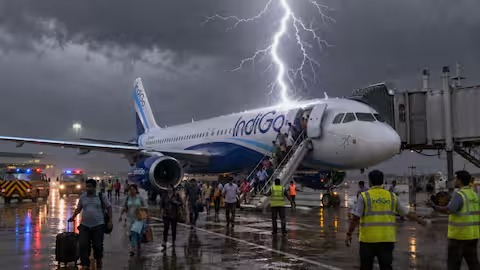
An IndiGo Airbus A320 Neo bound for Agartala was grounded at Kolkata Airport on Friday after being struck by lightning during a severe thunderstorm. While all 141 passengers were unhurt and re-routed, three ground staff members received medical care for temporary acoustic shock before being safely discharged.
KOLKATA — A commercial aviation incident unfolded on Friday morning, June 19, 2026, when an IndiGo flight to Agartala hit by lightning at Kolkata Airport during an intense monsoon thunderstorm. The aircraft, an Airbus A320 Neo operating as Flight 6E-6068, was stationary at aerobridge Stand 56L at Netaji Subhas Chandra Bose International Airport (NSCBI) when the sudden strike occurred at approximately 9:30 a.m. While all 141 passengers and six crew members inside the cabin escaped completely unharmed, the physical shockwave and accompanying ground electrical currents temporarily affected three tarmac workers. This development has triggered a mandatory civil aviation inspection, illustrating the volatile risks that severe weather poses to ongoing domestic airport operations.
Detailed Chronology of the Aerobridge Ground Strike
According to formal briefings from the Airports Authority of India (AAI) and regional operations personnel, the Agartala-bound flight had completed its passenger boarding sequence and secured its main cabin doors just moments before the incident. The sudden severe thunderstorm system, which brought sudden downpours to the Dum Dum area, generated a powerful lightning flash that directly grounded itself through the airframe.
The electrical discharge caused an immediate, temporary power outage within the cabin systems and generated a deafening thunderclap that startled both passengers and flight crew. Simultaneously, the Airport Operations Control Centre (AOCC), which had already active weather alerts in place for the region, initiated safety responses to coordinate ground team management and assess structural damage.
Technical Impact and Precautionary Aircraft Grounding
Aviation authorities confirmed that the aircraft involved, registered under fuselage marker VT-IPW, was immediately withdrawn from active service. In strict compliance with standard operating protocols enforced by the Directorate General of Civil Aviation (DGCA), the plane must remain grounded pending a comprehensive structural and technical inspection.
Engineers are tasked with scanning the metallic exterior and carbon-composite components of the Airbus A320 Neo to rule out scorch marks, localized fuselage melting, or deep-set damage to sensitive communication, navigation, and avionic networks. Airport officials noted that while modern commercial aircraft are safely engineered to act as a Faraday cage—allowing electrical currents to flow across the outer skin and dissipate harmlessly into the ground—the extreme nature of the strike required immediate deboarding of the passengers to maintain absolute safety standards.
Condition of Ground Personnel and Passenger Mitigation
The exterior impact of the severe weather strike was most pronounced on the active tarmac. Three ground personnel—consisting of two loaders employed by IndiGo and one ground-handling specialist from AI Airport Services Limited (AISEL)—were working near the apron area when the bolt struck the nearby structure. The massive electrical surge traveling through the ground surface subjected the workers to severe acoustic shock and minor ground current exposure.
The three affected ground workers were immediately transported to a local medical facility after reporting temporary hearing loss and acute physiological shock. Hospital administrators later confirmed that all three individuals responded well to treatment, their auditory functions stabilized, and they were subsequently discharged in normal condition. Meanwhile, the 141 passengers were safely guided back to the terminal building, where corporate representatives arranged for a replacement aircraft, an Airbus A321 (registration VT-ICD), which successfully departed for Agartala at 12:50 p.m.
Disruptions to Regional Air Travel and Commuters
The atmospheric disturbance that led to the event where the IndiGo flight to Agartala hit by lightning at Kolkata Airport caused cascading logistical issues across the metropolitan region. The India Meteorological Department (IMD) station at Dum Dum recorded an acute 88 mm of rainfall over a condensed period on Friday morning.
This led to severe waterlogging on critical arterial routes, most notably along VIP Road near the Haldiram crossing, heavily delaying travelers trying to reach the departure terminals. Major domestic airlines operating out of West Bengal were forced to issue urgent travel advisories, warning consumers of delayed flight schedules and urging passengers to depart for the airport well in advance of their scheduled boarding windows.
Official Sources Section
The details of this weather incident have been systematically compiled from official statements issued by the Airports Authority of India (AAI), tracking updates from the Airport Operations Control Centre (AOCC), and procedural updates delivered by the regional desk of the Directorate General of Civil Aviation. Corporate communications from IndiGo's media relations wing and medical status updates from the handling hospital provided verification for personnel welfare reports.
Quote Section
"Flight 6E 6068, scheduled to depart for Agartala, was readying for pushback around 9:30 a.m. when a streak of lightning accompanying the heavy rains hit the aircraft. The sound accompanying it shocked three ground staff, and they suffered a temporary hearing loss. All 141 on board, including the crew, were safe."
— Official Statement, Kolkata Airport Source via PTI
Why It Matters
This dramatic meteorological event highlights the importance of real-time weather monitoring and strict safety standards in modern aviation. Although an IndiGo flight to Agartala hit by lightning at Kolkata Airport can cause passenger anxiety and structural grounding, it demonstrates the reliability of aircraft engineering against environmental hazards. For airline investors and travelers, the minimal disruptions and rapid deployment of backup aircraft show that regional carriers can handle unexpected weather challenges effectively, even during intense monsoon seasons.
Key Facts at a Glance
The Incident: An IndiGo flight to Agartala hit by lightning at Kolkata Airport while parked at Stand 56L before pushback.
Passenger Status: All 141 travelers and 6 cabin crew members were uninjured and safely transferred to an alternative aircraft.
Ground Staff Incurred Injuries: Three tarmac personnel suffered temporary hearing loss from acoustic shock but have been discharged from the hospital.
Regulatory Compliance: The primary aircraft (VT-IPW) was grounded for an in-depth safety inspection under DGCA oversight.
Local Climate Context: The Dum Dum meteorological station logged 88 mm of torrential rainfall, causing heavy regional traffic delays.
FAQ Section
Q1: What happens when an aircraft is struck by lightning on the ground? When an aircraft is struck, its metal skin acts as a shield, conducting the electrical current around the outside of the cabin and safely discharging it into the ground. However, precautionary inspections are required afterward to check for minor entry/exit burn marks or interference with electrical systems.
Q2: Was there an alternate flight arranged for the Agartala passengers? Yes. Following the event where the IndiGo flight to Agartala hit by lightning at Kolkata Airport, all passengers were deboarded and accommodated on a replacement Airbus A321 aircraft, which departed later that afternoon at 12:50 p.m.
Q3: How were the ground staff affected if they were outside the plane? The ground workers were affected by the loud noise and ground currents. When lightning hits a tall structure or an aircraft, the electrical charge can spread across the wet ground surface, causing minor shock or acoustic distress to anyone nearby.
Source: