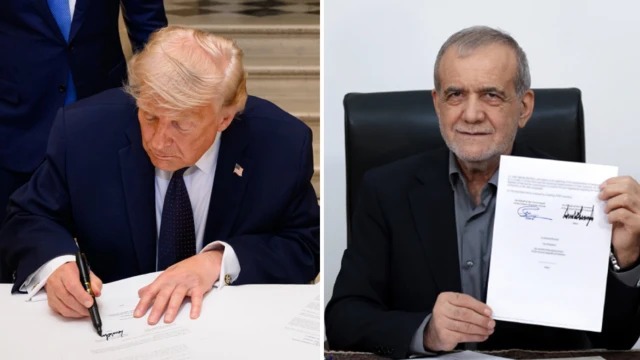
Iran's Supreme Leader Mojtaba Khamenei claimed President Donald Trump signed the recent ceasefire agreement out of "desperation". The comments came as the U.S. formally lifted its two-month naval blockade on Iranian ports, allowing over 12.5 million barrels of oil to transit the reopened Strait of Hormuz as a 60-day negotiation window begins.
TEHRAN — Iranian Supreme Leader Mojtaba Khamenei has issued his first public reaction following the signing of a landmark bilateral ceasefire framework, claiming that U.S. President Donald Trump agreed to the terms out of absolute desperation. The written statement, broadcast by state media on June 18, 2026, coincided with an official directive from U.S. Central Command (CENTCOM) halting all enforcement operations linked to the maritime blockade around the Strait of Hormuz and the Gulf of Oman. The reciprocal actions set in motion a critical 60-day window for comprehensive diplomatic negotiations between the long-time adversaries.
De-escalation Enforced Across Strategic Shipping Corridors
The implementation of the interim Memorandum of Understanding (MOU) signed directly by President Donald Trump and Iranian President Masoud Pezeshkian has immediately altered security architectures across the Persian Gulf. According to statements released by U.S. Vice President JD Vance at a White House press briefing, the U.S. Navy has allowed more than a dozen commercial shipping vessels to freely access Iranian maritime ports, effectively ending an aggressive two-month enforcement campaign.
The lifting of the naval blockade immediately released pent-up commercial energy traffic through the critical Strait of Hormuz choke point. White House logistical tracking confirmed that over 12.5 million barrels of crude oil safely transited the strategic waterway within hours of the operational freeze taking effect, marking the highest single-day volume logged since the active war commenced in late February. Concurrently, Iranian port authorities announced that passage fees through the strait would be completely waived for 60 days to expedite global cargo flow.
Internal Iranian Deliberations and Rhetorical Positioning
The supreme leader's message offered a rare glimpse into the internal political friction surrounding the diplomatic breakthrough. Mojtaba Khamenei, who has not been seen publicly since assuming office, revealed that he initially opposed the draft agreement "as a matter of principle." He ultimately granted his religious and political endorsement only after receiving firm assurances from President Pezeshkian and the Supreme National Security Council that Iran's core sovereignty and the interests of the regional "Resistance Front" would be strictly preserved.
In his sharply worded written address, Khamenei minimized Washington's leverage, stating that the administrative officials in charge executed extensive efforts out of sincere goodwill, whereas the American President used all available leverage purely out of desperation to resolve the conflict. He explicitly warned that entering face-to-face bilateral technical talks must not be interpreted as an acceptance of the American stance, asserting that the Iranian delegation will completely reject any future external demands deemed excessive by the state.
Domestic Political Backlash and Verification Guardrails
The interim ceasefire model faces sharp domestic political opposition in Washington, particularly from congressional Republicans who claim the current layout yields excessive ground to Tehran without securing permanent concessions regarding its uranium enrichment capabilities. Vice President JD Vance dismissed the internal party criticism, urging lawmakers to maintain faith in the administration's negotiation strategies and labeling claims of an unfavorable agreement preposterous.
To address security concerns raised by international allies, U.S. Defense Secretary Pete Hegseth emphasized that the Pentagon has established strict verification parameters rather than relying on diplomatic trust. Speaking at a NATO summit in Brussels, Hegseth verified that the Department of War remains fully prepared to resume immediate military operations if Tehran fails to uphold its baseline commitments. While CENTCOM confirmed its ships have ceased offensive interdictions, a large naval presence including two primary carrier strike groups will remain positioned in the general area to monitor compliance.
Official Sources Section
The diplomatic parameters, operational timelines, and official quotes utilized within this news broadcast are drawn directly from official press briefings hosted by the White House and public enforcement logs published by U.S. Central Command (CENTCOM). Regional responses and official written statements are cross-referenced with reports distributed by the Islamic Republic News Agency (IRNA).
Quote Section
According to officials from the United States Department of Defense during an international security briefing in Brussels:
"There are no unilateral giveaways associated with this framework. This is a strictly monitored interim ceasefire designed to protect global energy lanes from economic catastrophe. Every aspect of the 60-day negotiation timeline will be bound to strict physical verification on the ground, and our naval assets remain fully positioned to restart enforcement if compliance fails."
Why It Matters
The formal suspension of the maritime blockade provides immediate relief to a strained global economy, which was facing the prospect of a severe energy crisis due to the closure of the world’s most critical oil transit bottleneck. For international consumers, the resumption of commercial shipping routes drops global crude prices, directly lowering retail fuel inflation and shipping insurance premiums. However, the aggressive rhetoric from Iran’s senior leadership highlights the deep systemic distrust that could easily derail technical negotiations before a permanent settlement is finalized.
Key Facts at a Glance
Blockade Lifted: U.S. forces have officially ended all maritime restriction operations against Iranian commercial ports.
Energy Resurgence: Over 12.5 million barrels of crude oil safely transited the Strait of Hormuz on the first night of the ceasefire.
Rhetorical Posturing: Supreme Leader Mojtaba Khamenei claimed President Trump signed the interim agreement out of political desperation.
Negotiation Clock: Both nations have entered a legally binding 60-day window to negotiate long-term nuclear and sanctions solutions.
FAQ Section
What are the primary terms established under the current interim agreement?
The current MOU establishes an immediate bilateral ceasefire, completely lifts the U.S. naval blockade of Iranian ports, reopens the Strait of Hormuz to civilian shipping, and opens a 60-day period for broader diplomatic talks.
Will the U.S. military completely withdraw its forces from the Persian Gulf region?
No. U.S. Central Command confirmed that its naval vessels, including two active aircraft carriers, will remain stationed in the general area to verify that all terms of the agreement are fully obeyed.
What happens if the two nations fail to reach a deal after the 60 days expire?
The agreement functions as a temporary framework. If technical negotiations stall after 60 days, both the U.S. administration and the Iranian Revolutionary Guards have warned they are prepared to resume active military operations.
Source: Official press transcripts, military enforcement logs, and state media statements issued by the White House, U.S. Central Command, and the Office of the Supreme Leader of Iran.