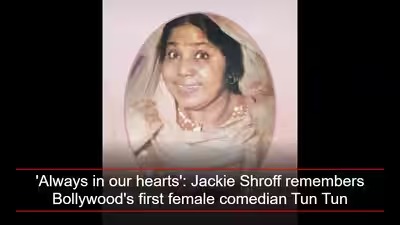
Actor Jackie Shroff led Bollywood in celebrating the 103rd birth anniversary of Tun Tun, widely recognized as Hindi cinema's first female comedian. Originally a playback singer named Uma Devi Khatri, she broke profound gender barriers in the 1950s to carve out an iconic, enduring space for female comic roles.
MUMBAI — Actor Jackie Shroff paid a heartfelt public tribute to legendary actress and comedian Tun Tun on the occasion of her 103rd birth anniversary on Saturday, July 11, 2026. Sharing a vintage portrait from the golden era of the Hindi film industry, Shroff commemorated her immense contributions to Indian entertainment. The public remembrance has sparked widespread reflection across Bollywood regarding the historic transitions of early cinema, tracing how a young playback singer broke rigid gender barriers to establish herself as cinema's definitive female comic icon.
From Uma Devi Khatri to Hindi Cinema’s Comic Icon
Born as Uma Devi Khatri on July 11, 1923, in a small village near Uttar Pradesh's Amroha district, the legendary artist overcame deep personal childhood tragedy, including the loss of her family over property disputes, before migrating to Mumbai. Long before she became recognized as the industry’s premier female comedian, she entered the entertainment sector as a classical playback singer in the late 1940s.
Renowned music director Naushad gave her an early professional break, propelling her to national fame with the iconic track "Afsana Likh Rahi Hoon Dil-e-Bekarar Ka" from the 1947 film Dard. As changes in the music industry shifted her career trajectory, she transitioned completely into active onscreen performance. Under the professional screen name 'Tun Tun'—coined directly by Naushad she reinvented her public persona, carving out a specialized comedic space in an industry where humorous roles were exclusively dominated by male actors.
A Legacy of Impeccable Timing and Classic Subversion
Over a career spanning more than four decades, Tun Tun won over generations of audiences with her sharp comic timing, expressive physical humor, and natural wit. Film archives maintained by the National Film Development Corporation (NFDC) note that she appeared in over a hundred Hindi feature films.
Her filmography includes definitive artistic contributions to masterworks of Indian cinema:
Mr. & Mrs. 55 (1955): Collaborating with filmmaker Guru Dutt, she delivered standout comedic support.
Pyaasa (1957): Provided lighthearted relief inside one of Indian cinema’s most intense emotional dramas.
Kohinoor (1960): Starred alongside Dilip Kumar and Meena Kumari in highly physical slapstick routines.
Half Ticket (1962): Executed timeless matching sequences alongside legendary actor Kishore Kumar.
Following her formal retirement from film sets in the late 1980s, the veteran actress led a private life in Mumbai until her death on November 24, 2003, at the age of 80.
Impact on the Modern Entertainment Landscape
Shroff’s tribute highlights an ongoing push within the Indian entertainment sector to honor its early artistic pioneers. For contemporary film viewers, actors, and screenwriters, Tun Tun's journey provides a masterclass in artistic versatility and resilience. Modern female comic actors credit her with expanding the limits of what women could achieve onscreen, showing that actors did not have to conform to rigid romantic stereotypes to hold massive box-office appeal. Her legacy continues to shape the casting dynamics of mainstream streaming networks and television comedy formats across South Asia.
Official Sources Section
The biographical timelines, historical song references, and film production databases cited in this report are based on public archival records preserved by the National Film Development Corporation (NFDC), official press releases from the Ministry of Information and Broadcasting, and historical interview logs archived by the National Film Archive of India (NFAI).
Quote Section
"Uma Devi Khatri (Tun Tun ji) always in our hearts. July 11, 1923 – November 24, 2003."
— Jackie Shroff, Official Social Media Commemoration
"According to officials and film historians, Tun Tun’s singular achievement was transforming physical presence and expressions into sharp comedic assets, fundamentally expanding the industry's parameters for female character roles during the post-Independence era."
Why It Matters
Remembering early pioneers like Tun Tun helps the modern film industry protect its rich creative heritage while encouraging diverse representations on screen. Her career transition from a highly successful playback singer to a top comic star proves the power of artistic reinvention. For contemporary media businesses and screenwriters, her enduring popularity shows that clean, family-oriented physical comedy retains timeless value across changing generational audiences.
Key Facts at a Glance
103rd Milestone: The Hindi film community officially commemorated the 103rd birth anniversary of pioneer Tun Tun on July 11, 2026.
Musical Roots: Before finding success in comedy, she achieved fame as a playback singer with the hit 1947 song "Afsana Likh Rahi Hoon".
Barrier-Breaking Actor: Widely recognized as Bollywood's very first dedicated female comedian, she challenged a male-dominated performance sector.
Shroff's Tribute: Veteran actor Jackie Shroff led public honors, sharing a vintage portrait to celebrate her lasting impact.
FAQ Section
What was Tun Tun’s original name before entering Hindi cinema?
She was born Uma Devi Khatri in 1923 in Uttar Pradesh. The stage name "Tun Tun" was given to her by legendary music director Naushad when she shifted into acting.
Which famous songs did she sing during her early musical career?
Her most famous track was the late-1940s hit "Afsana Likh Rahi Hoon Dil-e-Bekarar Ka" from the movie Dard, composed by Naushad Ali.
What are some of her most notable movie roles?
She delivered memorable comic performances in absolute classics of early Indian cinema, including Guru Dutt's Mr. & Mrs. 55 and Pyaasa, alongside comedies like Half Ticket.
Source: National Film Development Corporation (NFDC) Records, Press Information Bureau Cultural Archive, National Film Archive of India Directory.