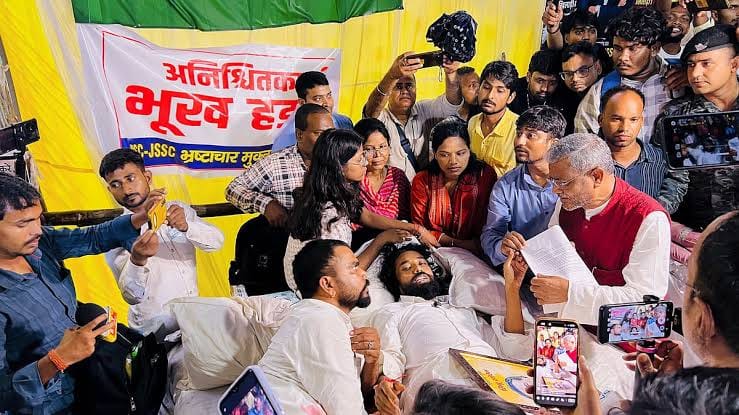
The Jharkhand Assembly Monsoon session opened in Ranchi amid intense opposition protests over alleged irregularities in public recruitment examinations. Opposition lawmakers staged protests wearing symbolic face masks demanding a Central Bureau of Investigation probe, while state authorities deployed security measures as student hunger strikes continued at nearby protest sites.
RANCHI — The Jharkhand Monsoon session commenced on August 6, 2026, on a stormy note as opposition legislators from the Bharatiya Janata Party (BJP) and All Jharkhand Students Union (AJSU) staged demonstrations inside and outside the Legislative Assembly complex in Ranchi. The protests centered on alleged irregularities and paper leaks in competitive recruitment examinations conducted by the Jharkhand Public Service Commission (JPSC) and the Jharkhand Staff Selection Commission (JSSC). The development comes as student agitations enter their second week, forcing the state administration to initiate high-level talks while deploying prohibitory orders around the assembly perimeter.
Opposition Demonstrations and Mask Protest in Ranchi
Lawmakers belonging to the National Democratic Alliance (NDA) bloc arrived at the legislative complex wearing printed face masks bearing slogans such as "We want justice, not deception" and demanding a Central Bureau of Investigation (CBI) probe into all competitive tests. Leader of the Opposition Babulal Marandi led the demonstration at the Assembly entrance, asserting that the state government’s current investigation lacks independent credibility.
Before Speaker Rabindra Nath Mahto convened the proceedings for customary obituary references, opposition members disrupted early proceedings, raising slogans against the government. BJP Chief Whip Naveen Jaiswal stated during the protest that the future of the state's youth was being compromised and urged the state cabinet to formally hand over the investigation to central agencies. Speaker Mahto subsequently adjourned the House until August 7, emphasizing that while differences of opinion are natural in a democratic assembly, public interest must remain paramount during the five-day session ending August 12.
Ongoing Student Agitation and Government Response
The legislative uproar mirrors intensifying street demonstrations at the Jaipal Singh Munda Stadium in Ranchi. Organized under the banner of the JPSC-JSSC Reforms Manch, the student-led movement began on July 25, demanding the cancellation of the 14th JPSC Civil Services Examination alongside systemic administrative reforms. Six demonstrators, including Jharkhand Loktantrik Krantikari Morcha (JLKM) leader Devendra Nath Mahto, have undertaken an indefinite hunger strike, drawing widespread attention across the state.
Responding to the mounting pressure, Chief Minister Hemant Soren acknowledged the seriousness of the issue, stating that competitive examination paper leaks constitute a broader national challenge affecting job aspirants across India. The state government announced the formation of a high-level ministerial committee to engage in direct dialogue with student representatives. Law enforcement officials confirmed that the Crime Investigation Department (CID) of the Jharkhand Police has raided 18 locations and arrested 19 individuals in connection with the examination irregularities. To maintain public order during the Jharkhand Monsoon session, the district administration promulgated Section 144 prohibitory orders within a 750-metre radius of the Assembly premises through August 12.
Economic and Governance Implications for Jharkhand
The political impasse over state recruitment examinations carries direct administrative and social consequences for Jharkhand. Thousands of government vacancies across civil services, education, and administrative cadres remain stalled or deferred pending the outcome of the investigations. The JPSC previously postponed its Combined Civil Services Mains Examination, directly impacting candidates who have spent years preparing for public sector appointments.
Additionally, the legislative deadlock threatens to delay debate on critical state business scheduled for the session, including the tabling of the first supplementary budget for the current fiscal year. Financial analysts and administrative observers note that prolonged uncertainty regarding state recruitments risks eroding youth trust in public institutions and slowing administrative capacity building across district departments.
Official Sources Section
According to official releases from the Government of Jharkhand, administrative committees have been instructed to expedite investigative findings while keeping communication channels open with candidate delegations. Regulatory filings and updates from the Jharkhand Public Service Commission confirm the deferral of scheduled examinations pending procedural reviews. Statements released by the Raj Bhavan Jharkhand noted that Governor Santosh Kumar Gangwar expressed grave concern regarding exam transparency and urged regulatory bodies to maintain absolute integrity.
Quote Section
"The government has set up a committee, but nobody trusts state-level internal inquiries when the careers of thousands of aspirants are at stake," stated BJP Chief Whip Naveen Jaiswal during the assembly grounds demonstration. "A comprehensive probe should be conducted by the Central Bureau of Investigation under High Court supervision."
Speaking on behalf of the state administration, Jharkhand Minister Sudivya Kumar stated: "According to officials, the government is treating the concerns raised by the candidates with utmost seriousness. The CID investigation has already resulted in multiple arrests, and our ministerial delegation remains fully prepared to engage in constructive talks with candidate representatives to resolve the deadlock."
Why It Matters
For Job Aspirants: Determines whether disputed state recruitment tests will be cancelled, re-conducted, or subjected to independent federal oversight.
For Citizens and Taxpayers: Impacts the delivery of public services and governance as government department hiring processes remain frozen.
For Legislators and Investors: Influences legislative output during the current parliamentary session, including approvals for state budgetary expenditures and infrastructure appropriations.
Key Facts at a Glance
Assembly Disruption: Opposition NDA legislators staged protests wearing face masks on the opening day of the session.
Core Grievance: Alleged irregularities and paper leaks in JPSC and JSSC competitive recruitment examinations.
Police Investigation: State CID has arrested 19 individuals and raided 18 locations across five districts.
Student Agitation: Six demonstrators remain on a hunger strike at Jaipal Singh Munda Stadium in Ranchi.
Security Protocol: Prohibitory orders enforced within a 750-metre radius of the Assembly through August 12.
FAQ Section
Why are opposition MLAs protesting during the Jharkhand Monsoon session?
Opposition legislators are demanding an independent CBI probe and the cancellation of disputed JPSC and JSSC examinations due to alleged paper leaks and procedural irregularities.
What action has the Jharkhand government taken regarding the exam allegations?
The government tasked the state police Crime Investigation Department (CID) with the probe, resulting in 19 arrests, and formed a ministerial panel to conduct formal talks with student delegates.
How long will the Jharkhand Monsoon session run?
The legislative session opened on August 6, 2026, and is scheduled to conduct official business through August 12, 2026.
What security restrictions are in place around the Jharkhand Legislative Assembly?
District authorities implemented prohibitory orders restricting public gatherings within a 750-metre radius of the Assembly building between 6:00 AM and 10:00 PM daily through August 12.
Sources: Government of Jharkhand Official Portal, Jharkhand Public Service Commission (JPSC)