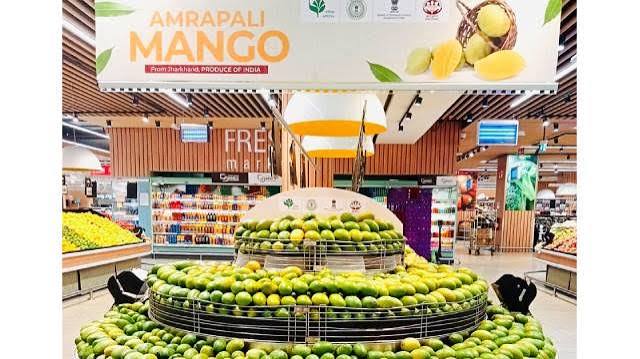
Jharkhand’s tribal women farmers have successfully exported two tonnes of Amrapali mangoes to Dubai, achieving 180% higher earnings than local market rates. Facilitated by APEDA and JSLPS, the initiative highlights the success of the Birsa Harit Gram Yojana in connecting rural, women-led collectives to global retail markets.
NEW DELHI — In a landmark achievement for India’s horticultural exports, two metric tonnes of premium Amrapali mangoes sourced from Jharkhand have been exported to Dubai. The initiative, facilitated by the Agricultural and Processed Food Products Export Development Authority (APEDA), marks a major milestone in integrating tribal and women-led farmer collectives into global supply chains.
The consignment, shipped on July 3, 2026, was distributed through Lulu hypermarkets in Dubai. The mangoes were produced by three women-led Farmer Producer Companies (FPCs) in the aspirational districts of Gumla and Deoghar.
Empowering Tribal Women Farmers
The exported produce was cultivated under the Birsa Harit Gram Yojana, a state-supported initiative that converges with the MGNREGA scheme to promote sustainable horticulture. The women-led FPCs involved—MVM Baghima Palkot, Raidih Agri, and Mohanpur Ajeevika Mahila Kisan—collectively represent over 50,000 member farmers.
Union Minister of Commerce & Industry Piyush Goyal lauded the development, highlighting it as a robust example of the "Local Goes Global" vision. He emphasized that by connecting rural producers directly with international markets, the government is strengthening the role of women in the agricultural value chain and providing them with significant economic empowerment.
Economic Impact and Market Linkages
The export initiative has proven to be a financial success for the participating women farmers. According to official data from the Ministry of Commerce & Industry, the international market linkage allowed these FPCs to realize returns approximately 180% higher than those available in prevailing local markets.
To ensure the produce met international standards, APEDA conducted rigorous capacity-building programs. These sessions trained the directors and members of eight FPCs in Palkot and Deoghar on post-harvest management, quality compliance, and international export procedures. This preparatory work was essential to meeting the stringent requirements for retail distribution in the UAE.
Official Sources
The initiative was spearheaded by APEDA in collaboration with the Jharkhand State Livelihood Promotion Society (JSLPS), district administrations, and private exporter M/s Fair Exports (India) Pvt. Ltd. The project remains a focal point of APEDA’s mandate to boost the export potential of India's horticulture sector.
Quote Section
"According to officials, this achievement demonstrates how technical support and market facilitation can transform rural agriculture. By providing women-led collectives with the tools to navigate global trade, the government is ensuring that local farmers capture a larger share of the value their produce creates."
Why It Matters
This successful export venture is significant as it demonstrates the scalability of "aspirational district" agriculture. By bypassing traditional middlemen and connecting directly with global retail giants like Lulu, the Jharkhand-based collectives have established a model for other rural regions. For the farmers involved, the 180% increase in revenue provides a blueprint for sustainable economic development that emphasizes high-quality horticultural production.
Key Facts at a Glance
Export Volume: Two metric tonnes of premium Amrapali mangoes.
Destination: Dubai, UAE (Retail distribution via Lulu stores).
Financial Benefit: Participating women-led FPCs reported 180% higher returns compared to local market prices.
Origin: Sourced from tribal women farmers in Gumla and Deoghar, Jharkhand.
Initiative: Supported by the Birsa Harit Gram Yojana and facilitated by APEDA.
Frequently Asked Questions
What variety of mangoes was exported from Jharkhand?
The exported consignment consisted exclusively of the premium Amrapali mango variety, known for its distinct taste and quality.
How does this initiative benefit women farmers directly?
By connecting them with global buyers through FPCs, farmers eliminate middlemen, receive higher prices for their produce, and gain exposure to international quality standards.
What is the role of APEDA in this project?
APEDA provided end-to-end support, including capacity-building for international trade, training in post-harvest handling, and creating vital market linkages in the UAE.
Source: APEDA, Ministry of Commerce & Industry, JSLPS