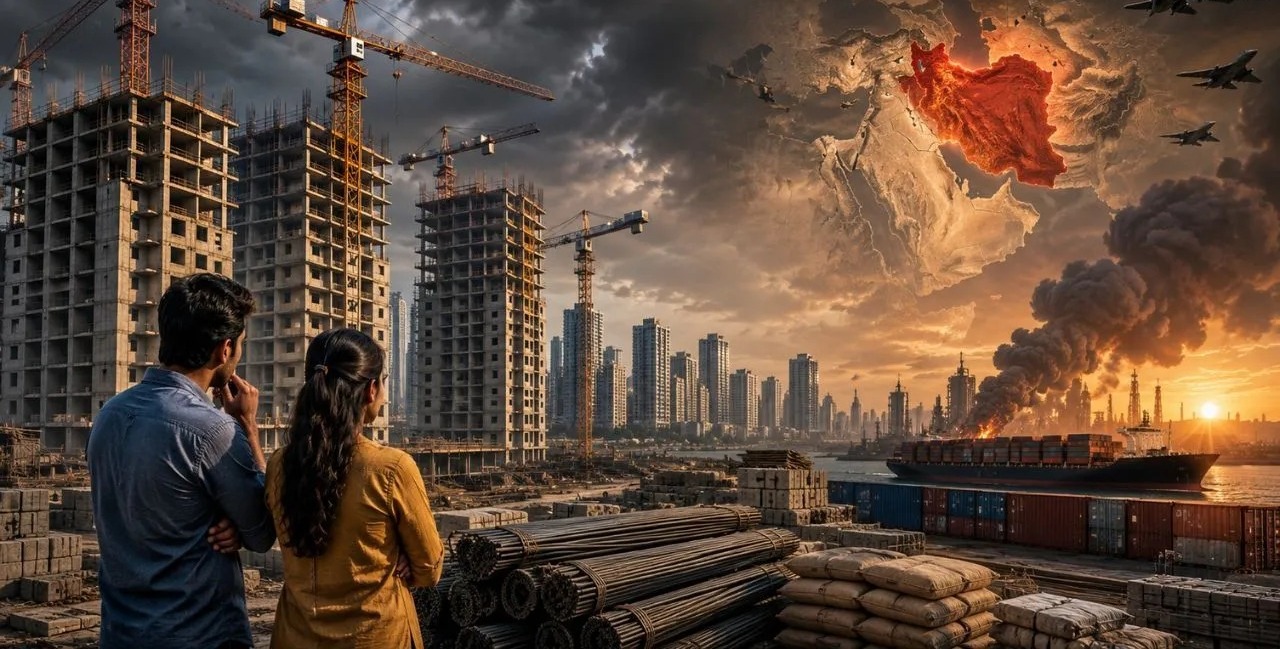
A record 5.4 lakh housing units scheduled for completion across India's top seven cities in 2026 face unexpected delivery risks due to the ongoing US-Iran war. Property consultancy ANAROCK notes that while local demand is strong, rising international energy costs and supply-chain shocks could spark material inflation and execution delays.
MUMBAI — India's residential real estate sector faces a critical execution test as an escalating US-Iran war threatens to derail the delivery of an unprecedented 5,40,400 housing units scheduled for completion across the country’s top seven cities. According to a comprehensive industrial assessment released by property consultancy ANAROCK Research, 2026 was positioned to mark the strongest year for residential handovers in over a decade. However, a prolonged geopolitical conflict in West Asia is driving up global energy prices, inflating material costs, and disrupting freight corridors, putting intense pressure on project timelines just as construction activity peaks.
Geopolitical Friction Pinches Project Economics
The threat to India's housing market stems directly from the macroeconomic fallout of the West Asia military crisis. While local consumer demand for residential property remains highly resilient and developer financing is in its healthiest state in recent cycles, the physical mechanics of completing homes rely heavily on stable global commodity pricing.
A sustained conflict between the United States and Iran has historical precedents for inflating crude oil prices and disrupting maritime logistics. This combination causes cascading cost pressures across key building materials.
According to the ANAROCK Group report, real estate developers are particularly exposed to price inflation regarding foundational inputs like steel, aluminum, copper, electrical equipment, and complex building systems. Because a significant portion of the 2026 completion pipeline consists of mid-to-premium segment towers launched between 2021 and 2023, developers must absorb these rising expenses or face execution bottlenecks that stall final finishing and occupancy certification.
Regional Concentration Puts Western Markets in the Crosshairs
The operational burden of this real estate pipeline is highly concentrated in specific geographical zones, leaving certain metropolitan regions far more vulnerable to macro economic disruptions than others. Data shows that the western markets of the Mumbai Metropolitan Region (MMR) and Pune collectively dominate the national pipeline, accounting for 57 percent of all homes due for delivery this year.
Together, MMR, Pune, and Bengaluru account for nearly 70 percent of the total national delivery load. Consequently, builders operating within these high-density urban areas face the steepest challenges in maintaining their delivery promises while shielding their corporate operating margins from sudden spikes in transportation and basic material overheads.
Historical Redux: Drawing Parallels to the 2020 Shock
The real estate advisory noted that ambitious, high-volume housing pipelines are historically vulnerable to massive external system shocks. Industry analysts drew direct comparisons to the pandemic-impacted year of 2020. During that cycle, approximately 4.66 lakh homes were scheduled for delivery across the top seven cities. However, widespread lockdowns, material shortages, and labor migration resulted in only 2.14 lakh units—or just 46 percent of the target—actually reaching buyers.
While ANAROCK emphasizes that the 2026 scenario is fundamentally different because construction sites remain open and local labor availability is entirely stable, the gap between planned and final completions proves that even projects in highly advanced stages of construction can quickly stall when confronted with global economic disruptions.
Compliance and Regulatory Oversight Under RERA
A key structural defense protecting buyers in the current cycle is the widespread enforcement of the Real Estate Regulatory Authority (RERA) across different state jurisdictions, such as MahaRERA in Maharashtra. Under strict RERA guidelines, developers face steep financial penalties and legal liability if they miss their specified possession deadlines.
While these tighter legal frameworks pressure builders to maintain their project monitoring schedules, a prolonged West Asia war may force builder associations to appeal to the Ministry of Housing and Urban Affairs (MoHUA) for temporary regulatory relief or grace periods if supply chains undergo severe structural blockages.
Executive Assessment on Industry Evolution
"While the industry in the last few years celebrated robust sales, rising prices, and rebooted buyer confidence, the spotlight now is shifting from sales to execution," stated Dr. Prashant Thakur, Executive Director and Head of Research & Advisory at ANAROCK Group. "2026's significance therefore extends beyond the sheer number of homes scheduled to be delivered. We are looking at a forced new evolutionary stage of India's residential real estate market which will stretch Indian developers' capabilities to an unprecedented extent. 2026 becomes the referendum year for our residential real estate sector's maturity."
Why It Matters
For hundreds of thousands of middle-class families, any delay in home possession directly extends their financial double-burden of paying monthly home loan EMIs while simultaneously covering rental expenses on their current housing. For the broader economy, a slowdown in real estate completion dampens core downstream industrial demand for cement, steel, paint, and consumer durable goods, which could slightly moderate near-term economic growth targets.
Key Facts at a Glance
Record Pipeline: A decade-high 5,40,400 housing units are slated for completion across India's top 7 cities in 2026.
Geopolitical Threat: The ongoing US-Iran conflict risks delaying handovers due to material cost inflation and supply-chain disruptions.
Western Vulnerability: MMR and Pune collectively account for 57 percent (over 3 lakh units) of the total delivery schedule.
Input Stresses: Builders face immediate margin compression from rising prices of steel, copper, aluminum, and electrical assemblies.
Regulatory Shield: Strict RERA enforcement serves as a critical mechanism to hold developers accountable to time-bound completions.
FAQ Section
Why does a conflict between the US and Iran affect housing construction in India?
Modern large-scale residential projects require immense volumes of industrial commodities like steel, copper wires, aluminum fittings, and complex electrical grid components. A war involving major global energy producers drives up crude oil and international freight costs, inflating the cost of importing or manufacturing these essential raw materials locally.
Which cities face the highest risk of home delivery delays?
The risk is heavily concentrated in the western and southern property hubs. The Mumbai Metropolitan Region (MMR) with 2,07,300 units, Pune with 1,00,300 units, and Bengaluru with 69,000 units together make up nearly 70 percent of the country's entire 2026 delivery pipeline.
Are property developers better equipped to handle this crisis than during the 2020 pandemic?
Yes. Unlike 2020, when construction sites were completely locked down and migrant labor left urban hubs, current construction activity remains fully operational. Furthermore, corporate developers currently hold significantly stronger corporate balance sheets and utilize improved digital project monitoring systems.
Source: Official real estate market research briefings published by the ANAROCK Group, industrial background releases via Fortune India, and statutory compliance regulatory archives from state RERA Authorities.