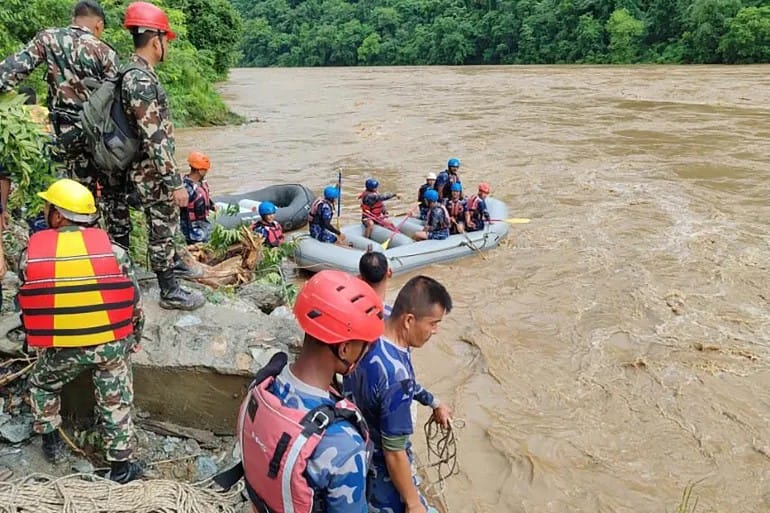
India's Ministry of External Affairs has released the names of 63 Indian nationals rescued from the Trishuli-I hydroelectric project following severe flash floods in Nepal. Emergency teams continue search and air-evacuation operations, while New Delhi has dispatched over 47 tonnes of relief material to support joint disaster response efforts.
NEW DELHI / KATHMANDU — India’s Ministry of External Affairs (MEA) has officially released the identified list of 63 Indian nationals rescued from the Trishuli-I hydroelectric project site in Nepal after catastrophic flash floods struck the region.
The disaster unfolded when heavy flash flooding swept through the Bhote Koshi and Trishuli river systems across northern and central Nepal, isolating critical infrastructure sites and damaging access routes. The published list forms part of broader evacuations coordinated between Indian diplomatic missions, local authorities, and Nepalese security forces.
Diplomatic and Rescue Operations
Official updates provided by MEA spokesperson Randhir Jaiswal confirmed that diplomatic channels in Kathmandu established contact with project management to verify employee safety and coordinate extraction. In addition to the 63 project workers, authorities reported the successful extraction of 21 pilgrims from Tamil Nadu who were stranded while returning from the Kailash Mansarovar Yatra.
The Government of India has ramped up emergency aid to assist Nepal’s disaster management bodies. External Affairs Minister S. Jaishankar announced that Indian Air Force transport aircraft delivered 47.5 tonnes of Humanitarian Assistance and Disaster Relief (HADR) supplies, including essential medicines, shelter items, and food packets to Kathmandu.
Meanwhile, Nepal Prime Minister Balen Shah reported that over 13,000 personnel from the Nepal Army, Nepal Police, and Armed Police Force have been deployed to execute multi-district search, air-rescue, and relief efforts.
Impact on Citizens, Workers, and Regional Transit
The flash floods have disrupted key transit corridors, energy infrastructure, and border trade posts between India, Nepal, and China.
Labor Force: Operations at hydro projects in the Rasuwa and Nuwakot districts remain temporarily suspended as damage assessments continue.
Travelers and Pilgrims: Border transit points near Keyrung have experienced traffic diversions, requiring international travelers to reroute through secondary land corridors.
Border States: Disaster management authorities in the Indian state of Uttar Pradesh have placed districts along the Gandak River basin on high alert and deployed State Disaster Response Force (SDRF) units to assist in border area evacuations.
Official Sources Section
Statements, updates, and rescue data cited in this report originate from:
Quote Section
According to MEA spokesperson Randhir Jaiswal:
"Please see the names of 63 Indian nationals working at Trishuli-I project in Nepal who have been rescued. Efforts are continuing to ascertain the whereabouts and ensure the safety of Indian nationals who remain uncontactable in the flood-affected areas."
According to Nepal Prime Minister Balen Shah:
"The situation is still challenging. All state mechanisms are operating at full capacity. Right now, our first priority is to save the lives of each and every citizen, search and rescue of the missing, treat the injured, and provide immediate relief."
Why It Matters
The rapid release of verified identity lists assists families, diplomatic units, and insurance operators in confirming worker safety amid disrupted telecommunication networks in the Himalayan region. Furthermore, cross-border relief mobilization highlights the reliance on joint disaster management protocols to stabilize critical economic assets and supply routes in South Asia.
Key Facts at a Glance
Evacuations: 63 workers from the Trishuli-I project and 21 pilgrims from Tamil Nadu safely extracted.
Relief Supply: India dispatched two cargo flights carrying 47.5 tonnes of HADR and medical supplies.
Personnel Mobilized: 13,295 security personnel active in rescue missions across affected Nepalese districts.
Helicopter Sorties: 69 air missions conducted within 24 hours to evacuate stranded individuals.
Frequently Asked Questions (FAQ)
Q1: How can relatives trace family members missing in the Nepal floods?
A: Relatives can contact the 24/7 Emergency Control Room established by Nepal's Ministry of Foreign Affairs or reach out directly to the Indian Embassy consular helpline in Kathmandu.
Q2: What caused the flash floods affecting the Trishuli-I site?
A: Intense rainfall and sudden sediment-laden surges originating in the upper river catchments swept through the Bhote Koshi and Trishuli basins, damaging roads and power infrastructure.
Q3: Are travel routes between India and Nepal currently open?
A: Main highway linkages through northern hill districts face localized blockages. Border authorities recommend checking state disaster management advisories before traveling.
Source: Ministry of External Affairs, India, Ministry of Foreign Affairs, Nepal, National Disaster Risk Reduction and Management Authority (NDRRMA).