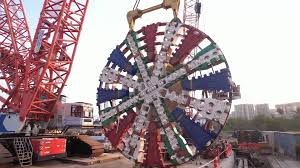
India has lowered its largest rail tunnel boring machine (TBM) cutterhead at Vikhroli in Mumbai for the Mumbai–Ahmedabad bullet train corridor, marking a key milestone for the project’s underground section. The 13.6-metre diameter cutterhead will drive a single large tunnel capable of carrying both up and down high-speed rail lines between Bandra Kurla Complex and Shilphata.
The operation completes the primary assembly of one of two giant TBMs that will excavate a 16 km stretch of the planned 21 km tunnel, which includes India’s first undersea rail tunnel segment under Thane Creek. For the National High Speed Rail Corporation Limited (NHSRCL), this is a visible sign that the long-delayed underground works are finally moving from drawings to dirt.
What Makes This TBM Different
The lowered cutterhead measures 13.6 metres in diameter and weighs about 350 tonnes, mounted on TBMs with total weights exceeding 3,000 tonnes each, making them the largest rail tunnel machines ever deployed in India. These mix-shield/slurry TBMs are designed to handle complex geology, including soft ground and undersea sections, while maintaining stability and pressure.
With a maximum cutterhead speed of about 4 RPM and an excavation rate of roughly 49 mm per minute, the machines are optimised for steady, controlled tunnelling that balances pace with safety in a dense urban and coastal environment. Critically, the single large-diameter tunnel design allows both tracks to run inside one bore, reducing surface disruption compared to twin smaller tunnels.
Why This Matters For The Bullet Train
The BKC–Shilphata stretch, including a 7 km undersea section below Thane Creek, is one of the most technically demanding parts of the Mumbai-Ahmedabad high-speed rail alignment. Progress here has been closely watched because tunnelling delays could easily cascade into overall project slippages. Lowering the cutterhead signals that TBM drives are now imminent, with both machines expected to work from the Vikhroli launch shaft.
From a broader infrastructure lens, the deployment of these record-size TBMs reflects a step-up in India’s tunnelling capabilities, with lessons likely to spill over into future metro, high-speed and undersea projects. For Mumbai, it also means years of disruptive preparatory work are finally translating into visible high-speed rail structures.
Tunnel Milestone Highlights
- 13.6-metre diameter cutterhead weighing about 350 tonnes lowered at Vikhroli
- Two TBMs of over 3,000 tonnes each to excavate a 16 km section of a 21 km tunnel
- Single large tunnel designed to house both up and down bullet train lines
- Section includes India’s first undersea rail tunnel under Thane Creek between BKC and Shilphata
- TBMs described as the largest rail tunnel boring machines yet used in India
Sources: NHSRCL press releases, Economic Times, Hindustan Times, Lokmat/ANI, The Print