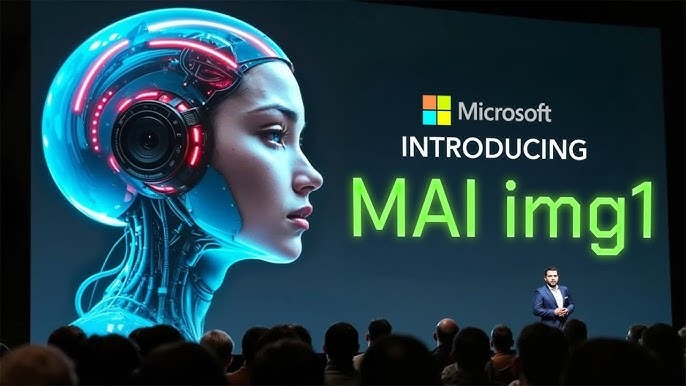
At Build 2026, Microsoft launched its own in-house AI family, MAI, including the MAI-Thinking-1 reasoning model and MAI-Code-1. By building its own intelligence layer from scratch, Microsoft has reduced its dependency on OpenAI, cut operational costs by 90%, and gained total control over its AI-integrated Windows and Azure ecosystems.
SAN FRANCISCO — In a definitive shift that reshapes the global artificial intelligence landscape, Microsoft has officially launched its own family of "homegrown" AI models, moving to control the core intelligence layer of its software stack. At the Microsoft Build 2026 developer conference, the company unveiled the MAI (Microsoft AI) family—a suite of seven proprietary models developed entirely in-house.
The announcement, led by CEO Satya Nadella, marks the end of Microsoft's era as a "passenger" on external technology. By building these models from scratch on commercially licensed data, Microsoft has eliminated "shortcuts" like distillation or fine-tuning from partner models, positioning itself as a direct competitor to the very labs it previously helped fund.
MAI-Thinking-1: The "No Shortcuts" Reasoning Model
The flagship of the new lineup is MAI-Thinking-1, Microsoft's first internally developed reasoning model. Unlike traditional Large Language Models (LLMs) that generate immediate responses, MAI-Thinking-1 utilizes an internal "chain of thought" to spend compute time on deliberation before answering.
According to technical briefings from Microsoft AI, the model is optimized for:
Complex Multi-Step Logic: Breaking down advanced math and scientific hypotheses.
High-Volume Coding: Benchmarks show it matches or exceeds the performance of Anthropic’s Claude Opus on the SWE-Bench Pro coding metric.
Long Context Tasks: A 128K context window allows for the ingestion of entire technical repositories.
"Platform companies do not like being tenants," noted industry analysts regarding the launch. By owning the model layer, Microsoft gains total control over its margins and deployment timelines for Windows, Azure, and Microsoft 365.
MAI-Code-1 and the Economic Shift in Development
Parallel to the reasoning model, Microsoft introduced MAI-Code-1 and its high-efficiency variant, MAI-Code-1-Flash. This coding-specific model is now the native engine powering GitHub Copilot and VS Code, replacing the OpenAI-based backends that defined the tools' early years.
The strategic value of MAI-Code-1 lies in its tenfold cost reduction for enterprise customers. By running in-house models on its own Azure infrastructure, Microsoft avoids the per-token licensing fees once paid to external vendors. This allows the company to transition GitHub Copilot to a new "AI Credits" billing model, favoring developers who use high-quality, targeted prompts.
Official Sources Section
According to official announcements from Microsoft Build 2026 and corporate blogs via Azure AI Foundry, the MAI family currently includes:
MAI-Thinking-1: Reasoning and logic.
MAI-Code-1: Specialized programming and debugging.
MAI-Image-2.5: Text-to-image and visual transformation.
MAI-Voice-2 & MAI-Transcribe-1.5: Multilingual audio processing.
Microsoft confirmed that MAI-Thinking-1 is currently available in private preview within Microsoft Foundry, while MAI-Code-1 has begun rolling out to all Copilot and VS Code users.
Quote Section
According to officials at Microsoft:
"MAI-Thinking-1 was designed to be good at complex multi-step instructions and code generation. We built it from scratch on commercially licensed data with no distillation from third-party models. This is about long-term self-sufficiency and providing our customers with a third credible option for frontier-scale reasoning."
Reflecting on the competitive shift, one developer attending the San Francisco conference stated:
"Benchmarks tell one story, but the transparency of the reasoning chain in MAI-Thinking-1 is what matters to us. Seeing how the model arrived at an answer—step by step—is a declaration of independence from the 'black box' models we've used for the last two years."
Why It Matters
This move fundamentally alters the "Buy vs. Build" calculation for global enterprises. For businesses, Microsoft’s in-house models provide a compliance-grade AI solution where the data provenance is clear and legally vetted. Practically, the 90% cost savings compared to previous frontier models like GPT-5 mean that AI automation is becoming a "utility" baked into the infrastructure rather than an expensive add-on. For the broader AI industry, Microsoft's pivot signals that the "Gold Rush" of licensing third-party brains is ending, replaced by a battle for sovereign, proprietary intelligence stacks.
Key Facts at a Glance
In-House Development: MAI-Thinking-1 is Microsoft's first proprietary reasoning model, trained without "distilling" data from OpenAI or Anthropic.
Massive Cost Savings: The shift to internal models offers a tenfold cost reduction in token pricing for Azure and GitHub Copilot users.
Coding Performance: MAI-Code-1-Flash, at just 5 billion parameters, achieves a 51% success rate on the SWE-Bench Pro coding benchmark.
Platform Integration: All MAI models are natively integrated into Azure AI Foundry, Windows AI APIs, and Microsoft 365.
Agentic Future: The models are designed to power "Microsoft Scout," a new personal AI agent for autonomous workplace tasks.
FAQ Section
Q: Does this mean Microsoft is ending its partnership with OpenAI?
A: No. Microsoft maintains its multi-billion dollar partnership and continues to offer OpenAI models on Azure. However, the MAI family allows Microsoft to offer a first-party alternative that is cheaper, more controllable, and tailored specifically to its software ecosystem.
Q: What makes a "reasoning" model different from a standard AI chatbot?
A: Standard chatbots predict the next word in a sequence instantly. Reasoning models like MAI-Thinking-1 perform "multi-step planning," checking their own logic and backtracking if they find an error before delivering the final answer.
Q: How can developers access the new MAI-Code-1 model?
A: MAI-Code-1 is available now as the default engine in GitHub Copilot and Visual Studio Code. Developers can also access the full MAI family through the new "MAI Playground" in Azure AI Foundry.
Source: Microsoft Build 2026 Keynote Archives, Microsoft AI Official Blog, Azure AI Foundry Documentation.