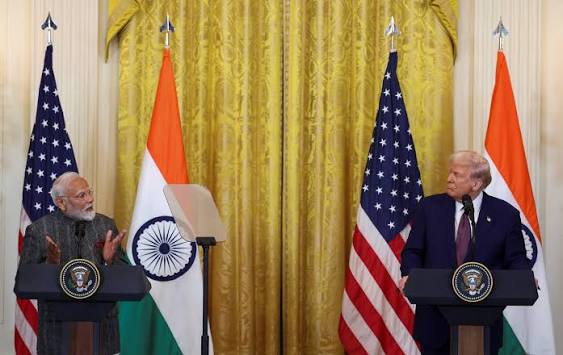
Indian Prime Minister Narendra Modi and U.S. President Donald Trump have instructed their trade teams to fast-track a balanced, commercially meaningful bilateral trade agreement. Foreign Secretary Vikram Misri confirmed negotiations are in the final stages, ahead of U.S. Trade Representative Jamieson Greer’s high-stakes visit to New Delhi next week.
EVIAN-LES-BAINS — Indian Prime Minister Narendra Modi and U.S. President Donald Trump have ordered their respective trade officials to swiftly finalize a long-awaited bilateral trade agreement. Speaking at a diplomatic press briefing in Paris on Thursday, June 18, 2026, Indian Foreign Secretary Vikram Misri announced that negotiations for the proposed interim trade pact have reached their final stages. The directive follows a high-profile, wide-ranging meeting between the two heads of state on Wednesday on the margins of the Group of Seven (G7) summit in Evian-les-Bains, France, marking an intensive effort to repair economic and strategic ties that faced unprecedented strains over the past year.
Restoring Trade Certainty After a Period of Friction
The accelerated timeline for the trade pact comes after a turbulent 12 months in bilateral commercial relations. Tensions peaked last year when the Trump administration implemented broad 50% tariffs on a variety of Indian exports, prompting complex legal maneuvers from New Delhi under Section 301 proceedings.
According to Foreign Secretary Misri, the persistent legal and regulatory standoffs created a damaging environment of market instability for cross-border corporations.
"There were some important and urgent issues that needed to be discussed yesterday, notably the trade agreement, which is something that has created a certain amount of uncertainty over the past year or so between the two countries," Misri told reporters. "And it was important that we move forward to some kind of certainty on these issues."
The proposed interim arrangement aims to establish a balanced tariff structure. Under the emerging framework, Indian industrial and agricultural exports to the United States would see their baseline tariff rates reduced to roughly 18%, down from the punitive 50% emergency rates enacted last year. In exchange, India is expected to grant American agricultural goods, electronic components, and medical equipment significantly broader access to its massive domestic consumer markets.
High-Level USTR Delegation Heading to New Delhi
To implement the directives issued by Modi and Trump, high-ranking trade officials are mobilizing immediately. Foreign Secretary Misri announced that U.S. Trade Representative (USTR) Jamieson Greer will arrive in India next week to oversee critical, face-to-face negotiations.
Indian Commerce Secretary Rajesh Agrawal provided supplemental operational schedules earlier this week, confirming that Greer is slated to land in New Delhi on the evening of June 22. On June 23 and 24, Greer will engage in rigorous, closed-door working sessions with India's Minister for Commerce and Industry to resolve outstanding technicalities.
"We expect that discussions will be centered around giving final touches to the framework deal and also on the larger Bilateral Trade Agreement (BTA) that has been under discussion between the two sides," Agrawal stated in an administrative release. The upcoming negotiations will explicitly focus on delivering permanent resolutions to the ongoing Section 301 market investigations, ensuring a predictable statutory environment for multi-national supply chain networks.
Reviewing Progress Under the COMPACT Initiative
Beyond traditional trade tariffs, the bilateral talks provided an avenue for both leaders to review overarching security and technological integrations. Modi and Trump assessed the substantial milestones achieved under the India-U.S. COMPACT (Catalyzing Opportunities for Military Partnership, Accelerated Commerce and Technology).
Initially launched during their prior face-to-face meeting in Washington, D.C., in February 2025, the COMPACT platform functions as a critical mechanism for co-developing advanced military technologies, securing semiconductor supply networks, and expanding civilian nuclear energy partnerships. Both leaders formally welcomed recent defense developments, noting that structural economic cooperation underpins their shared vision for a stable and open Indo-Pacific corridor.
Regional Maritime Safety and the West Asia Peace Deal
The leaders' summit also directly addressed recent maritime safety concerns. The meeting occurred shortly after a highly public dispute involving the deaths of three Indian merchant sailors in the Gulf of Oman, who were caught in an auxiliary crossfire during regional security deployments.
Prime Minister Modi raised the issue of seafarer safety directly with President Trump during the G7 sidelines, emphasizing that hundreds of thousands of Indian nationals serve as the operational backbone of global maritime trade routes. Modi linked their future safety to the newly signed U.S.-Iran peace memorandum, which is poised to reopen the crucial Strait of Hormuz to unimpeded international commerce.
Official Sources Section
The diplomatic assertions, official directives, timeline milestones, and delegation itineraries detailed in this news article were compiled directly from public media briefings delivered by Ministry of External Affairs (MEA) India Foreign Secretary Vikram Misri, official joint communiqués issued via the White House Press Office, and administrative schedules provided by the Ministry of Commerce and Industry.
Quote Section
"The leaders noted with particular satisfaction the significant progress made in negotiations towards an interim bilateral trade agreement," the official statement from the Ministry of External Affairs confirmed. "They instructed their officials to work towards a balanced, mutually beneficial, and commercially meaningful agreement at the earliest possible date."
Why It Matters
The rapid finalization of an interim trade agreement carries massive practical implications for multi-national manufacturers, technology investors, and consumer markets worldwide. Over the past year, punitive tariffs disrupted global supply chains, forcing industries to navigate unpredictable costs. Establishing statutory certainty between the world's largest democracy and its largest economy reassures institutional investors, protects global maritime workers, and stabilizes consumer prices across electronic and agricultural sectors.
Key Facts at a Glance
Direct Mandate: PM Modi and President Trump ordered immediate acceleration of the interim trade agreement during their G7 bilateral meeting in Evian, France.
Key Envoy: U.S. Trade Representative Jamieson Greer will arrive in New Delhi on June 22 to finalize the framework.
Tariff Relief: The pact aims to replace volatile 50% tariffs with an organized, lower tariff baseline near 18%.
Security Integration: The leaders reaffirmed deep strategic ties under the existing India-U.S. COMPACT defense framework.
FAQ Section
Q: What caused the recent trade uncertainty between India and the United States? A: Tensions expanded last year when the U.S. implemented emergency 50% tariffs on multiple Indian goods due to persistent disputes over market access and digital trade, prompting a reciprocal legal standoff under Section 301 proceedings.
Q: When is the new interim trade pact expected to be formally signed? A: While a definitive signing date has not been finalized, negotiators are placing the framework into its "final stages," with high-level USTR meetings in New Delhi on June 23–24 designed to iron out remaining obstacles.
Q: How does this development affect corporate manufacturers and consumer markets? A: By replacing punitive emergency tariffs with a predictable trading framework, the agreement lowers shipping costs, stabilizes consumer tech prices, and provides international businesses with a secure, certain investment landscape.
Source: * Ministry of External Affairs (MEA) India Press Briefing Archives