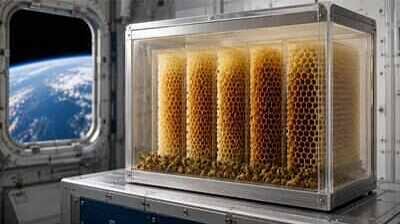
In April 1984, NASA launched over 3,300 honeybees aboard the Space Shuttle Challenger to study insect behavior in microgravity. Despite initial adjustment difficulties, the bees successfully adapted to weightlessness, built functional honeycomb structures, and proved that core colony instincts operate independently of gravity.
WASHINGTON — Archival mission records and recent payload evaluations have shed new light on a historic 1984 NASA experiment in which approximately 3,300 honeybees were sent into Earth orbit to test insect behavior and structural engineering in a microgravity environment.
The student-sponsored experiment, housed inside a specialized Bee Enclosure Module on the Space Shuttle Challenger during the STS-41C mission, sought to determine whether gravity is a mandatory prerequisite for bees to build hexagonal honeycombs. While the mission's primary high-profile objectives centered on capturing and repairing the orbiting Solar Maximum satellite, the modest middeck biological payload yielded foundational insights into animal adaptation that continue to inform aerospace life-support research today.
Microgravity Adaptation and Comb Construction
Launched on April 6, 1984, the flight experienced an initial adjustment phase. According to official mission logs, the insects initially struggled with orientation, with several bees colliding against the enclosure walls as they attempted to navigate weightlessness. However, by the seventh day of flight, the colony had adapted to the zero-gravity environment, displaying normal flight patterns and coordinated movement.
Despite the unfamiliar physical constraints, the bees constructed approximately 30 square inches (roughly 200 square centimeters) of honeycomb. Subsequent morphological analysis conducted after the shuttle's return on April 13 revealed that the space-built comb featured recognizable hexagonal cells, though microscopic evaluations noted minor variations including slightly thicker walls and smaller average diameters compared to terrestrial control samples. Furthermore, the onboard queen laid 35 eggs during the flight, proving that core reproductive and biological processes persisted in orbit.
According to official mission documentation, post-flight analyses, and aerospace archives:
Payload Scale: Approximately 3,300 honeybees alongside a queen housed in a compact Bee Enclosure Module.
Mission Duration: Seven-day operational window executed during the STS-41C Challenger flight.
Output Metrics: Roughly 200 cm of functional honeycomb successfully constructed in microgravity.
Sustenance Strategy: Utilization of an agar, water, and sugar syrup mixture to prevent liquid droplet dispersion in weightlessness.
Official Sources Section
Quote Section
"According to official mission reports from NASA, 'By Day 7, comb [was] well developed, [and] bees seemed to adapt to 0-g pretty well,' demonstrating that fundamental biological instincts and colony coordination persist independently of terrestrial gravitational cues."
Why It Matters
As international space agencies and private aerospace firms plan extended human habitation on the Moon and long-duration missions to Mars, understanding how biological organisms, ecosystems, and potential agricultural pollinators function in altered gravity is increasingly vital. The 1984 experiment remains a key baseline reference for evaluating self-sustaining biological habitats in deep space.
Key Facts at a Glance
Spacecraft: Space Shuttle Challenger (Mission STS-41C).
Launch Date: April 6, 1984.
Primary Finding: Gravity is not strictly required for bees to organize and construct recognizable honeycomb geometry.
Artifact Location: The flight hardware is currently preserved at the Smithsonian's Steven F. Udvar-Hazy Center.
FAQ Section
Why did NASA send bees into space in 1984?
The experiment was designed to test whether honeybees could maintain normal behavioral patterns and construct honeycomb structures without the influence of gravity.
How did the bees manage to build comb without gravity?
After an initial adjustment period where they bumped into enclosure walls, the bees adapted to microgravity and successfully built roughly 200 cm of functional honeycomb.
What did the bees eat during the seven-day spaceflight?
To prevent liquid food from floating away as stray droplets in the cabin, researchers fed the colony a specialized mixture of sugar, water, and agar.
Where can aerospace enthusiasts view the equipment used in the experiment?
The original Bee Enclosure Module is housed and displayed publicly at the Smithsonian National Air and Space Museum Portal.
Source: NASA History Division, Smithsonian National Air and Space Museum, The Economic Times Science Desk, The Times of India