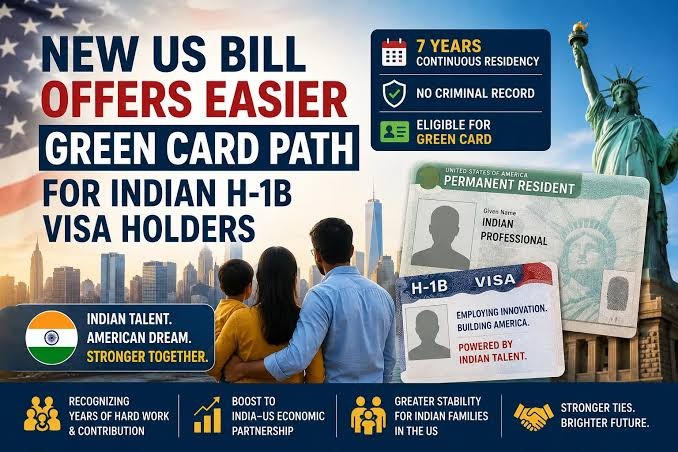
A new U.S. Congressional bill proposes eliminating per-country caps on employment-based Green Cards. The legislation aims to alleviate multi-decade backlogs for over 1 million Indian H-1B holders, offering STEM exemptions and age-out protections for H-4 dependent children.
WASHINGTON, July 30, 2026 — Thousands of Indian high-skilled tech professionals residing in the United States on H-1B temporary work visas could see significant relief under a new bipartisan legislative proposal introduced in the U.S. Congress. The newly introduced bill, designed to address multi-decade Green Card backlogs, proposes eliminating per-country numerical limits on employment-based immigrant visas and expanding statutory pathways to legal permanent residency (PR). Introduced by a coalition of lawmakers in the House of Representatives, the legislation aims to modernize the U.S. high-skilled immigration framework, offering a streamlined transition for foreign workers who have held valid non-immigrant status and maintained continuous U.S. employment.
Addressing the Decades-Long Employment-Based Backlog
Under current U.S. immigration law, no single country of origin can receive more than 7 percent of total available employment-based Green Cards in any fiscal year. Because Indian nationals represent over 70 percent of all H-1B visa beneficiaries annually, this statutory per-country ceiling has generated a severe imbalance between application volumes and available immigrant visas.
According to data compiled by U.S. Citizenship and Immigration Services (USCIS) and state department reports, more than 1.1 million Indian professionals—including approved main applicants and their dependents—are currently queued in employment-based second (EB-2) and third (EB-3) preference categories. Projections indicate that without legislative intervention, priority date waiting periods for Indian applicants in these categories could stretch past several decades.
| Green Card Preference Category | Primary Eligible Qualification | Current Statutory Per-Country Cap | Proposed Bill Adjustment |
| EB-1 (Priority Workers) | Extraordinary ability, outstanding professors/executives | 7% Per-Country Limit | Phased Cap Elimination |
| EB-2 (Advanced Degrees) | Professionals holding Master's degrees or equivalent | 7% Per-Country Limit | First-Come, First-Served Allocation |
| EB-3 (Skilled Workers) | Bachelor's degree holders and skilled professionals | 7% Per-Country Limit | Increased Allocation & Relief |
Key Provisions: How the Proposed Legislation Expands Pathways
The proposed bill introduces structural modifications to the Immigration and Nationality Act (INA) aimed at clearing aged priority date queues:
Phased Elimination of Country Caps: The legislation mandates a transition period over three fiscal years during which the 7 percent per-country cap on employment-based visas will be phased out, transitioning allocations strictly to a first-come, first-served basis.
Exemption for U.S. STEM Graduates: Foreign national graduates who have earned Master's or Doctoral degrees in Science, Technology, Engineering, or Mathematics (STEM) from accredited U.S. universities would be exempt from annual numerical Green Card limits.
Protection for Aging-Out Dependents: The bill introduces provisions to lock the age of dependent children (H-4 visa holders) at the time their parent's initial immigrant petition (Form I-140) is approved, preventing them from aging out of derivative visa eligibility at age 21.
Dual-Intent Portability Enhancements: H-1B professionals with approved I-140 petitions would gain broader job portability rights, allowing them to change employers or start businesses without resetting their priority dates.
Impact on Families, Employers, and the Technology Sector
If enacted, the legislative changes would provide immediate stability to Indian IT professionals, engineers, researchers, and corporate executives across key technology hubs in California, Texas, Washington, and New York. Employers stand to benefit from reduced administrative overhead associated with recurring H-1B extension filings and labor condition applications (LCAs).
For H-1B families, the bill reduces the risk of career disruption caused by job losses or visa processing delays. Furthermore, dependent spouses holding H-4 employment authorization documents (EAD) would receive permanent work authorization protection tied to the principal applicant's ongoing Green Card application process.
Official Sources Section
According to official releases published by the U.S. House of Representatives Judiciary Committee and public statements issued by U.S. Citizenship and Immigration Services, the bill must clear review in both Congressional chambers and obtain executive approval before taking effect.
Quote Section
"According to officials and immigration policy analysts, removing artificial per-country limits ensures that high-skilled workers who have contributed to the economy for years receive fair and equal access to permanent residency based on merit rather than place of birth."
Why It Matters
For over a million Indian workers and their families, the legislation represents an important step toward resolving chronic legal uncertainty. Resolving the employment-based backlog secures top international engineering talent within domestic technology and innovation ecosystems, mitigating the risk of talent loss to foreign markets with more flexible immigration frameworks.
Key Facts at a Glance
Legislative Proposal: A new U.S. Congressional bill seeks to eliminate the 7% per-country limit on employment-based Green Cards.
Primary Beneficiaries: Over 1 million Indian H-1B visa holders and dependents facing multi-decade wait times in EB-2 and EB-3 queues.
STEM Exemptions: Proposes removing annual Green Card caps for U.S. advanced-degree STEM graduates.
Child Status Protection: Prevents H-4 dependent children from aging out of derivative visa eligibility at age 21.
Frequently Asked Questions (FAQs)
How does the new bill help Indian H-1B holders currently in the Green Card queue?
The bill phases out per-country limits, transitioning Green Card issuance to a first-come, first-served system. This would significantly advance priority dates for Indian nationals who have been waiting in EB-2 and EB-3 queues.
What is the 7 percent per-country cap in U.S. immigration?
Under current immigration law, no single country can receive more than 7% of total available family-sponsored or employment-based Green Cards annually, regardless of population or application volume.
Does the bill protect H-4 dependent children from aging out?
Yes, the proposed legislation includes provisions to lock in a child's age when the parent's Form I-140 is filed or approved, protecting them from losing eligibility at age 21.
Where can individuals track official updates on the bill's progress?
Legislative texts and committee updates can be tracked on the official portal of the U.S. Congress and through updates published by U.S. Citizenship and Immigration Services.
Source: U.S. House of Representatives, U.S. Citizenship and Immigration Services, U.S. Department of State Visa Office