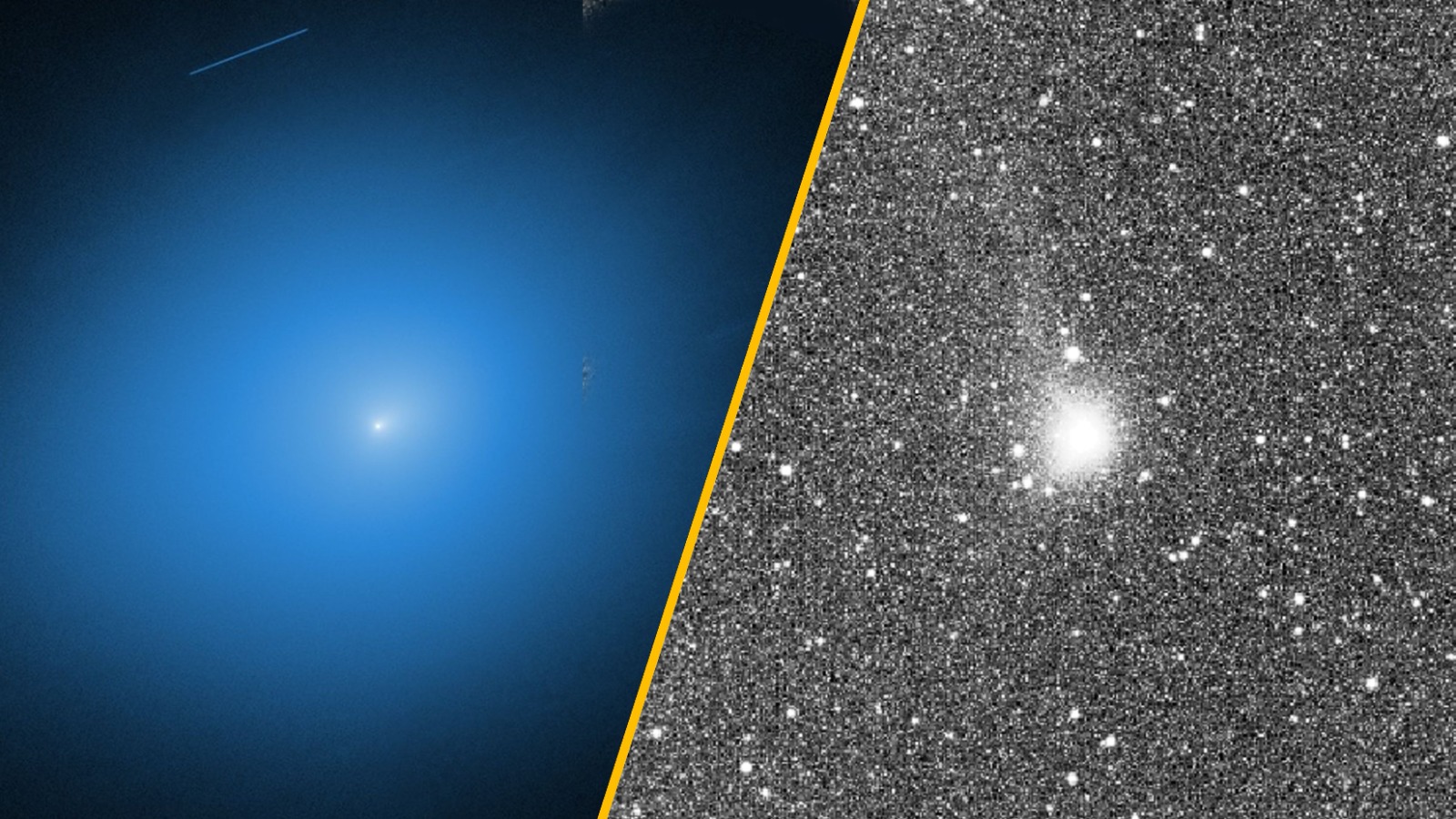
New images show comet 3I/ATLAS becoming active as it nears Earth, releasing gas and dust. Captured by NASA and ESA telescopes, the interstellar comet will make its closest approach on December 19, 2025. Scientists say its composition resembles solar system comets, offering rare insights into interstellar chemistry and cosmic origins.
Astronomers have released new images of comet 3I/ATLAS, revealing striking activity as the interstellar visitor speeds toward its closest approach to Earth later this month. The comet, first detected in July 2025, is now erupting with gas and dust, offering scientists a rare opportunity to study material from beyond our solar system.
Key Highlights
Fresh activity observed: NASA and ESA telescopes captured jets of gas and dust streaming from the comet’s icy nucleus, forming a glowing tail that confirms its active state.
Hubble’s latest view: On November 30, 2025, the Hubble Space Telescope imaged 3I/ATLAS at about 178 million miles from Earth, showing a teardrop-shaped dust cocoon enveloping the nucleus.
Interstellar origins: Classified as the third confirmed interstellar object after ‘Oumuamua and 2I/Borisov, 3I/ATLAS is helping scientists compare its composition and behavior with comets native to our solar system.
Closest approach: The comet is expected to make its nearest pass on December 19, 2025, providing astronomers with a window to analyze its structure and chemistry in unprecedented detail.
Scientific significance: Researchers believe studying 3I/ATLAS could shed light on whether our solar system is typical compared to others, as its dust and gas composition appears broadly similar to local comets.
Public fascination: The comet’s vivid imagery has sparked excitement among skywatchers, though experts stress it poses no threat to Earth.
Broader Impact
The arrival of 3I/ATLAS underscores the scientific value of interstellar visitors, which act as natural messengers from distant star systems. By analyzing its dust, gas emissions, and trajectory, astronomers hope to refine models of cometary evolution and interstellar chemistry. The comet’s activity also highlights the importance of space observatories like Hubble, which continue to deliver groundbreaking insights even decades after launch.
For the public, the comet’s glowing tail and dynamic eruptions serve as a reminder of the cosmic connections between Earth and the wider galaxy. While invisible to the naked eye, its presence is a milestone in astronomy, reinforcing humanity’s quest to understand the universe.
Sources: NASA Astronomy Picture of the Day, Hindustan TimesHindustan Times, IBTimes UK