Odisha Chief Minister Mohan Charan Majhi welcomed President Murmu and Prime Minister Modi, announcing a universal free education policy from kindergarten to post-graduation in all government institutions. Supported by a ₹42,565 crore education budget and ₹20 lakh crore in industrial investments, the state aims to eliminate financial barriers for students.
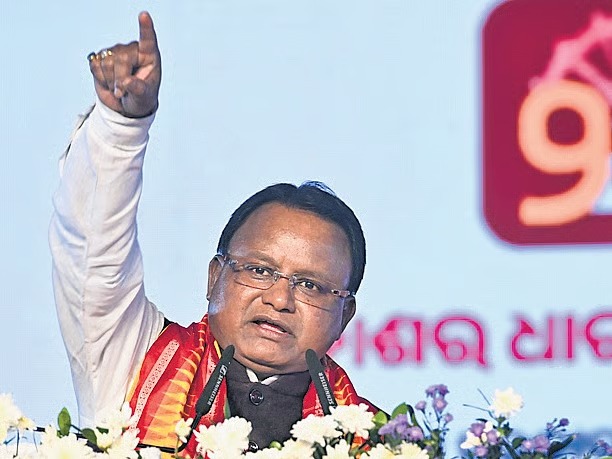
BHUBANESWAR — Odisha Chief Minister Mohan Charan Majhi officially welcomed President Droupadi Murmu and Prime Minister Narendra Modi during their high-profile state visit, using the joint governance forum to detail structural transformations underway in the state. Coinciding with the state administration marking two years in office, Chief Minister Majhi announced a historic "KG to PG" universal free education scheme across all government educational institutions. The flagship welfare policy is strategically paired with aggressive industrial development designed to leverage over ₹20 lakh crore in recent capital investments to fuel youth employment.
Elimination of Tuition Fees from Kindergarten to Post-Graduation
The most significant policy development announced by the state administration is the total elimination of educational tuition fees from kindergarten up to the postgraduate level. According to structural guidelines finalized by the Department of Higher Education, Odisha, the initiative covers all government schools, colleges, and state universities.
The policy transition to "free and universal" higher education is expected to provide financial relief to more than 10 lakh students across the state. While primary education up to Class 10 was already heavily subsidized, extending free access to university and master's degree tracks is a landmark development. Officials estimate that this reform will draw an immediate annual cost of nearly ₹30 crore from the state exchequer, a structural investment aimed at preventing economically vulnerable students from discontinuing studies due to rising academic fees.
Infrastructure Scaling and Massive Faculty Recruitment
To support the rapid influx of students expected under the universal free education mandate, the state government is executing a multi-phase infrastructure expansion. Chief Minister Majhi confirmed that budgetary allocations for the education sector have experienced a sharp uptick, climbing to ₹42,565 crore for the 2026–27 fiscal year. This represents approximately 14 percent of the state’s total budget expenditure, a 59 percent increase compared to the funding metrics recorded during the 2022–23 cycle.
According to data presented during the state briefing, the government has completed the recruitment of 26,615 teaching and non-teaching staff members over the past 24 months. To maintain a healthy teacher-student ratio, the administration plans to appoint an additional 45,000 teachers over the next three years. Furthermore, foundational work has begun on four new state universities, alongside the establishment of Godabarish Mishra Model Primary Schools across rural panchayats to standardize early childhood education.
Industrial Growth and Comprehensive Welfare Initiatives
Beyond educational access, the state's strategic growth plan heavily prioritizes major infrastructure corridors to spur job creation. The administration highlighted the ongoing progress of the coastal highway, two central expressways connecting southern and northern Odisha, and the Bhubaneswar-Cuttack-Puri-Paradip Economic Region (BCPPER). This infrastructure grid underpins the state's success in attracting more than ₹20 lakh crore in industrial and corporate investment.
Simultaneously, food security mechanisms are being expanded. Under the newly announced Chief Minister Annapurna Yojana, the state will provide an additional 5 kilograms of free rice per person each month to all beneficiaries enrolled under the National Food Security Act. This brings the total monthly allocation to 10 kilograms per individual, a comprehensive state expenditure totaling ₹8,813 crore annually that covers roughly 80 percent of Odisha's population.
Official Statements
"Our government is fully committed to making quality education truly free, accessible, and universal. Therefore, I announce that education from the KG to PG level will be completely free of cost in all government institutions. Financial constraints must never be a barrier to higher learning, and this move will immensely benefit our scholars, especially girls and those from economically backward classes."
— Mohan Charan Majhi, Chief Minister of Odisha
Why It Matters
The joint implementation of universal education and industrial development has extensive economic impacts:
Human Capital Retention: Free university access reduces student drop-out rates, preparing a skilled local workforce to supply incoming industrial projects.
Socio-Economic Relief: Merging free education with double the monthly rice allocations provides a robust safety net for families in economically weaker sections.
Investor Confidence: Dedicating 14 percent of the state budget to educational standards guarantees long-term talent pipelines for corporations investing within the BCPPER economic zone.
Key Facts at a Glance
Primary Policy Unveiled: Free education from kindergarten (KG) to post-graduation (PG) in all government institutions.
Target Demographics: Projected to benefit over 10 lakh students, with a primary focus on girls and economically weaker sections.
Educational Funding: State budget allocation raised to ₹42,565 crore, making up 14 percent of total state expenditure.
Job Deployment Goals: Planning the recruitment of 45,000 additional teachers alongside the activation of four new universities.
Industrial Capital Inflow: Secured over ₹20 lakh crore in economic investments tied to major expressway and highway projects.
Frequently Asked Questions (FAQ)
Q1: Does the free education scheme apply to private schools and colleges in Odisha? No, the universal free "KG to PG" education policy applies exclusively to students taking admission in government-run schools, colleges, and state universities across Odisha.
Q2: How much is the government investing annually to double the free rice allocation? The state government will spend approximately ₹8,813 crore annually on the expanded Chief Minister Annapurna Yojana, benefiting around 3.28 crore people by providing 10 kilograms of free rice monthly.
Q3: How many new teachers will be hired to handle the universal education policy? Building upon the 26,615 teachers recruited over the last two years, the state government has committed to appointing another 45,000 educational professionals over the coming three years.
Source: