The Odisha government has officially notified a massive ₹5,575-crore rural employment guarantee scheme, titled the Viksit Bharat – Guarantee for Rozgar and Ajeevika Mission (Gramin), effective July 1, 2026. The landmark initiative legalizes an enhanced safety net, ensuring a minimum of 120 to 125 days of paid manual labor for eligible rural households.
BHUBANESWAR, India — In a major policy structural overhaul, the Odisha state government has officially issued a statutory notification to implement its ambitious new rural employment initiative, the Viksit Bharat – Guarantee for Rozgar and Ajeevika Mission (Gramin). Confirmed by the State Cabinet chaired by Chief Minister Mohan Charan Majhi, the expansive state-backed framework will officially come into force on July 1, 2026, across all notified rural gram panchayats (village councils) throughout the state.
Backed by a dedicated fiscal allocation of ₹5,575 crore for the 2025–26 financial year, the program legalizes a substantial enhancement over historical employment baselines. It guarantees eligible rural households a minimum of 120 to 125 days of assured wage employment within every financial year. This development is explicitly designed to counter regional agricultural distress, curb distress migration, and establish a firm, long-term socio-economic safety net for unskilled manual laborers during lean seasonal windows.
Strategic Asset Creation and the 60-Day Agricultural Lockout
The newly codified policy introduces a highly sophisticated, two-pronged economic methodology that balances infrastructure deployment with actual market labor demand. A key structural highlight of the program is the formal identification of a 60-day window during critical local sowing and harvesting periods. During this aggregated period, standard public works will be strategically scaled back to ensure that local agricultural operations face zero labor shortages, while guaranteeing that workers retain access to a steady livelihood safety net across the remaining 305 days of the year.
Rather than focus on temporary, low-impact labor, the scheme mandates that all generated employment must be channeled through four priority developmental verticals:
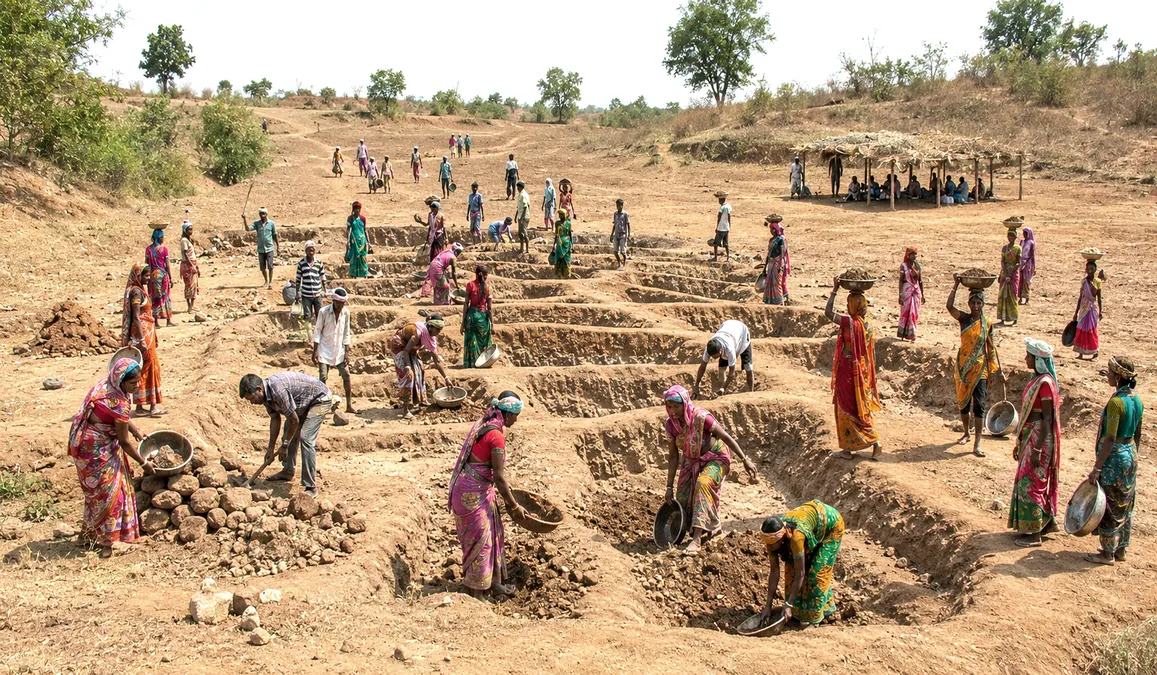
Water Security Infrastructure: Accelerated deployment of micro-irrigation networks, localized rainwater harvesting reservoirs, and the restoration of traditional community water bodies.
Core Rural Connectivity: Structural construction of all-weather intra-village pathways and link roads to streamline supply chains.
Livelihood Assets: Establishing dedicated community livestock shelters, cold-storage foundations, and local village marketplace platforms.
Climate & Disaster Resilience: Implementing specialized geo-spatial planning works to buffer agricultural communities against extreme weather disruptions.
Decentralized Planning and Regulatory Protections
To prevent systemic leakages and ensure the money lands precisely where needed, the state administration is making data transparency a core foundation. Every single development project must originate directly from community-led Viksit Gram Panchayat Plans. These localized blueprints will map the specific, physical infrastructural needs of individual villages using technology-enabled spatial data systems integrated with national planning architectures.
Furthermore, the statutory rules preserve rigorous consumer protections for registered applicants. Under the program's strict mandate, the state is legally bound to provide physical work within 15 days from the date an applicant formally submits an employment request. If the administrative machinery fails to deliver a valid work site allocation within this designated fortnight, the state is statutorily required to disburse a continuous unemployment allowance directly into the bank account of the affected job-card holder.
Official Sources Section
The programmatic guidelines, fiscal outlays, and statutory execution parameters have been formally cross-verified against official notifications released by the Panchayati Raj and Drinking Water Department, Government of Odisha.
The administrative and implementation timelines were officially outlined during institutional press briefings conducted by Chief Secretary Anu Garg through the Information and Public Relations Department, Government of Odisha.
Executive Commentary
"The scheme is designed to provide a highly predictable safety net for families facing intense income insecurity during lean agricultural periods. For the 2025-26 financial year, the state government has earmarked Rs 5,575 crore for the implementation of the programme, underscoring our absolute commitment to rural employment generation."
— Anu Garg, Chief Secretary, Government of Odisha
"According to officials from the Chief Minister's office, all public assets generated under this framework will be digitally aggregated directly into a unified national infrastructure stack to preserve operational transparency and allow for continuous real-time social audits."
Why It Matters: Practical Implications
For rural consumers and everyday families across Odisha, this enhanced job guarantee acts as an essential shield against food price fluctuations and seasonal inflation, ensuring that a dependable income stream is always accessible close to home. For the broader state economy, injecting ₹5,575 crore directly into grassroots cash circulation will visibly stimulate rural consumption, driving demand for basic consumer goods, agricultural equipment, and retail services.
Furthermore, the construction of permanent assets such as advanced irrigation ponds and durable rural roads delivers clear benefits to local businesses and smallholder farmers by lowering transport costs, improving crop survival rates, and maximizing long-term agricultural productivity.
Key Facts at a Glance
Official Launch Date: The program officially rolls out across all village blocks on July 1, 2026.
Enhanced Work Mandate: Upgraded legal provisions ensure between 120 and 125 days of guaranteed paid manual labor per household annually.
Dedicated Financial Budget: The state has deployed an initial annual corpus of ₹5,575 crore to bankroll the rollout.
Labor Market Balancing: A strategic 60-day operational pause during peak harvest seasons prevents structural agricultural labor shortages.
Legal Accountability: The government must allocate a work site within 15 days of application or pay an immediate unemployment allowance.
Frequently Asked Questions
How does this new program differ from older employment frameworks like MGNREGA?
The new Viksit Bharat (Gramin) framework increases the baseline job guarantee up to 125 days per year, integrates village-level technology-driven planning, and creates a strict 60-day pause during key farming periods to protect crop harvesting cycles.
What happens if the local Gram Panchayat fails to give me a job after I apply?
By law, if the local administration does not allocate a valid manual labor position within 15 days of your formal request, you are legally entitled to receive a daily unemployment allowance paid directly by the state government.
What kind of construction projects will be built under this ₹5,575-crore scheme?
The money is strictly restricted to building permanent community infrastructure, focusing heavily on water harvesting ponds, disaster-resilient village roads, climate buffer setups, and collective farming storage spaces.
Source: Panchayati Raj Department, Government of Odisha, Chief Minister's Office (CMO) Odisha, Information and Public Relations Department, Odisha, National Portal of India Financial Archive.