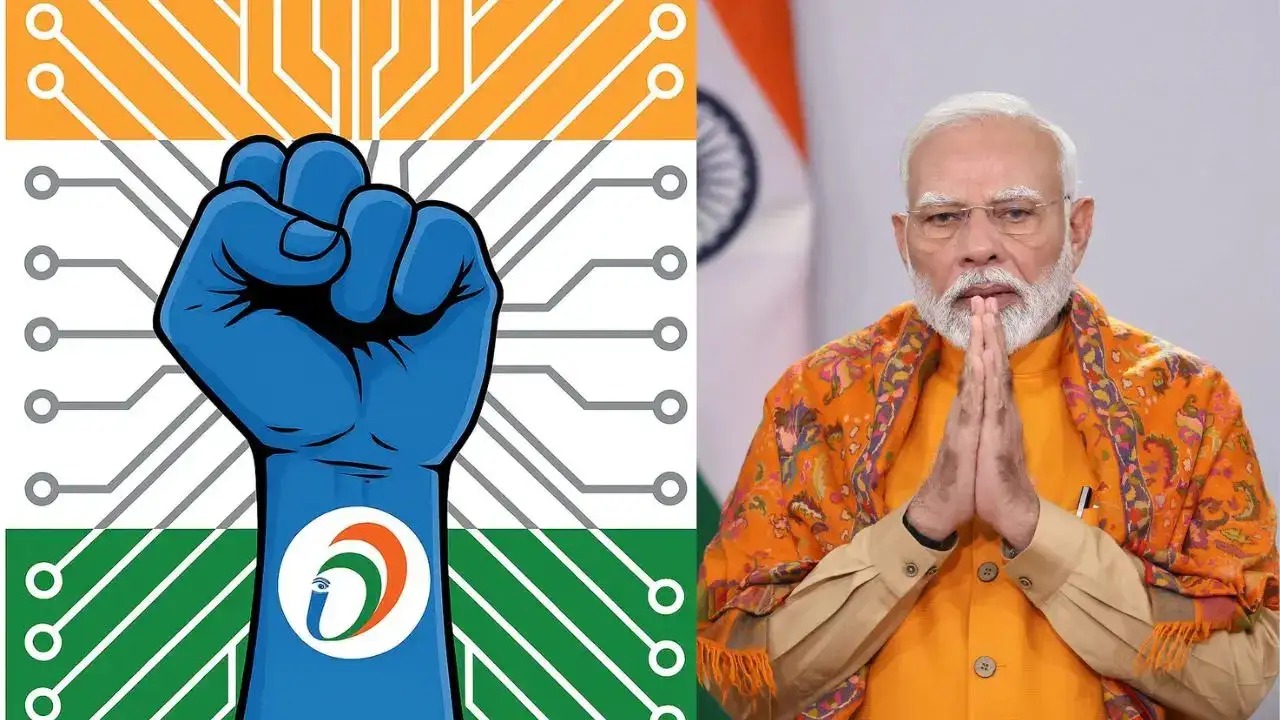
Prime Minister Narendra Modi celebrated the 11th anniversary of the Digital India initiative, highlighting its success in reshaping public governance and citizen empowerment. Backed by the JAM Trinity and UPI—which processes 49% of global real-time payments—the program now contributes up to 14% of India's GDP, advancing nationwide digital public infrastructure.
NEW DELHI — Prime Minister Narendra Modi on Wednesday marked the 11th anniversary of the Digital India initiative, describing it as a transformative program that has reshaped public governance, empowered citizens, and established a foundation for economic self-reliance. Officially launched on July 1, 2015, the nationwide campaign celebrated over a decade of deployment, transitioning India into one of the largest public tech-driven ecosystems globally. Government data indicates the program now supports massive data connectivity, automated welfare delivery, and a real-time financial transaction network used by over one billion citizens.
Expanding Digital Public Infrastructure and Economic Impact
According to the Press Information Bureau, the Digital India program has evolved from its initial goal of bridging the digital divide into a fully integrated Digital Public Infrastructure (DPI). The Ministry of Electronics and Information Technology reported that the digital economy now contributes an estimated 12% to 14% of India’s Gross Domestic Product (GDP). Economic forecasts from the central government suggest this share is on track to reach approximately 20% over the next decade.
The scale of financial transactions has expanded primarily through the Unified Payments Interface (UPI). Marking its own decade-long lifecycle, UPI now manages nearly 49% of all real-time digital payment transactions worldwide. Official data records show that UPI transactions grew from 2 crore (20 million) in the 2016-17 fiscal year to over 24,162 crore (241.62 billion) by the end of the 2025-26 fiscal year. Additionally, UPI's operational footprint has expanded across nine international borders, with Cambodia designated as the latest partner nation to integrate the framework for international travelers.
Direct Benefit Transfers and Rural Integration
A central component of the digital infrastructure remains the "JAM" Trinity—comprising Jan Dhan banking accounts, Aadhaar biometric identities, and universal mobile connectivity. Data published by the Prime Minister's Office reveals that Pradhan Mantri Jan Dhan Yojana accounts grew from 14.72 crore in March 2015 to 57.78 crore by February 2026, holding cumulative deposits of ₹2.94 lakh crore. Concurrently, certified Aadhaar biometric enrollments reached over 144 crore individuals by March 2026.
This framework facilitates direct financial assistance to individual bank accounts via the Direct Benefit Transfer (DBT) mechanism, significantly lowering leakages in public welfare administration.
To bridge rural connectivity deficits, the government’s optical fiber project has linked approximately 2.15 lakh Gram Panchayats—amounting to roughly 97% of local village councils nationwide—with nearly 7 lakh kilometers of optical fiber cable laid by early 2026. The total domestic broadband internet subscriber base reached 106.58 crore at the end of March 2026.
Institutional Upgrades in Healthcare and Education
The program has extended e-governance principles into healthcare via the e-Kranti framework. Flagship systems like the Online Registration System (ORS) have registered more than 1.37 crore digital hospital appointments, directly reducing manual processing lines at major public clinics. Similarly, the cloud-based telemedicine network, eSanjeevani, has documented over 48 crore remote patient consultations across 2.3 lakh onboarded medical centers.
Outside of healthcare, more than 6.5 lakh localized Common Service Centres (CSCs) and 1.6 lakh regional post offices have been outfitted to supply remote banking, e-governance requests, and citizen-centric certifications directly to rural populations.
Official Sources Section
The performance assessments, financial metrics, and operational counts mentioned in this report are based on official documentation released by the Press Information Bureau, direct statements from the Prime Minister's Office, and compiled agency archives from United News of India (UNI).
Quote Section
In an official public address on the social platform X, Prime Minister Narendra Modi stated:
"When over a billion people embrace technology, the impact is transformative! The success of 11 years of Digital India has given India a new identity worldwide. This initiative has redefined governance, empowered citizens, and accelerated all-round development."
According to officials from the Ministry of Electronics and Information Technology, future expansion cycles will prioritize deeper integrations of emerging tech ecosystems, specifically focusing on quantum computing, Artificial Intelligence (AI) safety models, and localized semiconductor fabrication units.
Why It Matters
For citizens and retail consumers, the integration of Digital India translates to instant, zero-fee financial transactions and immediate processing of state welfare allowances without administrative intermediaries. For corporate groups and small-scale digital startups, it establishes an accessible regulatory sandbox powered by open APIs (Application Programming Interfaces), driving down customer acquisition costs and expanding digital retail footprints into Tier-2 and Tier-3 municipal boundaries.
Key Facts at a Glance
Global Payments Leader: India's UPI infrastructure handles approximately 49% of the world's total real-time digital payment volume.
Financial Inclusion Scale: Jan Dhan accounts grew to 57.78 crore by early 2026, securing total domestic deposits of ₹2.94 lakh crore.
Rural Broadband Grid: Close to 7 lakh kilometers of optical fiber cable connect 97% of all village Gram Panchayats.
Telehealth Penetration: The eSanjeevani system has completed over 48 crore digital healthcare consultations across remote territories.
FAQ Section
Q1: What are the main strategic areas of the Digital India campaign?
The initiative operates across nine distinct pillars, including broadband highways, universal mobile access, public internet systems, electronic delivery of public services, and specialized IT training programs for local manufacturing jobs.
Q2: How does the JAM Trinity function within public governance?
The JAM framework combines Jan Dhan bank numbers, Aadhaar identities, and mobile links to run end-to-end identity verifications. This ensures that federal fund distribution goes straight to the correct recipient without localized middlemen.
Q3: What percentage of India's GDP is driven by the digital economy?
The digital sector constitutes between 12% and 14% of India’s overall Gross Domestic Product (GDP), with current projections tracking an expansion toward 20% within the next decade.
Source: Prime Minister's Office (PMINDIA), Press Information Bureau (PIB Delhi)