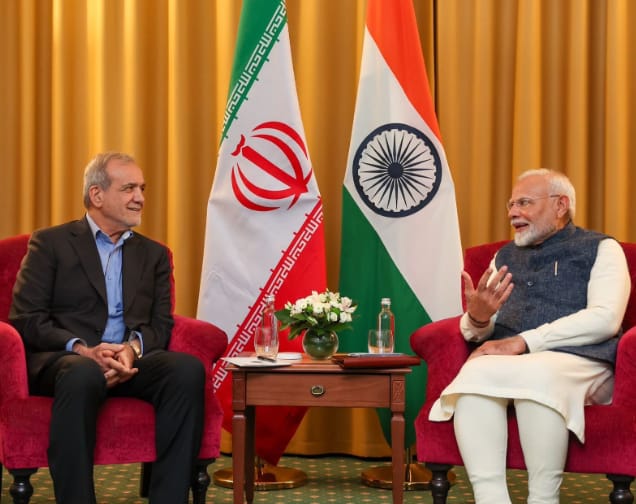
Prime Minister Narendra Modi spoke via telephone with Iranian President Masoud Pezeshkian on Tuesday to analyze the strategic situation in West Asia. Modi welcomed recent understandings reached in the region, strongly advocating for diplomatic dialogue to resolve ongoing conflicts while underscoring the critical need to safeguard global freedom of navigation and maritime commerce.
NEW DELHI — Indian Prime Minister Narendra Modi held a critical telephone conversation on Tuesday, June 30, 2026, with the President of the Islamic Republic of Iran, Dr. Masoud Pezeshkian, to evaluate the rapidly evolving geopolitical landscape in West Asia. During the high-level talks, President Pezeshkian briefed Prime Minister Modi extensively on recent regional developments, focusing heavily on the strategic way forward following a newly reached understanding in the region. Prime Minister Modi welcomed the latest breakthrough and strongly reiterated New Delhi's foundational foreign policy position: all international conflicts and disputes must be resolved exclusively through constructive dialogue and diplomacy. This high-profile interaction comes as major economic powers scramble to guarantee absolute freedom of navigation through critical trade routes like the Strait of Hormuz.
Strengthening West Asia Diplomatic Channels
The bilateral discussions between New Delhi and Tehran reflect a major shift toward regional stabilization. According to official diplomatic briefs, President Pezeshkian shared Iran's perspective on the regional architecture following the implementation of a landmark US-Iran memorandum of understanding (MoU) signed earlier this month. The diplomatic breakthrough aims to wind down months of severe tension that previously threatened to disrupt global shipping lanes and critical maritime infrastructure.
Prime Minister Modi emphasized that India remains on the side of global human welfare and sustainable peace. He urged all active stakeholders to sustain coordinated efforts to ensure lasting peace and long-term security in the region.
Safeguarding Global Maritime Commerce and Cargo Navigation
A central pillar of the discussion revolved around the protection of commercial maritime traffic. Given India's heavy reliance on Middle Eastern trade corridors, Prime Minister Modi highlighted the paramount importance of safeguarding freedom of navigation and unhindered commerce. The economic stability of South Asia remains tied to these waters, making maritime security a top-tier national security priority for the Indian government.
The Ministry of External Affairs (MEA) had earlier reported significant diplomatic movements, including multiple direct communications between External Affairs Minister S. Jaishankar and his Iranian counterpart, Abbas Araghchi, ensuring that Indian oil tankers and cargo vessels retain unhindered passage through volatile maritime chokepoints.
Official Sources Section
The details of this bilateral engagement were verified through official government releases published on June 30, 2026. The information aligns with documentation provided by the Prime Minister's Office (PMO) via the Press Information Bureau (PIB) and regulatory briefings distributed by the Ministry of External Affairs (MEA).
Official Quotes
"President Pezeshkian briefed the Prime Minister on the recent developments in West Asia and the way forward. The Prime Minister welcomed the understanding reached and reiterated India’s consistent position that all issues must be resolved through dialogue and diplomacy."
— Official Statement, Prime Minister's Office (PMO)
"According to officials familiar with the development, Prime Minister Modi stressed the need for continued efforts for lasting peace and stability in the region, while also emphasizing the critical nature of safeguarding freedom of navigation and global commerce."
— Government Source via Press Trust of India (PTI)
Why It Matters
The phone call directly affects global financial markets, energy logistics, and regional security architectures:
For Energy Consumers and Markets: De-escalation between Iran and regional actors stabilizes crude oil pricing, protecting consumers from sudden spikes at retail fuel stations.
For Maritime Logistics and Trade: Guaranteeing freedom of navigation ensures that global supply chains, commercial shipping containers, and cargo operations face minimal risk of seizure or kinetic disruption.
For Expatriates and Travelers: Thousands of Indian nationals working within Gulf Cooperation Council (GCC) countries and Iran gain an added layer of safety as diplomatic stability solidifies.
Key Facts at a Glance
Bilateral Dialogue: Prime Minister Modi and Iranian President Pezeshkian held a direct telephonic conference on June 30, 2026.
Core Diplomatic Stance: India formally welcomed the recent regional understandings and re-anchored its foreign policy around dialogue and diplomacy.
Strategic Priority: The leaders explicitly focused on protecting global commercial navigation and safeguarding the uninterrupted movement of goods across West Asian waters.
Institutional Track: The interaction builds upon a series of high-level ministerial calls executed by the Ministry of External Affairs to ensure localized stability for Indian assets.
Frequently Asked Questions (FAQ)
What was the primary trigger for the phone call between PM Modi and President Pezeshkian?
The telephone call was initiated to discuss the newest developments in West Asia, with President Pezeshkian briefing Prime Minister Modi on the practical way forward following a recent regional understanding and diplomatic breakthrough.
What is India's official stance on the West Asia conflict?
India maintains a neutral, pro-peace position, advocating that all regional disputes, civilian disruptions, and security concerns must be resolved solely via peaceful dialogue, systematic diplomacy, and the immediate de-escalation of hostilities.
How does this interaction affect global trade and economic safety?
By backing regional peace understandings and highlighting the absolute need for the freedom of navigation, the dialogue helps lower maritime insurance risks, ensures steady oil flow from the Gulf, and secures major international shipping routes like the Strait of Hormuz.
Source: Press Information Bureau (PIB) Delhi, Ministry of External Affairs (MEA) India, Press Trust of India (PTI).