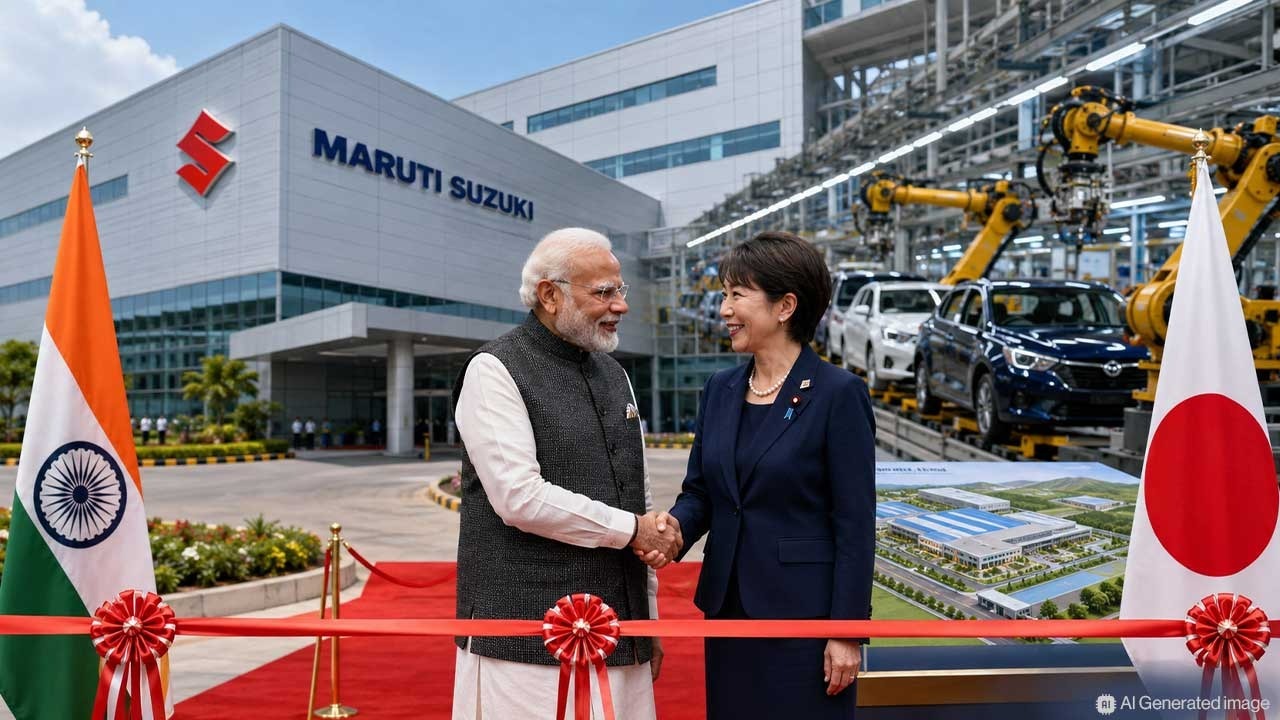
Prime Minister Narendra Modi and Japanese PM Sanae Takaichi jointly inaugurated Maruti Suzuki’s new ₹35,000 crore manufacturing facility in Kharkhoda, Haryana. This state-of-the-art "Industry 5.0" plant aims to boost annual production to one million vehicles, creating 21,000 jobs and strengthening the strategic India-Japan economic partnership and "Make in India" initiative.
NEW DELHI — Prime Minister Narendra Modi and Japanese Prime Minister Sanae Takaichi jointly inaugurated Maruti Suzuki India’s most advanced vehicle manufacturing facility at IMT Kharkhoda, Haryana, on July 2, 2026. The inauguration, conducted virtually during the India-Japan Joint Economic Forum in New Delhi, highlights a landmark investment in India’s automotive sector and underscores the deepening industrial cooperation between the two nations.
The Kharkhoda facility, Maruti Suzuki's fourth manufacturing plant in India, represents a total investment of ₹35,000 crore, including the development of an integrated supplier park. The plant is central to the company’s long-term vision of reaching an annual production capacity of four million units and reinforces India's role as a global automotive manufacturing hub.
Engineering the Future: Industry 5.0 and Sustainability
Designed around the "Suzuki Smart Factory" concept, the Kharkhoda complex is built to be one of the world's largest car manufacturing facilities once fully operational. It currently operates with an annual production capacity of 500,000 vehicles, which the company plans to scale to one million units in phases.
Key features of the facility include:
Industry 5.0 Technology: The plant utilizes AI-powered, human-aware collaborative robots (cobots) to enhance precision, productivity, and workplace safety.
Environmental Sustainability: The facility operates on 100% renewable electricity and functions as a Zero Liquid Discharge unit with 100% water recycling.
Future Infrastructure: Plans are in place for an in-house solar power plant (up to 70 MW), a biogas plant, and an in-plant railway siding to support sustainable logistics.
Strengthening India-Japan Economic Ties
The inauguration coincided with Prime Minister Sanae Takaichi’s first official visit to India for the 16th India-Japan Annual Summit. Addressing the forum, Toshihiro Suzuki, Representative Director and President of Suzuki Motor Corporation, praised India’s favourable policy environment under Prime Minister Modi’s leadership. He noted that the project is a testament to the success of the "Make in India" initiative and the strength of the India-Japan economic partnership.
Prime Minister Modi highlighted that two-thirds of Suzuki’s global production is now centred in India, with vehicles exported to over 100 countries. "When Japanese expertise and investment join India's speed and scale, the whole world benefits," the Prime Minister remarked, emphasizing the broader collaboration in sectors like semiconductors, artificial intelligence, and clean energy.
Economic Impact and Employment
The Kharkhoda facility is expected to create over 21,000 direct jobs, with significant additional employment generated through ancillary industries, component manufacturers, and logistics partners. Beyond manufacturing, the company is actively supporting the local ecosystem through CSR initiatives spanning education, healthcare, and sanitation in 10 villages surrounding the plant.
Key Facts at a Glance
Investment: ₹35,000 crore total project investment.
Capacity: Currently 5 lakh units, scaling to 1 million units per annum.
Scope: Spread across 800 acres with an integrated supplier park.
Sustainability: 100% renewable energy and Zero Liquid Discharge status.
Jobs: Over 21,000 direct employment opportunities created.
FAQ
Why is the Kharkhoda plant considered "Industry 5.0"?
The plant uses advanced AI-powered cobots that allow for seamless, safe, and efficient collaboration between human workers and automated systems.
What is the strategic significance of this plant for Maruti Suzuki?
It is a cornerstone of the company’s plan to reach an annual production capacity of 40 lakh vehicles across India, bolstering its "Make in India, Make for the World" strategy.
How does the plant contribute to environmental goals?
It is a Zero Liquid Discharge facility that uses 100% renewable electricity and includes advanced water recycling and solar power infrastructure.
Source: Maruti Suzuki Official Press Release, The Hindu, ANI News, The Economic Times