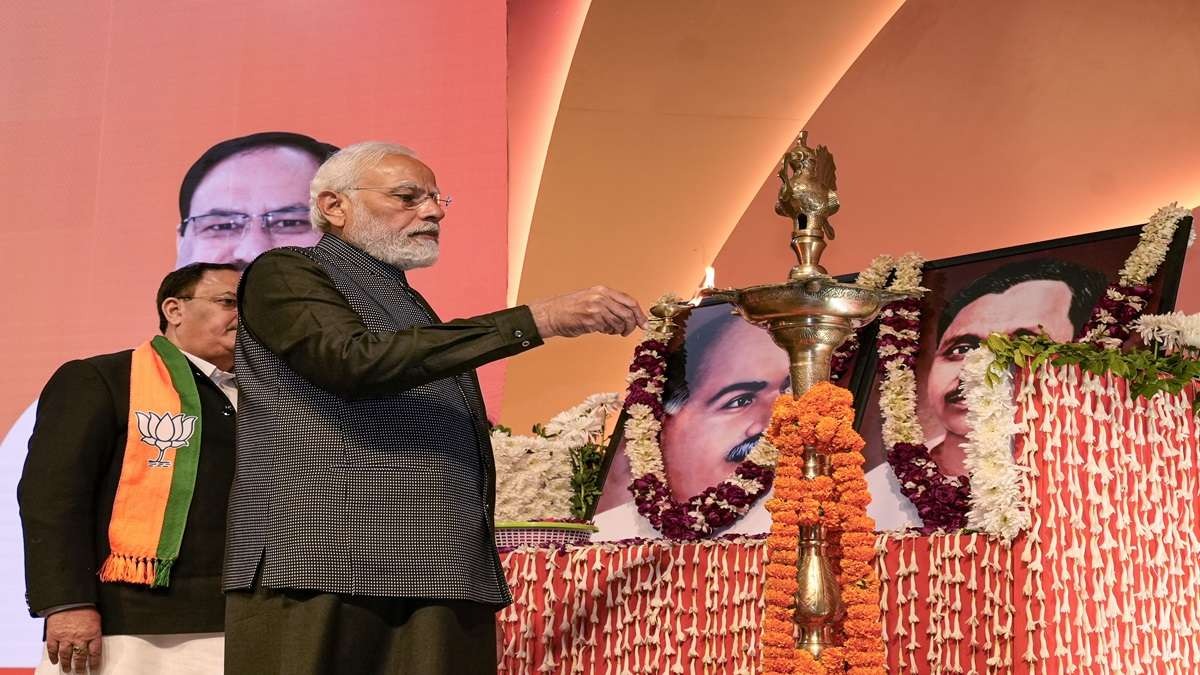
Prime Minister Narendra Modi paid national tribute to Dr. Syama Prasad Mookerjee on his 125th birth anniversary. Highlighting his contributions as an educationist, industrial pioneer, and defender of territorial unity, Modi noted that Mookerjee’s foundational vision for self-reliance continues to guide India’s path toward becoming a developed nation.
NEW DELHI — Prime Minister Narendra Modi paid a comprehensive national tribute today, July 6, 2026, to the founder of the Bharatiya Jana Sangh, Dr. Syama Prasad Mookerjee, on the milestone occasion of his 125th birth anniversary. In a detailed commemorative address and a multi-platform editorial release, the Prime Minister described Dr. Mookerjee as a transformative nation-builder who represented a unique confluence of intellect, public service, and unyielding moral conviction.
The anniversary marks a pivotal focal point within a wider, coordinated national remembrance campaign executed by the Union Ministry of Culture. The year-long commemorative framework aims to re-anchor public awareness around mid-century economic blueprints, territorial integration milestones, and localized educational reforms as India systematically targets its long-term development objective of "Viksit Bharat" by 2047.
Foundational Blueprint for Industrial and Educational Self-Reliance
Born on July 6, 1901, in Calcutta (now Kolkata), Dr. Mookerjee’s early career left an indelible mark on the sub-continent’s structural institutions. At the age of 33, he was appointed as the youngest Vice-Chancellor of the University of Calcutta, where he rapidly pioneered the introduction of standardized indigenous language curricula, advanced laboratory research funding lines, and student welfare grids.
Following independence, Dr. Mookerjee served as independent India's first Minister for Industry and Supply. In this state role, he laid the baseline foundations of modern industrial India by spearheading massive public sector undertakings, including the Damodar Valley Corporation and the strategic Sindri Fertiliser Plant.
Official accounts emphasize that his early industrial policy resolutely balanced large-scale automated manufacturing with protectionist assistance programs for handloom weavers, village artisans, and small-scale cottage industries to insulate millions of rural workers from post-war economic displacement.
Territorial Unity and the Legacy of National Integration
The primary theme of the Prime Minister's national dispatch centered on Dr. Mookerjee’s historic defense of the territorial integrity of the Indian Union. During the highly volatile period leading into the 1947 Partition, Dr. Mookerjee executed highly strategic political mobilizations to ensure that West Bengal was successfully retained as an integral part of independent India, rather than being fully absorbed into East Pakistan.
| Milestone Context | Historical Execution | Contemporary Policy Realization |
| Industrial Genesis | Launched heavy enterprise state anchors | Forms the basis of "Make in India" campaigns |
| Famine Mitigation | Scaled relief hubs and community kitchens | Guides emergency food security logistics |
| Constitutional Stance | Opposed separate permits for regional entry | Realized via 2019 Abrogation of Article 370 |
His deep conviction regarding absolute constitutional unity later directed his attention to Jammu and Kashmir, where he aggressively opposed the system of separate permits, flags, and autonomous prime ministerial designations within a single sovereign country. His subsequent arrest and abrupt death in detention in Srinagar in 1953 remain carved into the collective political memory of the state.
Prime Minister Modi reiterates that the landmark legislative abrogation of Articles 370 and 35(A) in August 2019 served as the ultimate structural fulfillment of Dr. Mookerjee’s historic sacrifice.
Official Sources Section
The underlying biographical timelines, institutional policy citations, and state anniversary parameters are compiled directly from historical compliance briefs distributed via the Press Information Bureau (PIB) and official digital statements recorded on the web tracking network of the Office of the Prime Minister of India. Commemorative event descriptions are verified through the public event logs managed by the Union Ministry of Culture.
Quote Section
In an official public statement released across state communication channels detailing the contemporary relevance of the late leader's intellectual footprint, Prime Minister Narendra Modi stated:
"Today, on the 125th Jayanti of Dr. Syama Prasad Mookerjee, I bow to one of India's most remarkable nation-builders, whose life was defined by scholarship, courage and an unwavering commitment to national service. As we move forward in our journey towards a Viksit Bharat, his vision continues to illuminate our path."
Why It Matters
For mainstream economic planners, reviewing Dr. Mookerjee’s post-independence industrial blueprints reinforces the contemporary logic of supply chain self-reliance and domestic manufacturing initiatives. For educational departments, his early academic experiments serve as foundational templates for implementing the multi-disciplinary learning parameters outlined under the modern National Education Policy (NEP).
Key Facts at a Glance
125th Anniversary: The national tribute marks the peak of the 125th birth anniversary celebrations of Dr. Syama Prasad Mookerjee.
Industrial Pioneer: Credited with creating independent India's first industrial strategy, establishing the Damodar Valley Corporation.
Academic Leader: Served as the youngest Vice-Chancellor in the history of Calcutta University.
Integration Legacy: Ideals directly inspired the 2019 constitutional abrogation of Articles 370 and 35(A).
FAQ Section
Why is Dr. Syama Prasad Mookerjee's 125th birth anniversary significant?
The milestone anniversary highlights his enduring influence on India's policies regarding self-reliance, national unity, and structural education reforms.
What major industrial projects did he launch as Minister?
As India’s first Minister for Industry and Supply, he masterminded the launch of foundational national assets like the Damodar Valley Corporation and the Sindri Fertiliser Plant.
How does the government connect his legacy to modern policy actions?
The administration identifies the 2019 abrogation of Article 370 as the historic fulfillment of Dr. Mookerjee's core mission to achieve absolute constitutional integration across India.
Source: Press Information Bureau, Government of India, Prime Minister's Office Media Centre, Ministry of Culture Commemorative Archives.