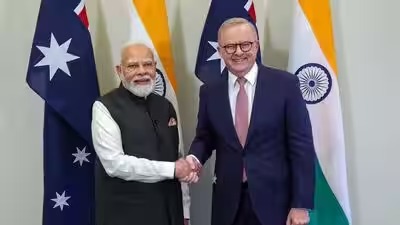
Prime Minister Narendra Modi, during the India-Australia Annual Summit in Melbourne, likened bilateral ties to cricket, noting that decisions are as fast as T20s while the partnership is as deep as a Test match. The leaders signed a civil nuclear energy pact and committed to deepening defense and economic cooperation.
During the third India-Australia Annual Summit in Melbourne, Prime Minister Narendra Modi described the bilateral partnership as having the speed of a T20 match and the depth of a Test match.
MELBOURNE — Prime Minister Narendra Modi utilized the shared cultural language of cricket to define the evolving strategic partnership between India and Australia during his visit to Melbourne on Thursday, July 9, 2026. Speaking alongside Australian Prime Minister Anthony Albanese after the third India-Australia Annual Summit, PM Modi characterized the high-level diplomatic engagements as a game of cricket, emphasizing the speed, focus, and long-term endurance of the relationship.
"India-Australia meetings feel like cricket," PM Modi stated during a joint press conference. "Our agenda is focused like a One-Day game. Decisions are as fast as T20s. And our partnership is as long and deep as a Test match."
The Prime Minister’s remarks were made in the sporting capital of the world, Melbourne, where he arrived on Wednesday as part of a three-nation diplomatic tour. PM Modi noted that failing to discuss sports in such a setting would be akin to "winning the toss in a cricket match but never starting the game," a sentiment that drew laughter from Prime Minister Albanese and attendees.
Strengthening Strategic Cooperation
Beyond the sporting analogies, the summit served as a critical platform for advancing the India-Australia Comprehensive Strategic Partnership. The two leaders held one-on-one and delegation-level talks, resulting in a series of landmark agreements. A significant outcome of the visit was the signing of a civil nuclear energy pact, which will facilitate the commercial supply of uranium from Australia to India, providing a boost to New Delhi’s clean energy objectives.
The leaders also reaffirmed their commitment to the early finalization of the Comprehensive Economic Cooperation Agreement (CECA). During the Australia-India CEOs Forum, PM Modi invited Australian businesses to deepen their investment in India, citing the nation's growing economic potential and stable policy environment.
Countering Global Security Threats
Security and defense cooperation remained a central theme of the joint summit. In a unified response to recent events, the two Prime Ministers strongly condemned the terrorist attacks in Pahalgam, Jammu and Kashmir, and at Sydney’s Bondi Beach. They pledged to intensify information sharing on regional threats and collaborate to counter radicalization, particularly the misuse of emerging technologies for extremist purposes.
The summit concluded with a joint declaration on defense and security, establishing an Annual Defence Ministers' Dialogue to enhance interoperability and maritime security in the Indo-Pacific region.
Key Facts at a Glance
Diplomatic Analogy: PM Modi described India-Australia relations as having the focus of a One-Day game, the speed of a T20, and the endurance of a Test match.
Key Agreement: A new civil nuclear energy pact was signed to facilitate uranium supplies for India's clean energy projects.
Strategic Goal: The leaders reaffirmed their commitment to finalizing the Comprehensive Economic Cooperation Agreement (CECA).
Security Cooperation: Both nations condemned recent terrorist acts in Pahalgam and Sydney, pledging increased collaboration against radicalization.
Economic Milestone: PM Modi addressed the Australia-India CEOs Forum to foster greater investment and infrastructure synergy.
Frequently Asked Questions (FAQ)
1. Why did PM Modi use cricket analogies?
The Prime Minister used cricket to illustrate the multifaceted nature of the diplomatic relationship, highlighting that the partnership is simultaneously fast-paced and long-term.
2. What major agreements were signed during the summit?
Key agreements included a civil nuclear energy pact to support India's clean energy goals and a joint declaration to enhance defense and maritime security.
3. What is the status of the India-Australia trade agreement?
The two Prime Ministers reaffirmed their commitment to the early finalization of a mutually beneficial Comprehensive Economic Cooperation Agreement (CECA).
4. How are India and Australia cooperating on security?
Both countries have established an Annual Defence Ministers' Dialogue and committed to greater intelligence sharing to counter terrorism, violent extremism, and radicalization.
Source: Ministry of External Affairs (India), Prime Minister's Office (India), Australian Government