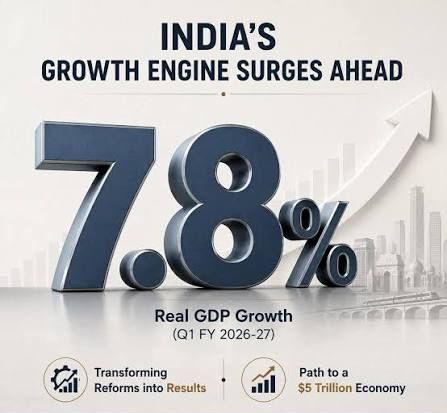
India's real GDP grew by 7.8% year-on-year in the first quarter of FY27, surpassing the Reserve Bank of India's 7% projection. Released on August 31, 2026, by the Ministry of Statistics and Programme Implementation, the robust expansion reflects resilient domestic demand and government capital expenditure amid global uncertainties.
Backed by official government data, the national economy expanded faster than anticipated in the June quarter, fueling discussions surrounding long-term development targets.
Surpassing market expectations and central bank projections, the Indian economy has registered robust macroeconomic expansion during the opening quarter of the fiscal year. According to official data released by the Ministry of Statistics and Programme Implementation (MoSPI) on August 31, 2026, India's real Gross Domestic Product (GDP) grew by 7.8% year-on-year in the first quarter (April–June) of FY27.
The figures comfortably beat the Reserve Bank of India’s (RBI) forecast of 7.0%, demonstrating strong domestic resilience against external headwinds, including geopolitical tensions and volatile global energy markets.
Evaluating Sectoral Performance, Consumption, and Capital Expenditure
Analyzing the underlying drivers of the first-quarter performance reveals widespread strength across manufacturing, services, and construction sectors. According to official disclosures and macroeconomic assessments, key operational highlights include:
Real GDP and GVA Expansion: Real GDP at constant prices reached ₹81.36 lakh crore in Q1 FY27 compared to ₹75.46 lakh crore in the corresponding period of FY26. Gross Value Added (GVA) grew by 8.2% in real terms.
Nominal Growth Metrics: Nominal GDP at current prices rose 10.3% year-on-year to an estimated ₹88.27 lakh crore.
Manufacturing and Industrial Lift: The manufacturing sector maintained a solid trajectory, growing 9.2%, while the electricity and construction sectors expanded by 8.9% and 7.7%, respectively.
Services Sector Dominance: Financial, real estate, and professional services emerged as standout performers, registering double-digit expansion.
Resilience Against External Shocks: Robust domestic consumption, public capital expenditure, and steady export performance successfully offset input cost pressures stemming from West Asian supply chain disruptions.
Why It Matters
The practical implications of a 7.8% quarterly GDP print reverberate across fiscal policy planning, foreign institutional investment, and long-term national development goals. For policymakers evaluating the path toward the "Viksit Bharat" (Developed India by 2047) vision, sustaining an accelerated growth trajectory requires balancing high-frequency domestic capital expenditure with structural reforms. For corporate entities and consumers, steady economic expansion reinforces business confidence, employment generation, and stable purchasing power amid volatile international commodity trends.
Key Facts at a Glance
Q1 FY27 Real GDP Growth: 7.8% year-on-year.
Comparison: Exceeded the RBI’s projection of 7.0% and previous year's 6.9%.
Nominal GDP: Reached ₹88.27 lakh crore (up 10.3%).
Key Growth Driver: Manufacturing GVA expansion at 9.2%.
FAQ Section
What was India's GDP growth rate in the first quarter of FY27?
India's real GDP grew by 7.8% year-on-year during the April–June quarter of the 2026–27 financial year.
How did the actual GDP figure compare with the Reserve Bank of India's forecast?
The 7.8% growth rate surpassed the Reserve Bank of India’s earlier projection of 7.0% for the quarter.
Which sectors contributed most significantly to the Q1 economic expansion?
Manufacturing (9.2%), electricity generation (8.9%), construction (7.7%), and financial, real estate, and professional services drove the quarterly performance.
Where can official quarterly GDP reports and statistical tables be accessed?
Official national accounts statistics, press notes, and release calendars are published regularly on the Ministry of Statistics and Programme Implementation (MoSPI) Official Website.
Source: Ministry of Statistics and Programme Implementation (MoSPI), Reserve Bank of India (RBI), The Economic Times, Press Information Bureau (PIB)