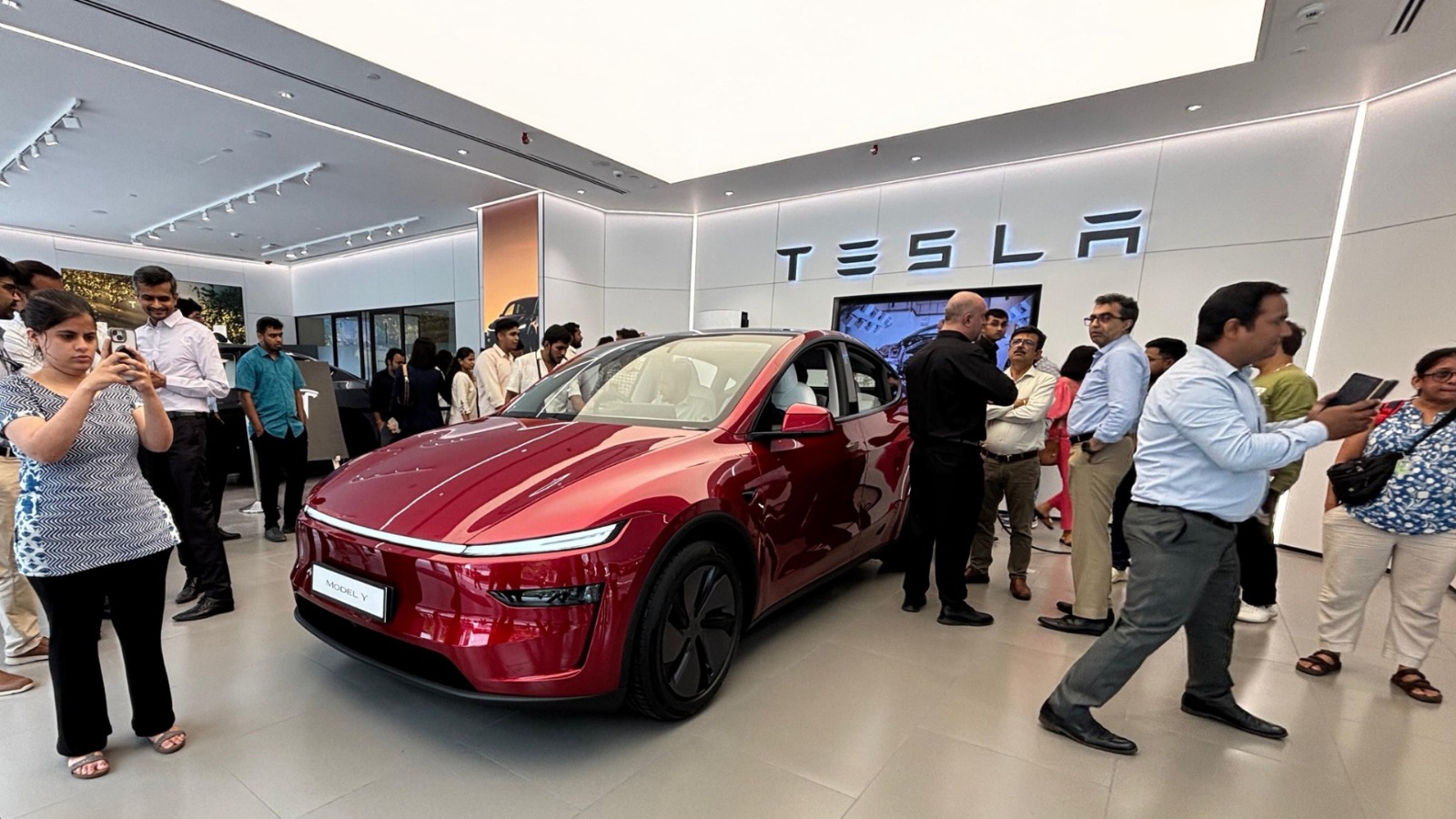
A year after entering the Indian market, Tesla has registered only 486 cars, according to official Vahan data. High import tariffs on its imported Model Y have kept prices elevated, allowing luxury rivals like BMW to dominate the premium segment while the broader domestic EV boom plays out at lower price points.
MUMBAI — A year after its highly anticipated commercial debut in India, US-based electric vehicle manufacturer Tesla, Inc. has registered a total of just 486 vehicles in the country. Dynamic registration logs tabulated up to July 14, 2026, show that the Elon Musk-led firm faces major obstacles in gaining traction within South Asia's largest automotive market. This development is important today because it reveals a clear disconnect between global brand popularity and local buying habits, showing that steep import tariffs and the lack of localized vehicle assembly are severely limiting Tesla's growth in an otherwise booming domestic electric passenger vehicle industry.
Muted Sales Dynamics Versus Established Luxury Rivals
According to comprehensive vehicle registration records extracted from the government's centralized portal, Tesla's monthly volumes have consistently failed to cross the 75-unit threshold since deliveries began. For example, during June 2026, the company managed to register only 35 electric vehicles nationwide.
This slower-than-expected momentum has allowed long-standing European premium brands to establish an early lead in the luxury electric vehicle (EV) segment. During the exact same June monthly tracking window, rival manufacturer BMW India successfully registered 486 electric cars, while Mercedes-Benz India delivered 234 zero-emission luxury passenger models to local buyers.
This distribution highlights that Tesla holds a minor 4.4% slice of the domestic luxury EV market, trailing far behind BMW’s dominant 60.8% share and Mercedes-Benz’s 29.1% share.
Industry analysts emphasize that while the broader Indian electric car ecosystem is expanding rapidly surpassing a record 31,000 total passenger EV deliveries in June 2026 alone the bulk of this transaction volume is happening at price points well below Tesla’s entry line.
The Core Challenges: Tariffs, Pricing, and Direct-to-Consumer Hurdles
Automotive industry experts point out that Tesla’s challenges in India stem from a mix of regulatory, economic, and operational factors. A central issue remains the company's decision to import its initial vehicle fleet from overseas manufacturing plants, such as Gigafactory Shanghai, as Completely Built Units (CBUs).
Because India levies a steep 70% to 110% import duty on imported cars depending on their value, the initial launch price of the basic Tesla Model Y sat at ₹59.89 lakh ($72,000), pushing it deep into luxury territory.
Even after Tesla later adjusted the Model Y's entry price downward by ₹9 lakh to a revised ₹50.89 lakh base, the vehicle struggled to attract value-conscious buyers. At this price range, consumers often opt for premium models with more traditional luxury interiors, like the locally assembled BMW iX1 or the competitive BYD Sealion 7, which launched at ₹49.40 lakh.
Furthermore, Tesla operates as Essentially a one-model brand in the country, lacking a diverse portfolio in the popular ₹20 lakh to ₹40 lakh price tier where competitors like Tata Motors, Mahindra & Mahindra, and JSW MG Motor India are seeing massive volume growth.
The company's online-first, direct-to-consumer sales model has also run into local retail habits. Premium car buyers in India still strongly prefer a hands-on dealership experience, which requires extensive test drives, financing support, vehicle exchange programs, and local maintenance touchpoints. With Tesla's physical experience centers limited to top metros like Mumbai, Delhi, and Gurugram, its overall customer outreach remains constrained.
Official Sources Section
The monthly transaction volumes, market share metrics, vehicle pricing adjustments, and statutory fleet parameters are sourced directly from statistical bulletins compiled by the Federation of Automobile Dealers Associations (FADA) and verified automotive transaction data from the Ministry of Road Transport and Highways' Vahan Dashboard.
Quote Section
Discussing Tesla's performance over its initial twelve months of regional operations, domestic dealer councils noted the structural constraints:
"According to officials from the automobile retail tracking association, relying solely on imported premium SUVs limits a brand's reach to a niche group of metropolitan buyers, especially when local manufacturers are quickly filling the middle-market EV space."
Why It Matters
The practical implications of Tesla’s initial sales slowdown highlight that global brand recognition alone isn't enough to crack the highly competitive Indian auto market. For foreign automakers looking to enter the region, this performance shows that long-term success requires local assembly or manufacturing plants to avoid steep import duties. Without a cheaper model and an expanded physical service network across Tier-2 cities, the local electric vehicle boom will likely continue to grow without the American EV giant.
Key Facts at a Glance
Cumulative Sales Volume: Tesla registered just 486 electric cars during its first full year of operations in India.
June Retails: The EV maker registered only 35 units in June 2026, capturing a small 4.4% share of the luxury electric vehicle market.
Pricing Pressures: High custom import duties on Completely Built Units (CBUs) initially pushed Model Y prices up to ₹59.89 lakh.
Limited Retail Footprint: The company relies on a direct-to-consumer model with physical showrooms concentrated in major hubs like Mumbai and Delhi.
FAQ Section
Why are Tesla's sales numbers lower in India compared to other global markets?
Tesla's lower sales numbers are primarily due to high import duties that place its cars in the premium luxury bracket, along with a single-model lineup and a limited network of physical service centers outside major cities.
Which Tesla model is currently available for purchase in India?
Tesla currently only offers the Model Y crossover SUV in the country, which is imported directly as a Completely Built Unit (CBU).
How does Tesla's market share compare to other luxury EV makers in India?
As of mid-2026, Tesla holds a minor 4.4% share of the luxury electric vehicle market, while established luxury brands like BMW India lead with over 60% of segment sales.
Source: Market reports and retail registration archives provided by the Federation of Automobile Dealers Associations (FADA) and national transit logs from the Ministry of Road Transport and Highways Vahan Registry.