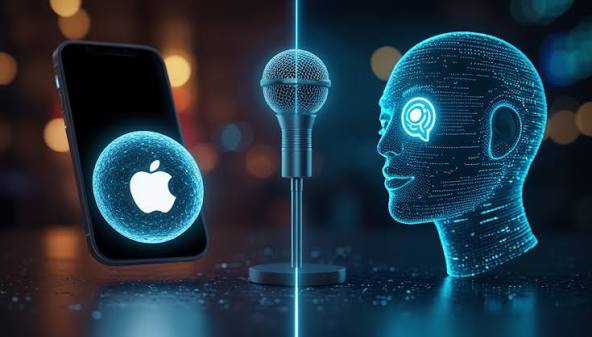
The debate between Apple’s Siri AI and ChatGPT highlights two distinct philosophies: hardware-native device control versus advanced cloud-based reasoning. Rather than competing directly, current software integrations allow the two assistants to work as a powerful hybrid duo, balancing local data privacy with high-end cognitive capabilities.
SAN FRANCISCO — The artificial intelligence landscape has evolved past the era of standalone chatbots, transforming into a deeply integrated battleground for consumer attention. At the center of this shift is the ongoing comparison between Apple’s upgraded Siri—powered by Apple Intelligence—and OpenAI’s standalone powerhouse, ChatGPT.
As mobile software updates roll out native generative features, users are no longer forced to choose between the two systems exclusively. Instead, the modern digital assistant experience has become a hybrid model where Apple’s operating system intelligence can seamlessly hand off complex queries to OpenAI's models. However, understanding the core strengths of each platform remains essential for consumers, developers, and enterprise users navigating the tech ecosystem.
Ecosystem Control Versus Deep Reasoning
The fundamental difference between Siri and ChatGPT lies in their architecture and primary design goals. Siri is engineered as an ambient, privacy-focused operating system layer. It possesses "hands," meaning it can interact natively with device settings, applications, messages, calendars, and personal context stored locally on a user's iPhone, iPad, or Mac.
Conversely, ChatGPT operates as an advanced conversational and analytical engine. While it lacks native access to device controls or local file systems without explicit user uploads, it significantly outperforms traditional voice assistants in complex logic, multi-step problem solving, coding, and long-form creative writing.
According to technical benchmarks and platform updates, the division of labor is distinct:
Siri’s Core Strengths: On-device privacy via Private Cloud Compute, deep hardware integration, hands-free automation, and contextual awareness across personal apps like Mail, Messages, and Photos.
ChatGPT’s Core Strengths: Advanced language comprehension, high-level reasoning, code generation and debugging, document analysis, and dynamic image creation.
The Collaborative Approach: Integration in Practice
Rather than a winner-take-all market, current software architecture allows Siri to route complex or open-ended inquiries directly to ChatGPT with user consent. When a user asks Siri a question requiring extensive world knowledge or creative drafting that exceeds Apple’s foundational models, the system prompts the user to hand the query off to ChatGPT.
This integration extends into system-wide writing tools, allowing users to proofread, rewrite, or summarize text across different applications using OpenAI's infrastructure. For consumers, this means the choice is less about picking an exclusive assistant and more about understanding which tool to invoke for specific tasks—using Siri for quick local device execution and ChatGPT for intensive cognitive workloads.
Official Sources Section
Quote Section
According to industry analysts and software evaluations:
"The pattern is clear. Anything that touches your device, your calendar, or your privacy leans toward Siri, and anything that needs real intelligence leans toward ChatGPT."
Why It Matters
For everyday consumers and professionals, the synergy between Siri and ChatGPT represents a maturation of artificial intelligence utility. Instead of navigating separate applications, users benefit from a unified interface where ambient device automation meets elite computational intelligence, setting a new benchmark for personal computing expectations.
Key Facts at a Glance
Device Native Control: Siri controls hardware settings, local applications, and personal data securely with on-device processing.
Advanced Capabilities: ChatGPT specializes in long-form generation, logic puzzles, programming code, and deep document analysis.
Seamless Hand-off: Modern Apple devices allow Siri to route complex queries directly to ChatGPT with built-in user permissions.
Privacy Architecture: Siri prioritizes local processing and Private Cloud Compute, whereas cloud-based ChatGPT routes queries through external servers.
FAQ Section
Is ChatGPT completely replacing Siri on Apple devices?
No. ChatGPT functions as an optional, integrated partner for Siri. Siri remains the primary operating system interface for device-level tasks, while ChatGPT handles advanced queries when invoked or handed off.
Do I need a paid subscription to use ChatGPT through Siri?
Both free and paid (Plus) ChatGPT accounts can be integrated with system-level tools, though higher usage tiers unlock advanced reasoning models and extended limits.
Which assistant is more secure for private data?
Siri is generally considered more private because it performs many tasks entirely on-device or via encrypted Private Cloud Compute, whereas ChatGPT processes cloud-based prompts on OpenAI servers.
Can ChatGPT control my iPhone settings like Siri can?
No. ChatGPT lacks access to device hardware, system settings, local messaging, or native app controls; those actions remain exclusive to Siri.
Source: Apple Newsroom, OpenAI, Tech Industry Benchmarks